Showing posts with label 7th CPC Projected Pay Scale. Show all posts

Friday, November 20, 2015

7th CPC Pay Fixation with examples

7th CPC Pay Fixation with examples

Pay Fixation in the New Pay Structure : The fitment of each employee in the new pay matrix is proposed to be done by multiplying his/her basic pay on the date of implementation by a factor of 2.57. 

The figure so arrived at is to be located in the new pay matrix, in the level that corresponds to the employee’s grade pay on the date of implementation, except in cases where the Commission has recommended a change in the existing grade pay. If the identical figure is not available in the given level, the next higher figure closest to it would be the new pay of the concerned employee. A couple of examples are detailed below to make the process amply clear.

The pay in the new pay matrix is to be fixed in the following manner:

Step 1: Identify Basic Pay (Pay in the pay band plus Grade Pay) drawn by an employee as on the date of implementation. This figure is ‘A’.

Step 2: Multiply ‘A’ with 2.57, round-off to the nearest rupee, and obtain result ‘B’.

Step 3: The figure so arrived at, i.e., ‘B’ or the next higher figure closest to it in the Level assigned to his/her grade pay, will be the new pay in the new pay matrix. In case the value of ‘B’ is less than the starting pay of the Level, then the pay will be equal to the starting pay of that level

Example I

i. For example an employee H is presently drawing Basic Pay of Rs.55,040 (Pay in the Pay Band Rs.46340 + Grade Pay Rs.8700 = Rs.55040). After multiplying Rs.55,040 with 2.57, a figure of Rs.1,41,452.80 is arrived at. This is rounded off to Rs.1,41,453.

ii. The level corresponding to GP 8700 is level 13, as may be seen from Table 4, which gives the full correspondence between existing Grade Pay and the new Levels being proposed.

iii. In the column for level 13, the figure closest to Rs.1,41,453 is Rs.1,41,600.

iv. Hence the pay of employee H will be fixed at Rs.1,41,600 in level 13 in the new pay matrix as shown below:

Pay Matrix


As part of its recommendations if Commission has recommended any upgradation or downgrade in the level of a particular post, the person would be placed in the level corresponding to the newly recommended grade pay.

Example II

i. Take the case of an employee T in GP 4200, drawing pay of Rs.20,000 in PB-2. The Basic Pay is Rs.24,200 (20,000+4200). If there was to be no change in T’s level the pay fixation would have been as explained in Example I above. After multiplying by 2.57, the amount fetched viz., Rs.62,194 would have been located in Level 6 and T’s pay would have been fixed in Level 6 at Rs.62,200.

Pay Matrix 7th CPC


ii. However, assuming that the Commission has recommended that the post occupied by T should be placed one level higher in GP 4600. T’s basic pay would then be Rs.24,600 (20000 + 4600). Multiplying this by 2.57 would fetch Rs.63,222.

iii. This value would have to be located in the matrix in Level 7 (the upgraded level of T).

iv. In the column for Level 7 Rs.63,222 lies between 62200 and 64100. Accordingly, the pay of T will be fixed in Level 7 at Rs.64,100.

7CPC PAY MATRIX

Authority: http://7cpc.india.gov.in/

Sunday, August 16, 2015

Government to incur additional expenses due to 7th Pay Commission

Government to incur additional expenses due to 7th Pay Commission : 

Pay and Allowances of Central Government employees will increase one lakh crore in the current financial year and also projected to increase further due to recommendations of 7th Pay Commission.

“Salary is a big question for even profit-minded private concerns. It is therefore not surprising that the employees of service-oriented Central Government departments are so obsessed about their pays and allowances. For a few central and state government organizations that rake in huge profits, salaries and allowances to their employees is no big issue.”

A report on the spending habits of the middle class was presented in the Parliament yesterday. According to the report presented by the Minister of Finance, Arun Jaitley, “the salary given to Central Government employees in the current financial year will exceed Rs.1 lakh crore.” The amount is expected to rise further after the implementation of the recommendations of the 7th Pay Commission. This could lead to a financial crunch.

According to estimates, there could be an increase of 9.56 percent in the salary allocation for Central Government employees, to Rs.1 lakh 619 crores. In the Financial Year 2016-17, after the implementations of the 7th Pay Commission’s recommendations, it is very likely to increase to 15.79 percent and touch Rs.1.16 lakh crores. During the Financial Year 2017-18, it will further rise to Rs.1.28 lakh crores. Funds for pensioners will increase to Rs.88,521 crores this financial year. During the Financial Year 2016-17, it is expected to be 1.02 lakh crores. By the Financial Year 2017-18, it would be Rs.1.12 lakh crores.

7th Pay Commission is expected to submit its final report including the revised pay and pension structure for Central Government employees and pensioners to the Central Government on in the last week of September.
If everything goes as planned, the 7th Pay Commission recommendations will come into effect from 01.01.2016 onwards.

Meanwhile, there is no doubt in the fact that employees are extremely curious to find out how much their salaries would increase if the new Pay Commission recommendations are implemented.

Wednesday, August 5, 2015

A Crucial Indicator for determining the Basic Pay of 7th Pay Commission- Multiplication Factor

A Crucial Indicator for determining the Basic Pay of 7th Pay Commission- Multiplication Factor

It is well known that Multiplication Factor 1.86 was being used by the 6th Pay Commission to calculate the new revised basic pay. The 6th Pay Commission had initially suggested 1.74, but it was later modified to 1.86.

The Multiplication Factor was arrived at by adding dearness allowance percentage to the basic pay with a simple methodology. The 6th Pay Commission also brought in a new concept called the Grade Pay. So, the basic pay diveded into two segments, which are called as Band Pay and Grade Pay.

Now that Grade Pay is not going to be included, it remains a mystery as to how the 7th Pay Commission will calculate the new Multiplication Factor.
 
A lot of speculations are now on about this.

With plenty of rumours afloat that salaries for Central Govt employees could increase twofold, an article was published by 90Paisa Blogrecently, which claimed that only a 30% hike in salary is sure to come. The article had used a Multiplication Factor of 2.68.

Last month, gservants.com claimed that the 7th Pay Commission may recommend a Multiplication Factor of 2.86. The website created waves when it published a projected basic pay structure by using a Multiplication Factor of 3.

The NC JCM Staff Side, in its memorandum to the 7th Pay Commission, suggested that a Multiplication Factor of 3.7 be used for calculation of new basic pay. They had also given a detailed explanation for it.
And one more, the Karnataka COC, which is an organization for Central Government employees, had demanded a Multiplication Factor of 3.85, and gave its own reasons for it.

All these are mere speculations…!
It’s up to the employees to believe what they want to.

Source: www.7thpaycommissionnews.in

Monday, June 22, 2015

Expected 7th Pay Commission Pay Structure for Central Government Employees

Central Government News

Expected 7th Pay Commission Pay Structure for Central Government Employees : 

We are providing some important information about 7th Central Pay Commission and its expected pay scale and allowances…

Proposed 7 CPC Pay Scale with Multiplication Factor by NC JCM Staff Side

Proposed Pay Scale NC JCM Staff Side with MF 


EXPECTED PAY STRUCTURE OF 7TH CPC

EXPECTED 7TH CPC PAY SCALE :-

7th CPC Pay Scale is fast becoming the most mesmerizing phrase among Central Government employees these days.
Every Central Govt Employee is waiting to find out the changes in their pay scale that the 7th CPC would recommend to the pay structure. Sensing this eagerness, Bloggers have been regularly coming up with their own versions of what the pay structure could be. Do not take those writings seriously sand authentically. 
Based on all the changes right from the 1st CPC, until the 6th CPC, we have predicted a pay structure. Even though we weren’t keen on it, we have been receiving requests by email and comments. At a point, it became unavoidable. We just had to give our own interpretation too.
Since the basic pay of an ordinary employee has evolved from 260-950-3050-7730, the next change is expected to increase the salary by 2.5 times. Our Projected Pay Scale is expecting an increase of no more than 3 times.
It could be 260-950-3050-7730-22500..!
More than the hike, everybody is hoping that the Grade Pay would be in proper series.
And, everybody wants and hopes for a recommendation that prescribes a uniform Multiplication Factor (6th CPC 1.86) to all categories of employees.
6th CPC PAY STRUCTURE
EXPECTED PAY STRUCTURE OF 7TH CPC
Pay Band Pay Bands Grade Pay Pay in the Pay Band Pay Scale Pay Band Grade Pay Pay in the Pay Band Pay Scale
PB-1 5200-20200 1800 5200 7000 15000-60000 5000 15000 20000
PB-1 5200-20200 1900 5830 7730 15000-60000 5500 17000 22500
PB-1 5200-20200 2000 6460 8460 15000-60000 6500 20000 26500
PB-1 5200-20200 2400 7510 9910 15000-60000 7500 23000 30500
PB-1 5200-20200 2800 8560 11360 15000-60000 8500 26000 34500


PB-2 9300-34800 4200 9300 13500 30000-100000 10000 30000 40000
PB-2 9300-34800 4600 12540 17140 30000-100000 13500 35000 48500
PB-2 9300-34800 4800 13350 18150 30000-100000 15000 40000 55000


PB-3 15600-39100 5400 15600 21000 50000-150000 16500 50000 66500
PB-3 15600-39100 6600 18750 25530 50000-150000 20000 60000 80000
PB-3 15600-39100 7600 21900 29500 50000-150000 23000 70000 93000


PB-4 37400-67000 8700 37400 46100 100000-200000 26000 100000 126000
PB-4 37400-67000 8900 40200 49100 100000-200000 27500 110000 137500
PB-4 37400-67000 10000 43000 53000 100000-200000 30000 120000 150000

 Source: http://90paisa.blogspot.in/

Wednesday, May 6, 2015

Depending on the weightage fitment formula may range from 2.72 times to 3.72 in 7th Pay Commission

Depending on the weightage fitment formula may range from 2.72 times to 3.72 in 7th Pay Commission
“Depending on the weightage fitment formula may range from 2.72 times to 3.72“
“The Sixth Central Pay Commission has recommended a minimum wage of Rs 6600/- per month against the demand of Rs 10,000/- per month as worked out by Staff side of JCM, Today the minimum need based wage works out to Rs 26,000/ per month.”
Minimum Wage of Rs 26,000/- Justified and Fitment formula

Comrade,

The DIRECTORATE OF ECONONMICS & STATISTICS DEPARTMENT OF AGRICULTURE & COOPERATION MINISTRY OF AGRILCULTURE GOVERNMENT OF INDIA NEW DELHI has published the RETAIL PRICES OF FOOD AND NON FOOD ITEMS VIDE http://rpms.dacnet.nic.in/ PLEASE GO THROUGH THIS IMPORTANT LINK . which contains district wise price report.

http://rpms.dacnet.nic.in/Bulletin.aspx

You can get any price of any article using the Query option.
http://rpms.dacnet.nic.in/QueryReport.aspx

The prices of many items provided by the Staff side JCM are lower than the retail prices provided by the Government agency . Hence the Minimum wage of Rs 20,000/- is justified for the erstwhile Group “D” with effect from 1/1/15 using Dr Aykroyd formula . After weightage of 25% for Group “C” it works out to Rs 26,000/- .

Please click here for Prices of Food items as on 1/1/15
Please click here for Prices of Non Food items as on 1/1/15

Please click here for Minimum Wage Caluation Sheet

The fitment formula may range from 2.72 times to 3.72 depending upon the weightage.
The Sixth Central Pay Commission has recommended a minimum wage of Rs 6600/- per month against the demand of Rs 10,000/- per month as worked out by Staff side of JCM, Today the minimum need based wage works out to Rs 26,000/ per month.
Comradely yours
(P.S. Prasad)
General Secretary
Source: www.karnatakacoc.blogspot.in

Friday, April 17, 2015

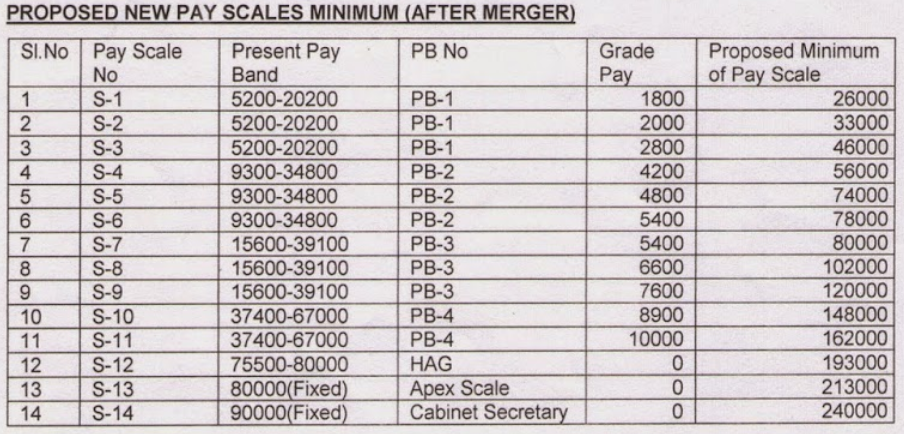
PROPOSED NEW PAY SCALES MINIMUM (AFTER MERGER) SUBMITTED TO 7TH PAY COMMISSION – INDWF

PROPOSED NEW PAY SCALES MINIMUM (AFTER MERGER) SUBMITTED TO 7TH PAY COMMISSION – INDWF

Oral evidence submitted by National Council (JCM) Standing committee and the VII CPC on 23.03.2015, 24.03.2015 and on 31.03.2015 respectively.

The JCM(NC), JCM Constitutents including INDWF jointly prepared the memorandum on pay Structure, Pay determination, Allowances, leave, women issues, LTC, TA/DA and Retirement benefits etc., on 30.06.2014. Similarly, on behalf of INDWF, we have submitted matters relating to Defence Civilian Employees on service matters on 28.07.2014.

Defence Federations were invited from 30th to 31st march, 2015. INDWF met the VII CPC on 31.03.2015 in the VII CPC office, New Delhi from 1030 HRs to 1200 HRs.

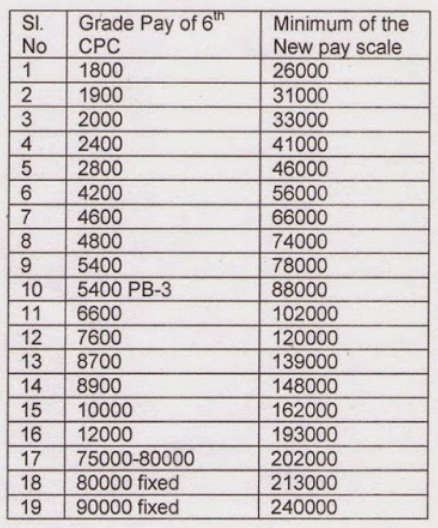
Proposed new pay scales after removal of existing Grade Pay Rs.1900, Rs.2400, Rs.4600 and Rs.8700 in order to reduction of pay scales from 19 to 14.

Proposed Pay Scale INDWF

PROPOSED NEW PAY SCALES MINIMUM (AFTER MERGER)
Proposed Pay Scale Minimum after Merger INDWF

Source: INDWF

Wednesday, January 28, 2015

3 time increase in pay of Central government employees according to the estimated pay scales

Triple time increase in pay of Central government employees according to the estimated pay scales

The DA increase in January and July 2015 will play a vital role in the final numbers of the Pay Scale of 7th CPC. The estimated Pay Scales for Central Government Employees that the Seventh Pay commission can recommend for Employees working in Central Government establishments…

The Seventh Pay Commission report is expected to be released by the end of this year, and it seems that there will be no delay for the government to implement the report.

The Modi Government, being a believer in business will never want make arrear payments to the central government employees in the future and impose additional financial burden to the government.

If this is true, the seventh pay commission report will be implemented on 01/01/2016 and this news will be like a sweet melody in the ears of the central government employees.

Central government employees are also expecting the DA to be merged with their Pay. In such, along with the Implementation of the report, there will be growth in House Rent Allowance (HRA) and Educational allowance.

As on today’s date, the DA is at 107% and there are three more DA instalments remaining before the announcement of the Seventh Pay commission. One instalment in January 2015 and the second in July 2015 and final third one Jan 2016 will be implemented.

The DA calculation will be based on the All India Consumer Price Index. Based on the data available on today’s date, the DA is expected to rise by 6% which increases the DA to 113% in this instalment. If the same trend continues, the DA is expected to have another 6% hike this July and also in Jan 2016.

Hence the pay commission will consider 124% DA before preparing the final report; this will prove to be an important number in the final calculation. If by 01.01.2016 the DA reaches 124%, then just considering the DA alone, the pay of the central government employees will be doubled.

But the pay commission considers various other factors to finalise the Pay scales. While adding those numbers, it is certain that the Pay of the central government employees may have a triple time hike. This is good news for the Central Government employees.

Now we have to see how candid does the government stay on the expectations of the central government employees. Nearly 50 lakh central government employees and Pensioners are eagerly waiting for the implementation of the Seventy Pay commission.

Our numbers state that a triple time rise in pay is sure, now it is to see how much more will the government add to these numbers.

Friday, August 15, 2014

AIRF proposed pay scales for all categories of Railway Employees for 7th Pay Commission

AIRF proposed pay scales for all categories of Railway Employees for 7th Pay Commission
PAY SCALES PROPOSED BY THE ALL INDIA RAILWAYMEN’S FEDERATION FOR THE 7th CENTRAL PAY COMMISSION
OPERATING DEPARTMENT

S.No.Post/DesignationVI CPCProposed New Pay Scales of VIIth CPC
1Station MasterPB-I + GP 2800Rs. 56,000
2Dy.Station ManagerPB-2 + GP 420074000
3Station ManagerPB-2 + GP 460078000

S.No.Post/DesignationVI CPCProposed New Pay Scales of VIIth CPC
1SECTION CONTROLLERPB-2 + GP 4200Rs. 74,000
2CHIEF CONTROLLERPB-2 + GP 460078000

S.No.Post/DesignationVI CPCProposed New Pay Scales of VII CPC
1Pointsman/LevermanPB-1 + GP 180026000 (Pointsman Gr.III/Leverman)
2Sr.Pointsman/Sr.LevermanPB-1 + GP 190033000 (Pointsman Gr.II/Leverman)
3--46000 (Pointsman Gr.I)
4CabinmanPB-1 + GP 190033000
5Sr.CabinmanPB-1 + GP 240046000

S.No.Post/DesignationVI CPCProposed New Pay Scales of VII CPC
1SwitchmanPB-1 + GP 280046000

S.No.DesignationVI CPCProposed New Pay Scales of VII CPC
1GatemanPB-1 + GP 180033000

S.No.DesignationVI CPC ProposedNew Pay Scales of VII CPC
1Station PorterPB-1 + GP 180026000

S.No.Post/DesignationVI CPCProposed New Pay Scales of VII CPC
1Train ClerkPB-I + GP 190046000 (Train Clerk)*
2Sr.Train ClerkPB-I + GP 240046000 (Train Clerk)*
3Hd. Train ClerkPB-2 + GP 420056000
4Chief Train Clerk-74000

S.No.Post/DesignationVI CPCProposed New Pay Scales of VII CPC
1Shunting JamadarPB – 1 + GP 240046000
2Shunting MasterPB – 2 + GP 420056000
3Chief Shunting MasterNew Scale74000

DesignationExisting VIth CPC Pay structureNew Proposed Scales
Safaiwala/SafaiwaliPB-1+180026,000
Senior Safaiwala/SafaiwaliPB-1+190033,000
Asst Sanitary SupervisorPB-1+280046,000
Sanitary SupervisorPB-2+420056,000
Sr.Sanitary SupervisorNew Scale Proposed74000

DesignationNew Proposed Scales
Traffic Asst56000

Click to continue
#7th CPC, #7th CPC Pay Scale, #7th CPC Pay Structure, #7th Pay Commission News, #7th Central Pay Commission, #7th CPC Pay Scales, #7th CPC Projected Pay Scale, #AIRF Proposals

Wednesday, August 13, 2014

Memorandum to 7th Pay Commission – AINTSSA submitted on 30.7.2014

 Memorandum to 7th Pay Commission – AINTSSA submitted on 30.7.2014

MEMORANDUM TO SEVENTH CENTRAL PAY COMMISSION GOVERNMENT OF INDIA

B.B. Mohanty
Member, Naval Heaquarters JCM Council,
Confederation of Defence Recognized Association

President
All India Naval Technical Supervisory Staff Associations.

Address: F-10/105, Kings Ville, Green City,
Ambarnath (East), Thane-421501.
Email-mohanty555@yahoo.co.in
Mob. No. 08655481087

AINTSSA/BBM-DO/31 /VII CPC

30 Jul 2014
The Member Secretary,
7th Central Pay Commission,
Post Box No. 4599,
Hauz Khas Post Office,
New Delhi-110016.

Respected Madam,

PREFACE

On behalf of All India Naval Technical Supervisory Staff Association, I welcome and wish all the success to the 7th Pay Commission in their mission of evolving pay structures and other related matters, which is expected to be fair enough for the government employees to lead a dignified life and perform their duties effectively and efficiently.

AINTSSA represents about 4000 Technical Supervisors working in Indian Navy in various Naval establishments of the Nation. They are basically from all the branches of engineering – including Civil , Mechanical , production, Electrical , Computer, Electronics & Telecom Engineering etc. They supervise and guide around 26000 workforce of Navy.

We present this memorandum to 7th CPC representing the following categories in the Indian Navy:

Around 2400 Chargeman
Around 1600 Foreman


Degree of skills, strain of work and requirement of knowledge, experience & expertise, continued & updated technical knowledge with effective training, mounting responsibility and accountability, multifaceted work contents, working condition with hazards and fatigue, mental & physical strain pertaining to these categories have been elaborately explained in the subsequent explanations.

The key to efficiency and competitive spirit in work lies not only in getting appropriate salary for the job but also with dignity & status. We welcome the provisions provided in the terms of reference. Those strategies are to be evolved in order to attract talents and retain them in service which is considered to be the need of the day in the globalised era.

Important role of these middle level managers was recognized by 3rd & 4th CPC which exclusively granted appropriate pay scales to technical supervisors based on their job contents and other factors. But it was shattered by the V & VI CPC which completely ignored their duties and responsibilities and diluted their status by seriously disturbing their relativity.

Further the fact that Naval Dockyards, NSRYs, Training centers and Ship building establishments of Indian Navy are basically technical organizations and the safe successful and efficient performance of the organizations lies primarily in the hands of their technical work forces who are supervised, trained and overseen by these technical supervisors.

7th CPC is requested to look into the serious anomalies caused especially by the Sixth CPC which have demoralized the category due to non-redressal of these anomalies – as brought out in this Memorandum. We request the Pay Commission to kindly evolve a replacement scale to the categories and ensure natural justice and dignity.

Technical Supervisors shoulder the direct responsibilities of safe, efficient & ‘Failure proof’ production, repair, maintenance and operation of almost all the systems of Naval warships of Indian Navy. Reduction of manpower in artisan staff, introduction of new ships, addition of new assets and introduction of new & modern technologies etc, have substantially added to their duties and responsibilities over the years. Other departments provide only necessary support to them in order to enable them to discharge their functions.

It is unfortunate that both 5th and 6th Pay Commissions had underestimated the significance and sensitiveness of the work-content of the technical supervisors, their responsibility and accountability. Many vital factors like their ‘Professional qualifications’ & ‘greater responsibilities’ as well as the accountability towards public safety and efficiency of the Nation went out of sight of both these Pay Commissions.

But, supporting categories like Accounts, Teachers and Nurses who were all along in the lower pay scales than the Technical Supervisors, were given up-gradation and were placed even two grades higher than Technical Supervisors. Worse and even more humiliating is the fact that the pay of categories like MCM, which work under the Technical Supervisors, were also equated with them – undermining the Supreme Court judgment of “the supervisor’s pay cannot be equal to the person being supervised”.

It is our earnest request that 7th CPC may consider the facts brought out in our memorandum. Commission is requested to remove various obstacles that come in the way of attracting talents to the technical supervisory cadre of Indian navy and in improving the efficiency of working system for which the Commission may kindly provide appropriate replacement scales for Chargemen and Foremen, which may justify the relativity of the emoluments in accordance with the job contents, working conditions, accountability & responsibilities, multi-faceted skills & critical management capacity.

I, also earnestly believe that we may be summoned for tendering oral evidence before 7th CPC in line with the earlier CPCs.


Thanking you,
yours faithfully,
(BB Mohanty)
President
Click to read Memorandum

#7th CPC, #7th CPC News, #7th CPC Pay Scale, #7th CPC Pay Structure, #7th Pay Commission News,  #7th Central Pay Commission, #7th CPC Common Memorandum, #7th CPC Memorandum, #7th CPC Projected Pay Scale, #AINTSSA

Friday, August 8, 2014

Will the Federations recommended salary hikes materialize in 7th Pay Commission

Will the Federations recommended salary hikes materialize in 7th Pay Commission

‘Expected Pay Scale of 7th CPC’ – This is the hottest topic of discussion among central government employees right now! Hereinafter the topic and article have become the exciting headline of discussion and make countless debates among government employees.

What will the pay scale recommended by the 7th Pay Commission be like..?

Will the 7th Pay Commission recommend the salary hike suggested by the various associations and unions..?

Particularly, Will the 7th CPC take into consideration of the proposed pay structure presented by the (JCM) Staff Side and the Confederation?

For the time being, our only answer is- we’ll have to wait and watch..!

Some of our readers have felt that the suggestions made by the NC (JCM) Staff Side and Confederation are over-ambitious and beyond the realms of imaginations. They feel that such suggestions would be even considered only by the 8th Pay Commission and also hefty hike reflected in pay scale…etc.

The associations and various federations reflect the mindset of their majority employees. Although there is no denying the fact that they have been asking for slightly high, one has to examine the way these demands were made. It is not an easy task to make a sensible memorandum based on acceptable facts. The proposed pay structure suggested by the staff side is designed on visionary thinking. In 6th pay commission also federations were suggested to fix Rs.10000 as minimum pay, but the Government had fixed it as Rs. 7000. Now they are asking to fix Rs.26000 as minimum pay instead of Rs. 7ooo.

Minimum Pay Scale in 4th CPC Rs. 750

Minimum Pay Scale in 5th CPC Rs. 2550

Minimum Pay Scale in 6th CPC Rs. 7000

Minimum Pay Scale in 7th CPC Rs. 26000 (Demanded by NC JCM Staff Side)

The crying baby only gets the milk…Nothing happens by itself.

Source: www.cgstaffnews.in

Wednesday, July 30, 2014

7th Pay Commission Chairman proposes to visit Bengaluru between 25th and 27th August 2014

7th Pay Commission Chairman proposes to visit Bengaluru between 25th and 27th August 2014
Visit Bengaluru between 25th to 27th August 2014
The commission has, in its first phase of interaction, been seeking the views of various stakeholders on its terms of reference. To this end, meetings have been held in Delhi with various organisations and heads of various agencies.

In its second phase of interaction, the Commission plans to hold meetings in different parts of the country to facilitate stakeholders staying in various areas to present their views personally before the Commission and ensure larger representation. This exercise is being undertaken to enable the Commission to get a firsthand impression about the functioning and the condition of service prevailing in different parts of the country.

Accordingly, the Commission, headed by its Chairman, Justice Shri A. K. Mathur, proposes to visit Bengaluru between 25th August and 27th August 2014. The Commission would like to invite various entities/associations/federations representing any/all categories of employees covered by the terms of Reference of the Commission to present their views.

Your request for a meeting with the Commission may be sent through e-mail to the Secretary, 7th Central Pay Commission at secy-7cpc@nic.in . The memorandum already submitted by the requesting entity may also be sent as an attachment with this e-mail. An early response in this regard would facilitate proper scheduling of the meetings.

Source: http://7cpc.india.gov.in/

Monday, June 23, 2014

Principles of Determination of Pay and Minimum & Maximum Wages Submitted to 7th CPC by IRTSA

Presentation on Principle of Pay determination & Minimum and Maximum Pay – Compiled by Er. K.V. Ramesh, Senior JGS/IRTSA
 
Principles of Determination of Pay & Determination of Minimum & Maximum Wages Submitted to 7th CENTRAL PAY COMMISSION
 
Indian Railways Technical Supervisors Association (IRTSA)
 
M. SHANMUGAM HARCHANDAN SINGH
Central President General Secretary
Compiled by K.V.RAMESH, Senior JGS/IRTSA

Relevant Terms of reference
 
2.a) To examine, review, evolve and recommend changes that are desirable and feasible regarding the principles that should govern the emoluments structure including pay, allowances and other facilities / benefits, in cash or kind, having regard to rationalization and simplification therein as well as the specialized needs of various Departments, agencies and services, in respect of the following categories of employees:-
 
i. Central Government employees-industrial and non- industrial;
 
2.b)To examine, review, evolve and recommend changes that are desirable and feasible regarding principles that should govern the emoluments structure, concessions and facilities/benefits, in cash or kind …….

Article 43. Living wage, etc., for workers
The State shall endeavour to secure, by suitable legislation or economic organisation or in any other way, to all workers, agricultural, industrial or otherwise, work, a living wage, conditions of work ensuring a decent standard of life and full enjoyment of leisure and social and cultural opportunities and …..
 

Job Evaluation
Scientific job evaluation methods are available for a fair comparison of wages.
Difference in nature of work can well be taken care of in scientific job evaluation.
Recommendation of 3rd CPC for adoption of Job evolution technique on experimental basis is still not tried.
Classification or Grading method is easier method for job evaluation.

Proposed method for Job Evaluation
Brief Job descriptions and details of pay scales, emoluments and other particulars be collected for various group of Employees. 
Jobs can be broadly grouped like “Industrial”, “Non-Industrial” and “Secretarial” etc.
These groups may be further broken up into various sub-groups like “Artisan”, “Supervisory”, “Administrative”, “Supportive”, etc. 
 
Separate “Grade definitions” shall be finalised for each of these Groups & sub-groups, Indicating, type of work, level of job difficulty, area & Span of Supervision, etc., Maintaining horizontal parities & vertical relativities. 
 
Will results in better justice, better job satisfaction, greater industrial harmony leading to higher efficiency and productivity and the time, cost and effort would definitely be worth the returns, particularly in the long run

Minimum Wage as per 6th CPC method
Pay in Pay Band + Grade Pay + % DA + Compensation factor based on rise in NNP at factor Cost.
Calculation of compensation factor
 
Year Per Capita NNP at factor cost At constant price Increase over previous year
2005-06 26015 1872
2006-07 28067 2052
2007-08 30332 2265
2008-09 31754 1422
2009-10 33901 2147
2010-11 36342 2441
2011-12 38037 1695
2012-13 39168 1131
2013-14* 41046 1878
2014-15* 42924 1878
% Increase of NNP at factor cost on Constant Prices for the period of ten years
65%
* Assumed figures as per average increase
 
Proposed Minimum Pay w.e.f. – 1.1.2016
 
Minimum Basic Pay + DA 140%+ Compensationfactor 65% of BP + DA
Minimum Basic pay after VI CPC Rs.7000
Projected DA 140% (as on 1.1.2016) Rs.9800
BP+DA Rs.16800
Compensation factor (65%) Rs.10920
Proposed Minimum Pay Rs.27720 or Rs.28000
Proposed Number of times increase of BP 3.96
 
Proposed Minimum & Maximum Pay based on post 6th CPC formula
 
EXISTING PAY PROPOSED PAY @ 3.96 TIMES (ROUNDED OFF) OF EXISTING PAY
Minimum Maximum Minimum Maximum
Pay in Pay Band Grade Pay
Rs.5200 Rs.1800 Rs.80,000 Rs.20,800 Rs.7200 Rs.3,20,000
 
Minimum Pay shall be increased from Rs.7000 to Rs.28,000. 

Maximum Pay Shall be increased from Rs.80,000 to 3,20,000.
 
Intermediate Pays shall be fixed in the same way.
Upgradation shall be granted to specific categories on functional & other related justification.
 

Determination of Maximum Pay First & then arriving Minimum Pay in the ratio of 9:1
Maximum Pay shall be fixed first as per rise of NNP and then the Minimum pay in the ratio of 9:1thereof and the Intermediate Pays shall be fixed.
 
Maximum Pay = Rs.80,000 x Compensation factor based on rise in NNP at factor Cost. = 80000 x 3.96 = Rs.316800 or Rs.3,20,000.
 
Therefore, Minimum Pay works out to be Rs.320000 / 9 = 35555 or Rs.35500.
 

Rate of Increments
Annual Increment:- Rate of annual increment in each grade may please be granted @ 5 per cent.
Increment on Promotion:- During Promotion minimum 10% increase in Basic Pay has to be granted.
Fixation of Pay on Promotion at par with Entry Pay:- Pay on Promotion should be fixed at least at par with Entry Pay in the Revised Pay Structure.
 
Thank you
 
Source: IRTSA
[http://www.irtsa.net/pdfdocs/7th_CPC_Principle_of_Pay_Determination.pdf]

Tuesday, May 20, 2014

7th Pay Commission Ready for Online Survey

7th Pay Commission Ready for Online Survey

Intends to Gather Suggestions via Web Survey: The 7th Pay Commission is all set to utilize the power of the internet. The decision, to not confine itself to just the opinions of the Central Government officials and various employees federations and instead gather feedback from all employees, is a very appreciable one.

The Central Government appointed the 7th Central Pay Commission on February 28, 2014, comprising Justice Shri Ashok Kumar Mathur as Chairman, Shri Vivek Rae as full time Member, Dr. Ratin Roy as part time Member and Smt. Meena Agarwal as Secretary and enumerated a list of tasks for the Commission. To examine various issues relating to emoluments’ structure, retirement benefits and other service conditions of Central Government employees and to make recommendations on the changes required.

The 4-member Commission acted promptly and, as first step, prepared a 42-points questionnaire covering 15 different topics. The questionnaire was then sent to the Secretaries of all Departments of Indian Government and to the various Central Govt Employees Federations, with a request that the completed questionnaire should be returned before the month of June.

On behalf of the JCM National Council staff, the completed questionnaire, with the approval of all the staff side members of National Council, was sent to the 7th CPC as early as May 8. While the 7th CPC awaits the responses of other departments and federations, it decided to launch an online survey to seek the views from all stakeholders including members of the general public. The individuals should give some personal information for registration and participate in the online survey on an easy-to-use webpage created especially for this. The invitation to participate in the survey has been extended to various organizations, groups and associations too.

The 42 questions have been given with separate space for each answer. The user can choose the format he/she is comfortable with to answer these questions. Also, there is an option to express one’s opinion in written format, until June 15.

Despite the fact that federations reflect the general opinion of employees, it is not clear why the CPC has sought for opinion of the general public. It is not an easy task for a Government employee to answer all these 42 questions. They would be able to give clear answers to only some of the questions asked in the questionnaire. That’s precisely what the CPC is looking for!

It is a well known fact that the Pay Commission cannot simply draft its recommendations based solely on these suggestions and answers. Yet, this is a welcome start. The responses will clearly indicate the topics that should be high-priority issues.

The online survey would be very effective and serve its purpose if all the Central Government employees participate in it. Each Central Government department has its own issues and expectations. It would be unreasonable to expect solutions to problems that the Pay Commission isn’t even aware of. The employees can choose to only reply to the questions they know the answers to. Each question has a separate space for answers. The webpage has been designed with instructions on how these answers have to be written.
It is necessary for all the Central Government employees to participate in this online survey. Take some time to prepare your replies to the questions and then attempt the survey. Those who don’t know English can have their answers translated.

In addition to these, each federation will make a list of the complaints and suggestions for each department and present them to the 7th Pay Commission. On behalf of the JCM National Council staff side, a request was made to extend the deadline to submit these lists, to July 30.

It is becoming obvious that the 7th CPC is getting ready to present its recommendations well within the 18 months time given to it.

Source: 90paisa.blogspot.in
[http://90paisa.blogspot.in/2014/05/7th-pay-commission-ready-for-online.html]

Thursday, April 10, 2014

EXPECTED PAY STRUCTURE OF 7TH CPC

EXPECTED PAY STRUCTURE OF 7TH CPC

EXPECTED 7TH CPC PAY SCALE :-

7th CPC Pay Scale is fast becoming the most mesmerizing phrase among Central Government employees these days.
Every Central Govt Employee is waiting to find out the changes in their pay scale that the 7th CPC would recommend to the pay structure. Sensing this eagerness, Bloggers have been regularly coming up with their own versions of what the pay structure could be. Do not take those writings seriously sand authentically. 
Based on all the changes right from the 1st CPC, until the 6th CPC, we have predicted a pay structure. Even though we weren’t keen on it, we have been receiving requests by email and comments. At a point, it became unavoidable. We just had to give our own interpretation too.
Since the basic pay of an ordinary employee has evolved from 260-950-3050-7730, the next change is expected to increase the salary by 2.5 times. Our Projected Pay Scale is expecting an increase of no more than 3 times.
It could be 260-950-3050-7730-22500..!
More than the hike, everybody is hoping that the Grade Pay would be in proper series.
And, everybody wants and hopes for a recommendation that prescribes a uniform Multiplication Factor (6th CPC 1.86) to all categories of employees.
6th CPC PAY STRUCTURE
EXPECTED PAY STRUCTURE OF 7TH CPC
Pay Band Pay Bands Grade Pay Pay in the Pay Band Pay Scale Pay Band Grade Pay Pay in the Pay Band Pay Scale
PB-1 5200-20200 1800 5200 7000 15000-60000 5000 15000 20000
PB-1 5200-20200 1900 5830 7730 15000-60000 5500 17000 22500
PB-1 5200-20200 2000 6460 8460 15000-60000 6500 20000 26500
PB-1 5200-20200 2400 7510 9910 15000-60000 7500 23000 30500
PB-1 5200-20200 2800 8560 11360 15000-60000 8500 26000 34500


PB-2 9300-34800 4200 9300 13500 30000-100000 10000 30000 40000
PB-2 9300-34800 4600 12540 17140 30000-100000 13500 35000 48500
PB-2 9300-34800 4800 13350 18150 30000-100000 15000 40000 55000


PB-3 15600-39100 5400 15600 21000 50000-150000 16500 50000 66500
PB-3 15600-39100 6600 18750 25530 50000-150000 20000 60000 80000
PB-3 15600-39100 7600 21900 29500 50000-150000 23000 70000 93000


PB-4 37400-67000 8700 37400 46100 100000-200000 26000 100000 126000
PB-4 37400-67000 8900 40200 49100 100000-200000 27500 110000 137500
PB-4 37400-67000 10000 43000 53000 100000-200000 30000 120000 150000


Source: 90paisa.blogspot.in
[http://90paisa.blogspot.in/2014/04/expected-pay-structure-of-7th-cpc.html]

Tuesday, March 25, 2014

6th CPC INTRODUCED NEW METHOD OF CALCULATION FOR INCREMENTS

6th CPC INTRODUCED NEW METHOD OF CALCULATION FOR INCREMENTS
6th CPC has the honour of introducing a number of new changes.

Some of the most important changes introduced by the 6th CPC are GRADE PAY STRUCTURE, 3% INCREMENT, CHILDREN’S EDUCATION ALLOWANCE, and announcing July 1 as INCREMENT DAY FOR ALL. In addition, it also created new regulations to avoid smaller calculations – the method of “ROUNDED OFF TO THE NEXT MULTIPLE OF TEN.”

Even as the 7th CPC is fast approaching, doubts about the Increment Calculation on the basis of the 6th CPC persists, especially about the “ROUNDED OFF TO THE NEXT MULTIPLE OF TEN” method. It is obvious that doubts persist.

In order to avoid decimals, it is a usual practice to round off anything over 50 as 1, and less than 50 as 0. But, according to the Revised Pay Rules 2008 of the 6th CPC, 100.90 is to be taken as 100, and, 101 is to be rounded off as 110.

Let us assume that a person’s increment calculation results in 510.90. That has to be taken as 510. But, if the number is 511, then it has to be taken as 520.

Let us get to the interesting part of this concept:

For those with Band Pay higher than 7440, there are chances that Transport Allowance would rise from Rs. 400 to 800 or from Rs. 600 to 1600. There are possibilities that even 10 Paise could make a big impact.

The difference between Rs. 7430 and Rs. 7440 is huge..! Many would have found themselves in critical junctures where these small differences would result in differences of Rs. 1000 per month, adding up to Rs. 12000 per year. That could be one of the reasons why some employees are upset with these calculations. The ones who had to lose due to these calculations will remember it for a very long time.

Even when 6th CPC tried to remove the impact of Paise in the calculations, it somehow continues to have an effect!

Source : www.7thpaycommissionupdates.blogspot.in
[http://7thpaycommissionupdates.blogspot.in/2014/03/6th-cpc-introduced-new-method-of.html]

Monday, March 24, 2014

Ministry of Finance is launching a new website for 7th Central Pay Commission

Launching new website for 7th Central Pay Commission

Ministry of Finance is launching a new website for 7th Central Pay Commission

The official page is under the category of ‘Employees Corner’. Just you scroll down the Finance Ministry Official Website and get it in the right side of bottom. The page now contents only one official order that ‘Resolution on Terms of Reference of 7th CPC, which was published on 28.2.2014.

Click here to view the webpage here…

Minutes of the 1st meeting of the Pay Commission Committee (PCC) held on 26.02.2014

Minutes of the 1st meeting of the Pay Commission Committee (PCC) held on 26.02.2014

Minutes of the 1st meeting of the Pay Commission Committee (PCC) held in the Conference Room with the representatives of the Federations and Associations at 11.00 hours on 26.02.2014.

List of those present in the meeting is annexed.

1. At the outset, Smt. Arti C.Srivastava Member – Secretary extended a warm welcome to all the invites. Member-Secretary further informed that a Pay Commission Cell (PCC) had been constituted under the chairmanship of Shri.Aidtya Mishra Sr.DDG/CP at OFB Hqrs to initiate deliberations and invite suggestions from all the stakeholders. Three preliminary meetings of the PCC have already been held. The meeting with the representatives of the Federations and Associations has been convened, as a part of the series of the meetings proposed to be held with all stakeholders to formulate views on various issues. A portal has also been launched on the OFB COMMENT to seek views of the officers, staff and employees on matters concerning 7th Pay commission and the General Mangers/Head of the Units have also been required vide Letter dated 14.02.2014 from the Chairman, PCC to have wide-ranging consultations in this regard and communicate their views and recommendations in the matter.

2. The Chairman of PCC, Terms of Reference ToR of the 7th Pay Commission are yet to be framed. However, at this stage, it is desirable if we pro-actively initiate all preparatory actions and crystallize our views and recommendations so that the same could be collated and compiled in the form of a comprehensive presentation before the pay commission at the appropriate time. Particularly, views are being sought on the methodology to the followed by the PCC, issues to be projected before the 7th Pay Commission and the areas/material/data to justify special considerations to the OF organisation vis-a-vis other organisations/cadres. In this connection, Chairman, PCC highlighted that issue relating to anomalies arising for the organisation, uniqueness about OFB, best practices in manufacturing sector, structural and policy limitations of the current system and the emerging ethos in line with other organisation could be deliberated. Therefore, Chairman, PCC invited representatives of the Federations and Associations to share their views in the matter.

3. From the views offered by the representatives of the Federations/Associations, it emerged that detailed proposals can be prepared only after the Terms of Reference (ToR) of the 7th CPC are finalised. The representatives of each Federation/Association however briefly raised the issues which would merit detailed consideration/deliberations at a later stage. Also based on the experience of the previous pay commission, it was proposed that :

1. it should be impressed upon the 7th CPC that the Ordnance Factories Organisation as an Industry has a different role to play and that its working is different from other Central Government Deptts. with employees working under hazardous conditions and hard stations.

2. All Cadre review proposals to be finalised immediately.

3. Anomalies arising out of the 6th Pay commission be settled.

4. Categories found to be not adequately taken care of in the 6th Pay commission be given thrust.

5. Recast skills, functions, roles of employees and pay structure to bring parity among various categories.
6. Outstanding of activities to be discouraged.

7. OFB to take lead in interacting with 7th CPC as done on earlier occasions.

4. After detailed discussions, it emerged that pending finalisation of the Terms of Reference of the 7th pay commission by the Government, certain issues summarised below, were required to be addressed and the views concretised to establish a platform for formulating clear and effective recommendations on various issues :
i. Early finalisation of all cadre review proposals – Action by DDG of the respective Cadre Controlling Authority Division

ii. Settlement of anomalies arising out 6th Pay commission – DDG/Admin, DDG/G&DDG/IR (for ii, iii and iv and v)

iii. Examine issues which have resulted in litigations

iv. Policy issues which require immediate consideration

v. Strengthening of the PPC Cell at OFB Hqrs.

5. The meeting ended with thanks to the Chair.

sd/-
(Smt. Arti C.Srivastava)
Member Secretary
Source : INDWF

Friday, March 14, 2014

Main demands for inclusion in Memorandum to 7th CPC

Main demands for inclusion in Memorandum to 7th CPC

For comments & corrections by MOU Partners, Affiliates/Members/Supporters & Well-wishers
Few of the main demands of C.G. Pensioners’ identified by BPS for inclusion in the Memorandum to 7th CPC

(Department wise issues will be attached as Annexure)

1.Bring down the Ratio between maximum & Minimum of Salay to 1: 9
Some 25 years back 4th CPC had determined the ratio between minimum & maximum of salary to be 10.7(Chapter 41 & 43) Vth cpc   maintained it to be 10.97 (Appendix ‘I’ to VOl.III of 5th CPC report “ Summary of recommendations” para19) in their recommendations which while implementation was raised to 1:11.76
Shredding the basic fiber of the Constitution of Indian Socialistic State, after implementation of 6th CPC   this ratio stand raised to 1: 12.85. Both for salaried employees & Pensioners. Which is much more, than even the capitalist countries like America & Britain.


This negative and socially regressive effects of the 6th Central Pay Commission has had the effect of worsening wealth and income inequality not only between pre-and post-2006 retirees, but even within pre-2006 retirees where in higher-ups from Scales S30.S31& above got full parity in Pension.
Raising, instead of reducing  the ratio between minimum & maximum of salary is  unconstitutional .

We demand:  That Preamble to the Constitution, Articles 366(17),14 & 21read in the light of Honorable Supreme Court judgments, in the cases of D.S. NAKARA & OTHERS  Vs UNION OF INDIA DATED 17/12/1982   1983 AIR  130,1983 SCR  (2) 16, 1983 SCC  (1) 305 1982 SCALE  (2)1213, and, in the case of Consumer Education and Research Centre & Others Vs union of India(AIR 1995 supreme court 922) to be implemented in letter & spirit.
Accordingly the Ratio between minimum & maximum of Pay/Pension should progressively go on reducing ensuring complete equality.

We appeal to the 7th CPC: That the ratio between maximum & minimum Salary/Pension be brought down to 1: 9 accordingly, 7th pay commission should first workout the top most revised salary, divide it by 9 to arrive at the minimum revised salary & then on this basis derive a uniform multiplication factor to arrive at revised Pay & Pension with the condition that Pension shall not in any case be less than 65% & family Pension 45% of the last Pay in Pay in Pay Band/Pay scale or of average of last 10 months emoluments (Whichever is more beneficial)

2.Pension to be 65% of last drawn or 65% of Av. Of   last 10 months emolument whichever beneficial & Family Pension to be 45% of last drawn or Av. Of 10 month:

Honorable Supreme Court, in its landmark 5-Judge Constitutional Bench judgment dated 17.12.1982 in the case D.S.Nakara vs UOI, ruled that “A pension scheme consistent with available resources must provide that the Pensioner would be able to live Free from  want, with decency, independence and self respect, and at a standard equivalent at pre- retirement level”. As laid down in Para 127.9 of 5th Central Pay Commission report Vol. III, the study done by the Consultants to 5th Central Pay Commission (TECS – Tata Economic Consultancy Services) recommended Pension to be 65% of the last emoluments drawn.

We demand 65% of the last drawn emoluments or 65% of Av. Of   last 10 months emolument whichever beneficial & Family Pension to be 45% of last drawn or Av. Of 10 month:

Honorable Supreme Court, in its landmark 5-Judge Constitutional Bench judgment dated 17.12.1982 in the case D.S.Nakara vs UOI, ruled that “A pension scheme consistent with available resources must provide that the Pensioner would be able to live Free from  want, with decency, independence and self respect, and at a standard equivalent at pre- retirement level”. As laid down in Para 127.9 of 5th Central Pay Commission report Vol. III, the study done by the Consultants to 5th Central Pay Commission (TECS – Tata Economic Consultancy Services) recommended Pension to be 65% of the last emoluments drawn.
We demand 65% of the last drawn emoluments or 65% of the last 10 months’ average emoluments, whichever is more beneficial, as Pension and 45% as Family Pension subject to the condition that minimum pension shall not in any case will be less than 65 % of the 7th Central Pay Commission revised minimum Basic Pay of Central Govt. employees,

3. Grant 5% upward enhancement in pension be granted every five years’
  after the age of 60 years & upto 80 years & thereafter as per existing dispensation.
In their Para 5.1.32, the 6th Central Pay Commission agreed that older pensioners require a better deal on account of their needs, especially those relating to health, increase with age. Accordingly, the Commission recommended that quantum of pension available to the old pensioners should be increased as follows:-
On attaining age of Additional quantum of pension
80 years – 20% of basic pension
85 years – 30% of basic pension
90 years – 40% of basic pension
95 years – 50% of basic pension
100 years – 100% of basic pension
In the present scenario of climatic changes, incidence of pesticides and rising pollution old age disabilities/diseases set in by the time an employee retires and go on manifesting very fast, needing additional finances to take care of these disabilities and diseases, especially as the cost of health care has gone very high compared to 01.01.2006.
We therefore, demand, that 5% upward enhancement in pension be granted every five years’  after the age of 60 years & upto 80 years & thereafter as per existing dispensation.

4.. Pension to be net of Income Tax :

The purchase value of pension gets reduced day by day due to continuously high inflation and steep rise in cost of food items and medical facilities. Retired persons/Senior citizens do not enjoy fully public goods and services provided by Government for citizens due to lack of mobility and many other factors. Their ability to pay tax gets reduced from year to year after retirement due to ever-increasing expenditure on food and medicines and other incidentals. Their net worth at year end gets reduced considerably as compared to the beginning of the year. Inflation, for a pensioner is much more than any tax. It erodes the major part of the already inadequate pension. To enable pensioners, at the far end of their lives, to live in minimum comfort and to cater for ever rising cost of living, they may be spared from paying Income Tax.
We demand that pension should be net of income tax as recommended by 5th Central Pay Commission, vide their Para 167.11(Vth CPC report Vol. III)

5. Automatic Merger of Dearness relief with Pension :

The Pension of Central Government Pensioners undergo revision only once in 10 years during which period the pension structure gets seriously dis-aligned; 50% increase in price takes place even in less than 5 years. This results in considerable erosion of the financial position of the pensioner with otherwise inadequate Pension. As admitted by Shri Montek Singh Ahluwalia, Deputy Chairman, Planning Commission, in his statement to PTI on 27.2.2008, DA does not adequately take care of inflation. Working employees are getting automatic relief by way of 25% increase in their allowances with every 50% rise in Dearness Allowance. As pensioners do not get any allowances, they feel discriminated against. In order to strike a balance, DR may be merged with Pension whenever it goes beyond 50% as recommended by 5th Central Pay Commission.
We demand automatic merger of DR with pension, whenever it goes above 50%

6. Restoration of commuted vale of Pension in 12 years

Commutation value in respect of employee superannuating at the age of 60 years between 1.1.1996 and 31.12.2005 and commuting a portion of pension within a period of one year would be equal to 9.81 years Purchase. After adding thereto a further period of two years for recovery of interest, in terms of observation of Supreme Court in their judgment in writ petitions No 395-61 of 1983 decided in December 1986, it would be reasonable to restore commuted portion of pension in 12 years instead of present 15 years. In case of persons superannuating at the age of 60 years after 31.12.2005 and seeking commutation within a year, numbers of purchase years have been further reduced to 8.194. Also, the mortality rate of 60 plus Indians has considerably reduced ever since Supreme Court judgment in 1986; the life expectancy stands at 69 years now.
We demand restoration of commuted value of pension in a period of 12 years.

7. The 6th Central Pay Commission’s new benefits,
e.g. full pension for 20 years of service/10 years in superannuation cases, last pay drawn or average of last 10 months’ pay whichever is beneficial to the retiring employee as emoluments for computation of pension etc., have been limited only to post-1.1.2006 retirees.  This is in violation of the letter and spirit of Hon’ble Apex Court judgment in Nakara Case.
We appeal to the 7th CPC to extend the above benefits to all pre-1.1.2006 retirees with monetary benefit from 1.1.2006 to do them equal justice. And that new benefits as 7th CPC too be made equally applicable to present & past pensioners

8..Medical facilities:

To ensure hassle free health care facility to Pensioners/family pensioners, Smart Cards be issued irrespective of departments to all Pensioners and their Dependents for cashless medical facilities across the country. These smart cards should be valid in all Govt. hospitals all NABH accredited Multi Super Specialty hospitals across the country which have been allotted land at concessional rate or given any aid or concession by the Central or the State govt. all CGHS, RELHS & ECHS empanelled hospitals across the country.
    Medical attendants. Reimbursement bill for treatment both for hospitalization & No referral should be insisted in case of medical emergencies. For the purpose of reference for hospitalization & reimbursement of expenditure thereon in other than emergency cases Doctors/Medical officers working in different Central/State Govt. department dispensaries/health units should be recognized as Authorized OPD can be made by respective departments.
The enjoyment of the highest attainable standard of health is recognized as a fundamental right of all workers in terms of Article 21 read with Article 39(c), 41, 43, 48A and all related Articles as pronounced by the Supreme Court in Consumer Education and Research Centre & Others vs Union of India (AIR 1995 Supreme Court 922) The Supreme court has held that the right to health to a worker is an integral facet of meaningful right to life to have not only a meaningful existence but also robust health and vigour. Therefore, the right to health, medical aid to protect the health and vigour of a worker while in service or post retirement is a fundamental right-to make life of a worker meaningful and purposeful with dignity of person. Thus health care is not only a welfare measure but is a Fundamental Right.
We demand that, all the pensioners, irrespective of pre-retiral class and status, be treated as same category of citizens and the same homogenous group. There should be no class or category based discrimination and must be provided Health care services at par with IAS and ex-Ministers.

9. Hospital Regulatory Authority:

To ensure that the hospitals do not avoid providing reasonable care to smart card holders and other poor citizens, a Hospital Regulatory Authority should be created to bring all NABH-accredited hospitals and NABL-accredited diagnostic Labs under its constant monitoring of quality, rates for different procedures & timely bill payments by Govt. agencies and Insurance companies. CGHS rates be revised keeping in mind the workability and market conditions.
We demand that a Hospital Regulatory Authority be constituted.

10.Fixed Medical allowance (FMA):

As is recorded in Para 5 of the minutes of Committee of Secretaries (COS) held on 15.04.2010 (Reference Cabinet Secretariat, Rashtrapati Bhavan No 502/2/3/2010-C.A.V Doc No. CD (C.A.V) 42/2010 Minutes of COS meeting dated 15.4.2010) which discussed enhancement of FMA: CGHS card estimates for serving Personnel since estimates are not available separately for pensioners M/O Health & Family Welfare had assessed the total cost per card p.a. in 2007-2008 = Rs 16435 i.e. Rs.1369 per month for OPD. Adding to its inflation the figure today is well over Rs 2000/- PM. Ministry of Labour & Employment, Govt. of India vide its letter no. G-25012/2/2011-SSI dated 07.06.2013 has already enhanced FMA to Rs 2000/- PM for EPFO beneficiaries. Thus, to help elderly pensioners to look after their health, Adequate raise in FMA will encourage a good number of pensioners to opt out of OPD facility which will reduce overcrowding in hospitals. OPD through Insurance will cost much more to the Govt. As such the proposal for raising Fixed Medical allowance to Pensioners is fully justified and is financially viable.
We demand that FMA for all C.G. Pensioners be raised to at least Rs 2000/- PM without any distance restriction linking it to Dearness Relief for automatic further increase. We further demand that FMA be exempted from INCOME TAX: Fixed Medical Allowance (FMA) is a compensatory allowance to reimburse the medical expenses. As Medical Reimbursement is not taxable, FMA should also be exempted from Income Tax.

11.Grievance redressal Mechanism:

Pensioners/Family Pensioners are exploited, harassed and humiliated by their own counterparts in chair, who at the sight of an old person adopt a wooden face and indifferent attitude. Pensioners do not have representation even in Forums & Committees wherein pension policies and connected matters are discussed. The forum of Pension Adalat too is not of much avail as it meets only once a year which is too long a period for an elderly nearer to his end. Moreover, these Adalats deal with settlement claims only. SCOVA too meets only twice a year for about 3 hours at occasion. Moreover, the scope of SCOVA is limited to feedback on Government policies. DOP (P&PW) is perceived as a toothless authority which lacks direct Service Delivery Capability. It has been striving over the years to redress the Pensioners’ grievances through the ‘Sevottam’ model of the Department of Administrative Reforms & Public grievances; in the absence of strict timeline with punitive clause it is, however, proving to be a failure. Grievances are either not resolved for years or closed arbitrarily without resolving.
We therefore, appeal that for resolving Pensioners complaints of all pensioners,
(i) A strict time line with punitive clause be introduced in “Sevottam model”
(ii) Grievances are not allowed to be closed without resolving.
(iii) SCOVA be upgraded to JCM  level covering all Pensioners by introducing suitable legislative amendment  if required.
(iv) As recommended vide Vth CPC report Vol III para 141.30 Pensioners’ representatives should be included in various committees & other For a of Govt where issues relating to the welfare of pensioners are likely to be discussed &debated

Er.S.C.Maheshwari
Secy Genl
Bharat Pensioners Samaj
Source: http://scm-bps.blogspot.in
[http://scm-bps.blogspot.in/2014/03/main-demands-for-inclusion-in.html]

Should the GRADE PAY STRUCTURE continue in the 7th CPC too?

Should the GRADE PAY STRUCTURE continue in the 7th CPC too?

Once every 10 years, the Central Government revises the pay grades of its employees. It is common knowledge that the Cabinet had ordered the formation of the 7th CPC (CENTRAL PAY COMMISSION) and has also given its approval to the TERMS OF REFERENCE.

The Central Government has, until now, constituted six CPCs. The 6th CPC has the distinction of having introduced the GRADE PAY STRUCTURE. Until then, there was only the PAY SCALE. It was the 6th CPC that changed it to PAY BAND, GRADE PAY and PAY IN THE PAY BAND. It was then said that the reconstitution was made to reduce the number of categories in the PAY SCALE. They also explained how GRADE PAY was calculated.

Until then, it was difficult to immediately deduce an employee’s BASIC PAY. It was often explained on the Government’s behalf that, after the 6th CPC, the BASIC PAY would amount to the sum of GRADE PAY and PAY IN THE PAY BAND.

Since the difference between each GRADE PAY was not uniform, the employees came under lot of stress. Between 1900 and 2000, the difference was just Rs. 100. But, after Rs. 2800, the next GRADE PAY was Rs. 4200. These differences continue to remain unacceptable.

‘GRADE PAY HIERARCHY’ was introduced as a crowning feature of it all. For years, each CENTRAL GOVERNMENT DEPARTMENT has its own ‘PROMOTIONAL HIERARCHY’ in place. Promotions were given only on the basis of this sequence. Based on their PROMOTIONAL HIERARCHY, in the 5th CPC, each employee was given an ACP (ASSURED CAREER PROGRESSION). ACP is a scheme under which those who didn’t get any promotions for 12-24 years were given financial upgradations. This didn’t create any big problem.

The 6th CPC introduced MACP (MODIFIED ASSURED CAREER PROGRESSION) in the place of ACP. A scheme was introduced to give FINANCIAL UPGRADATION to those who weren’t given any promotions in 10, 20 or 30 years. This was where the Government ordered that promotions should be given only on the basis of GRADE PAY HIERARCHY.

The confusion that began with implementing the GRADE PAY HIERARCHY, which was common to all, instead of PROMOTIONAL HIERARCHY for promotions continues, and remains unresolved until now.

There is no doubt that most of the anomalies created after the 6th CPC related to MACP stem from the ‘GRADE PAY HIERARCHY’. Central Government employees now wonder if the ‘GRADE PAY’ method is even required in the first place.

Source: www.employeesnews.in
[http://www.employeesnews.in/2014/03/should-grade-pay-structure-continue-in.html]

Saturday, December 28, 2013

Minutes of the 7th CPC Seminar on Common Demands COC KARNATAKA

Minutes of the 7th CPC Seminar on Common Demands COC KARNATAKA

The seminar on 7th CPC common demands held at Income Tax office Bangalore on 18/12/13 which was presided over by Com S.Radhakrishna Working President COC Karnataka.

The seminar  was attended by following affiliates of COC Karnataka.
1) All India Postal Employees Union.
2) Income Tax Employees Federation.
3) Postal Accounts Employees Association.
4) RMS Employees Association.
5) Central Ground Water Board Employees Association.
6) Indian Audit & Accounts Employees Association
7) Survey of India Employees Association.
8) Census Employees Association.
9) Atomic Energy (RMP Mysore) Employees Association.
10) P& T Audit Employees Association.
11) GPO Employees Association.
12) Postal Admin Employees Association.
13) Central Excise Employees Association.
14) CGHS Employees Association.
15) NAL Employees Association.
16) IMD Employees Association.
17) Civil Accounts Employees Association.

Other invitees and others 5 members. Total 135 members.
Deliberation of the Seminar started at 11 AM  and concluded at 4.30PM.

Comrade R.Seethalaxshmi  Vice President COC Karnataka welcomed the chief Guest and Delegates for the seminar.

Com P.S.Prasad General Secretary COC Karnataka welcomed the Chief Guest and Delegates for the seminar.  He explained the background of conducting this seminar as the Central Government has decided to constitute the 7th CPC, hence this seminar will debate on the common issues of CG Employees to be presented in the 7th CPC. He further stated that the work paper has been circulated and it can be debated in this seminar, so that the COC view of Karnataka can be finalised.. At the same time he urged the affiliates to be prepared for struggle if the Government does not agree to the staff side demands of terms of reference. He assured the CHQ leaders Karnataka has always in the forefront of the CG movement.  He also thanked the ITEF leadership for making arrangements for this seminar including hall, printing of work paper, providing good food at subsidized rates etc.

Com S.Radhakrishna Working President COC Karnataka in his speech explained to the members right from the first Central Pay Commission to sixth Central Pay Commission, the Central Pay Commission has done injustice to the Employees by not awarding the right pay scales and fitment formula. The concept of fair wages has been deprived to CG Employees. Usually pay commissions had adopted a multiplying factor of 3.2 to 3.6 to arrive at the new scales compared to earlier scales. But the VI CPC adopted conversion factor of about 2.6 at the lowest where as it was about 6 at the highest scale. By this method well established ration 1:12 between the lowest scale and highest scale was disturbed by the VI CPC.  He further elaborated how be struggle oriented approach the Confederation was able to get improvements in the recommendations of earlier pay commission reports.  He supported the decision of Confederation Hqrs to chalk out series of programmes to prepare the membership for strike.

Inaugural address by Comrade M.Krishnan Secretary General Confederation of Central Govt. Employees New Delhi.
Inaugurating and initiating discussion of seminar Secretary General  congratulated the COC Karnataka for organising this seminar on the common demands of CG Employees which is first of its kind in the country. He also thanked the COC Karnataka for participation in strikes and struggles launched by Confederation. He narrated the circumstances under which the earlier pay commissions had been constituted. Even in case of VII CPC Confederation was first to raise the demand and later adopted by all organisations. Government after seeing the mobilisation for strike ballot proposed to be held in November 2013  announced the constitution of VII CPC. which has put pressure on the Government in announcing the 7th CPC, He explained to the members about the terms of reference prepared by the staff side of JCM to the Central Government, He also informed that if the Central Government does not agree to our demands or the terms of reference prepared by the staff side of JCM  then the Confederation will  take up struggle path.

Comrade M.Krishnan deliberated on the work paper prepared by the COC Karnataka and each and every item was discussed by him. He expressed satisfaction on the this report and informed the delegates that while preparing the 7th CPC  memorandum by the Confederation the views of the COC Karnataka will be taken into account, he also assured that the members will be consulted before finalising the 7th CPC memorandum as this will be displayed on the Confederation website. 

Presentation of work paper by Com P.S.Prasad General Secretary COC Karnataka, He presented the work paper which was approved by the members.

Com Kameshawari from IMD wanted the  IMD to be declared as scientific department.

Com Ashok Kumar from Census wanted increase in tour TA/DA rates, Com R. Srinivas wanted filling up of vacant post.

Concluding address by Comrade M.S.Raja Working President of Confederation of Central Govt. Employees  New Delhi
In his speech he explained how the C. G. Employees were denied the trade union rights, he urged members to be prepared for the struggles and he explained how the struggles from first CPC to sixth CPC has yielded results. He also agreed to the work paper on common demands of CG Employees prepared by COC Karnataka.

Comrade K.S.Madhusudhan Secretary General  AICGWBEA and General Secretary COC  Harayana State.
In his speech he agreed on the work paper on common demands of CG Employees prepared by COC Karnataka, He explained the need for filling up  vacant post and travelling allowance to be provided to field staff. He urged all persons to prepare their 7th CPC memorandum, He informed that for CGWB a committee has been formed in which Com P.S.Prasad has been made member of the committee.
Com S.Radhakrishna Working President COC Karnataka made his concluding remarks and assured the Apex leadership that State unit will implement the calls of Hqrs in letter and spirit.

Seminar concluded at 4.30 Pm with Vote of thanks by Com Ravindranth Joint Secretary of COC Karnataka.

Source: www.confederationhq.blogspot.in

Now Trending

34% DA Order for Central Govt Employees wef 01.01.2022 - Latest CG Employees DA Order Jan 2022

 DA Order for Central Government Employees from Jan 2022 - Finmin Order 2022 Latest CG Employees DA Order Jan 2022 Dearness Allowance payabl...

Disclaimer:

All efforts have been made to ensure accuracy of the content on this blog, the same should not be construed as a statement of law or used for any legal purposes. Our blog "Central Government Staff news" accepts no responsibility in relation to the accuracy, completeness, usefulness or otherwise, of the contents. Users are advised to verify/check any information with the relevant department(s) and/or other source(s), and to obtain any appropriate professional advice before acting on the information provided in the blog.

Links to other websites that have been included on this blog are provided for public convenience only.

The blog "Central Government Staff news" is not responsible for the contents or reliability of linked websites and does not necessarily endorse the view expressed within them. We cannot guarantee the availability of such linked pages at all times.

Any suggestions write to us
centralgovernmentnews@gmail.com