Consumer Price Index for Industrial Workers (2016=100) – October 2020
AICPIN for the month of Oct 2020
The Labour Bureau, an attached office of the M/o Labour &
Employment, has been compiling Consumer Price Index for Industrial
Workers every month on the basis of retail prices collected from 317
markets spread over 88 industrially important centres in the country.
The index is compiled for 88 centres and All-India and is released on
the last working day of succeeding month. The index for the month of
October, 2020 is being released in this press release.
The All-India Consumer Price Index for Industrial Workers (CPI-IW)
for October, 2020 increased by 1.4 points and stood at 119.5 (one
hundred nineteen and point five). On 1-month percentage change, it
increased by (+) 1.19 per cent between September and October, 2020
compared to (+) 0.93 per cent increase between corresponding months of
previous year.
The maximum upward pressure in current index came from Food &
Beverages group contributing (+) 1.29 percentage points to the total
change. At item level, Arhar Dal, Poultry (Chicken), Eggs (Hen), Goat
Meat, Mustard Oil, Sunflower Oil, Brinjal, Cabbage, Carrot, Cauliflower,
Chillies Green, Gourd, Lady Finger, Onion, Peas, Potato, Electricity
Domestic, Doctor’s Fee, Bus Fare, etc. are responsible for the increase
in index. However, this increase was checked by Wheat, Fish Fresh,
Tomato, Apple, etc., putting downward pressure on the index.
At centre level, Doom-Dooma Tinsukia, Patna and Ramgarh recorded the
maximum increase of 4 points each. Among others, 3 points increase was
observed in 9 centres, 2 points in 24 centres and 1 point in 33 centres.
Rest of 19 centres’ indices remained stationary.
Year-on-year inflation based on all-items stood at 5.91 per cent for
October, 2020 as compared to 5.62 per cent for the previous month and
7.62 per cent during the corresponding month of the previous year.
Similarly, Food inflation stood at 8.21 per cent against 7.51 per cent
of the previous month and 8.60 per cent during the corresponding month a
year ago.
All-India Group-wise CPI-IW for July and August, 2020
Sr. No.
Groups
August, 2019
Jul, 2020
August, 2020
I
Food Group
330
119.7
123.0
II
Pan, Supari, Tobacco & Intoxicants
391
131.6
132.5*
III
Fuel & Light
282
117 .6
117 .4
IV
Housing
434
113.5
113.5*
v
Clothing, Bedding & Footwear
226
125.6
126.4
VI
Miscellaneous Group
254
116.8
117 .0
General Index
320
118.1
119.5
The next issue of CPI-IW for the month of November, 2020 will be
released on Thursday 31st December, 2020. The same will also be
available on the office website labourbureaunew.gov.in.
Key Points:-
All-India CPI for Industrial Workers (2016=100) for October,
2020 increased to 119.5 points compared to 118.1 points for September,
2020.
In percentage terms, it rose by 1.19%
w.r.t. previous month mainly due to Food group items having a share of
39.17% in the total weight which recorded a rise of 76% between these
two months. During the period, increase in prices of food items viz.
Arhar Dal, Poultry Chicken, Goat Meat, Egg, Mustard Oil, Onion, Potato,
Brinjal, Peas, Doctor’s Fee, Bus Fare, etc., had greater impact.
Year-on-year
inflation based on all-items stood at 5.91 per cent for October, 2020
compared to 5.62 per cent for September, 2020 and 7.62 per cent during
the corresponding month of the previous year. Similarly, Food inflation
stood at 8.21 per cent against 7.51 per cent of the previous month and
8.60 per cent during the corresponding month a year ago.
Compassionate appointment to ensure transparency in selection process
F.No.A.12012/8/ 2020- Ad.III.B Government of India Ministry of Finance Department of Revenue Central Board of Indirect Taxes & Customs
Gr. Floor, Hudco Vishal Building, Bhikaji Cama Place, RK Puram, New Delhi-66, Dated: 18.11.2020
To
(i) DGHRD, (HRM-II) , Customs & Central Excise, 507, Deep Shikha, Rajendra Place, New Delhi- 110 008
(ii) The All Cadre Controlling Authorities Under Central Board of Indirect Tax & Customs
Subject: Clarification for selecting of applicants who secured equal weightage points on the 100 points scale in merit – reg.
Sir/ Madam,
Please refer to Board’s letter F.No.A.12012 / 52/ 2018-Ad.III B dated
15th May, 2019 wherein a standard operating procedure based on a
100-point scale was circulated for compassionate appointment to ensure
transparency and maintain uniformity and to avoid litigation in the
selection process.
2. It has been reported to the Board by one CCA that while applying
100 points scale parameters, as mentioned in SOP, some candidates have
equal marks in merit and Cadre Controlling Authority is unable to decide
the merit of such candidates in case of tie of marks secured by some
candidates. The matter has been deliberated in the Board to resolve such
situation.
3. After examination the issue in detail, it is felt that the tie breaking factor can be per dependant available income e.
total of first three financial parameters prescribed in SoP
(Pension-annualised, total terminal benefits and annual income of
earning members and income from property) divided by total number of
dependants (spouse, parents, unmarried daughters, minor children,
unmarried major son below 25 years and dependant major sons who are
physically/ mentally challenged). The lesser the per dependant availableincome, the higher the rank amongst the applicants whose scores hada tie.
4. In case of tie even after applying the factor of per dependant availableincome, then
the left-over service of Government Servant can be conside This is
suggested as it is felt that longer the left-over service of the
deceased, the more is the impact on the family. Applicants related to
Government servant with higher left-over service would be considered
over the one with lesser left-over service. In case of tie even then,
the next factor can be age of the applicant, with elder applicants given
preference .
5. The tie breaking factor(s) in the order indicated above, should be
used only to decide relative merit of the applicants scoring same
points on 100- point scale and only if the applicants scoring same
points cannot be accommodated against available All the above details
are already included in the SOP and hence would be readily available
with CCAs in case of a tie.
6. It is requested to offer your comments/ suggestions, if any, on
the proposed formula to resolve the Tie cases not later than 26th Nov,
2020.
Yours faithfully,
Sd/- (MohammadAshit) Under Secretary to the Govt. of India 011-26 162780
Copy to: The Director General System & Data Management, New Delhi
60 Days Productivity Linked Bonus (P.L.B.) for the employees of the EPFO for the year 2019-2020
Bonus for EPFO Employees 2020
Employees’ Provident Fund Organisation (Ministry of Labour & Employment, Govt. Of India) Head Office Bhavishya Nidhi Bhawan, 14-Bhikaiji Cama Place, New Delhi-1 10066
No. WSU/25(1)/2018-19/ PLB
Date: 22.10.2020
All Addl. CPFC (Zones), RPFC-I (ASD), Head Office & Director (PDNASS) and All Regional P.F. Commissioners-Incharge of Regional Offices.
Sub: Declaration of Productivity Linked Bonus (P.L.B.) for the employees of the EPFO for the year 2019-2020.
The Central Government has conveyed its approval to the existing
Productivity Linked Bonus Scheme for the year 2019-2020 for the
employees of EPFO vide letter No A- 26022/1/94 -SS-1 (Pt) dated 22nd October, 2020.
2. Accordingly, the competent authority is pleased to convey the
approval for payment of the Productivity Linked Bonus for the year
2019-2020 for 60 (Sixty) days in all the offices of
EPFO. The bonus of 60 days has been assessed on the basis of data/
information submitted by the Zonal Offices in compliance to Head Office
letter dated 07.10.2020. The payment of bonus is to be released to all
Group ‘C’ and Group ‘B’ (Non-Gazetted) employees of EPFO.
3. The quantum of bonus may be assessed as per the following formula:-
(AVERAGE EMOLUMENTS) X (NUMBER OF DAYS OF BONUS) 30.4*
(* Average number of days in a month)
4. The expenditure incurred for payment of bonus may be debited from the budget head “Productivity Linked Bonus.” It may be ensured that Bonus is disbursed as per eligibility.
5. This has approval of Central P.F. Commissioner.
Employees appointed on purely temporary ad-hoc basis? Yes, if there is no break in service
Employees who resigned, retired from service or expired before 31st March, 2020? As
a special case only those persons who superannuated or retired on
invalidation on medical grounds or died before 31st March, 2020 but
after completing at least six months regular service during the year
will be eligible for the ad-hoc bonus on pro rata basis in terms of
nearest number of months of service.
Employees on
deputation/ foreign service terms to state governments, U.T.
Governments, Public Sector Undertakings, etc., on 31st March, 2020? Such
employees are not eligible for the ad-hoc bonus to be paid by the
lending departments. In such cases the liability to pay ad-hoc bonus
lies with the borrowing organization depending upon the ad-hoc bonus/
PLB/ ex-gratia/ incentive payment scheme, if any, in force in the
borrowing organization.
Employees who reverted during accounting year from deputation on foreign service with the organizations indicated in ‘C’ above? The
total amount of bonus/ex-gratia received for the accounting year from
foreign employer and the ad-hoc bonus, if any, due from a central
government office for the period after reversion will be restricted to
the amount due under ad-hoc bonus as per these orders.
Employees from state Government/U.T. Admn./ Public Sector Undertakings on reverse deputation with the Central Government? Yes,
they are eligible for ad-hoc bonus to be paid by the borrowing
departments in terms of these orders provided no additional incentive as
part of terms of deputation, other than Deputation Allowance, is paid
and the lending authorities have no objection.
Superannuated employees who were re-employed? Re-employment
being fresh employment, eligibility period is to be worked out
separately for re-employment period; the total amount admissible, if
any, for prior to superannuation and that for re¬employment period being
restricted to the maximum admissible under ad-hoc bonus under these
orders.
Employees on half-Pay leave/ E.O.L./ Leave not due/study leave at any time during the accounting year? Except
in the case of leave without pay the period of leave of other kinds
will be included for the purpose of working out eligibility period. The
period of E.O.L./ dies non will be excluded from eligibility period but
will not count as break in service for the purpose of ad-hoc bonus.
Contract employees? Yes,
if the employees are eligible for benefits like dearness allowance and
interim relief. Categories not eligible for these benefits would be
considered at par with casual labor in terms of ad-hoc bonus orders.
Employees under suspension at any time during the accounting year? Subsistence
allowance given to an employee under suspension for a period in the
accounting year cannot be treated as emoluments. Such an employee
becomes eligible for the benefit of ad-hoc bonus if and when reinstated
with benefit of emoluments for the period of suspension, and in other
cases such period will be excluded for the purpose of eligibility as in
the case of employees on leave without pay.
Employees
transferred from one Ministry/ Department/ Office covered by ad-hoc
bonus orders to another within the Government of India or a Union
Territory Government covered by ad-hoc bonus orders and vice versa? Employees
who are transferred from any of the Ministry/ Department/ Office
covered by ad-hoc bonus orders to another such office without break in
service will be eligible on the basis of combined period of service in
the different organizations. Those who are nominated on the basis of a
limited departmental or open competitive exam from one organization to a
different organization will also be eligible for the ad-hoc bonus. The
payment will be made only by the organization where he was employed as
on 31st March, 2020 and no adjustments with the previous employer will
be necessary.
Employees who are transferred from a
Government Department /Organization covered by ad-hoc bonus orders to a
Government Department/ Organisation covered by productivity – Linked
Bonus scheme or vice versa? They may be paid what would have
been paid on the basis of emoluments in ad-hoc bonus covered department
for the entire year less the amount due as productivity-linked bonus.
The amount so calculated may be paid by Department where he was working
on 31st March, 2020 and/or at the time of payment.
Part-time employees engaged on nominal fixed payment? Not eligible.
Those
who have put in specified number of days of work in different offices
during each of the three years ending with the said accounting year? The
eligibility is to be worked out for three years from the said
accounting year backwards. The period of 240 days of work in each of
these years may be arrived at by combining the number of days worked in
more than one offices of the government of India, for which bonus,
ex-gratia or incentive payment has not been earned and received.
Casual labour who were not in work on 31st March, 2020? The
condition of being in employment on 31st March, 2020 as laid down in
these orders is applicable to regular Government Employees and not to
casual labour.
Those who have put in at least specified
number of days of work in each of two years preceding the accounting
year but are short of this limit due to regularization in employment in
the said accounting year? If a casual labour, who has been
regularized in the accounting year does not fulfill the minimum
continuous service of six months as on 31st March, 2020 and therefore,
cannot be granted benefit as a regular employee, he may be allowed the
benefit as for a casual labour provided the period of regular service in
the said year if added to the period of work as casual labour works out
to at least specified number of days in that accounting year.
20th October 2020 as Grant Bonus Day For Central Government Employees – CONFEDERATION
CONFEDERATION OF CENTRAL GOVT. EMPLOYEES & WORKERS 1st Floor, North Avenue PO Building, New Delhi – 110001
No. Confd./ Circular-2020
Dated : 17th October-2020
URGENT CIRCULAR
OBSERVE 20th OCTOBER 2020 TUESDAY AS “GRANT BONUS DAY.”
HOLD PROTEST DEMONSTRATIONS (OBSERVING COVID PROTOCOL) AT ALL CENTRES AND IN FRONT OF ALL OFFICES.
Dear Comrades,
This year’s Bonus to Central Government Employees is not yet declared
by the Central Government. Normally, every year Bonus is declared
before the second week of October. We suspect some hidden agenda behind
the deliberate delay on the part of the Government. From 1978 onwards
Central Government Employees are paid Bonus without any interruption.
Bonus is a product of historic strike of Railway employees under the
banner of Railway Federations and other Central Government Employees
under the banner of Confederation of Central Government Employees and
Workers. Any attempt to deny Bonus under any pretext cannot be
tolerated.
Confederation of Central Govt. Employees and Workers calls upon the
entirety of Central Government Employees including Gramin Dak Sevaks GDS to
hold protest demonstrations all over India at all centres and also in
front of all offices (observing Covid protocol) on 20th October 2020,
Tuesday. Railway Federations have also given a similar call for protest
demonstrations on 20.10.2020. Let us be ready for strike with short
notice if circumstances demand.
AICPIN for the month of August 2020 – Expected DA 2020 – Central Government Employees News
Consumer Price Index for Industrial Workers (CPI-IW) – August, 2020
The Labour Bureau, an attached office of the M/o Labour &
Employment, has been compiling Consumer Price Index for Industrial
Workers every month on the basis of the retail prices of selected items
collected from 289 markets spread over 78 industrially important centres
in the country. The index is compiled for 78 centres and All-India and
is released on the last working day of succeeding month. The index for
the month of August, 2020 is being released in this press release.
The All-India CPI-IW for August, 2020 increased by 2 points and stood at 338 (three
hundred and thirty eight). On 1-month percentage change, it increased
by (+) 0.60 per cent between July and August, 2020 compared to (+) 0.31
per cent increase between corresponding months of previous year.
The maximum upward pressure in current index came from Food group
contributing (+) 1.14 percentage points to the total change. At item
level, Rice, Mustard Oil, Milk (Buffalo), Chillies Green, Onion,
Brinjal, Carrot, French Bean, Gourd, Green Coriander Leaves, Lady
Finger, Palak, Parval, Potato, Banana, Mango (Ripe), Tea (Readymade),
Flowers/Flower Garlands, etc. are responsible for the increase in index.
However, this increase was checked by Wheat, Wheat Atta, Fish Fresh,
Goat Meat, Poultry (Chicken), Tomato, Guava, etc., putting downward
pressure on the index.
At centre level, Coimbatore recorded the maximum increase of 9 points
followed by Salem (7 points) and Madurai (6 points). Among others, 5
points increase was observed in 3 centres, 4 points in another 3
centres, 3 points in 12 centres, 2 points in 14 centres and 1 point in
16 centres. On the contrary, Labac-Silchar recorded the maximum decrease
of 4 points. Among others, 2 points decrease was observed in 3 centres
and 1 point in 8 centres. Rest of 15 centres’ indices remained
stationary.
The indices of 31 centres are above All-India Index and 47 centres’ indices are below national average.
Year-on-year inflation based on all-items stood at 5.63 per cent for
August, 2020 as compared to 5.33 per cent for the previous month and
6.31 per cent during the corresponding month of the previous year.
Similarly, Food inflation stood at 6.67 per cent against 6.38 per cent
of the previous month and 5.10 per cent during the corresponding month a
year ago.
MACPS – Modified Assured Career Progression Scheme
1. Doubt: What is modified Career Progression Scheme (MACPS) ?
CLARIFICATION: The MACP Scheme for Central Civilian
Government Employees is in supersession of earlier ACP Scheme . Under
the MACP Scheme three financial Up-gradations are allowed on completion
of 10, 20. 30 years of regular service, counted from the direct entry
grade. The MACPS envisages merely placement in the immediate next higher
grade pay as given in Section I, Part -A of the first schedule of the
CCS ( Revised Pay) Rules 2008, in case no ( promotion has been earned by
the employee 1 during this period.
2. Doubt: From which date the MACPS is effective?
CLARIFICATION: The MACPS is effective w.e.f.
01.09.2008 or on completion of 10, 20 & 30 years of continuous
regular service, whichever is later. Financial upgradation will also be
admissible whenever a person has spent 10 years continuously in the same
grade pay. (Para 9 of OM dated 19/5/2009)
3. Doubt: Who are entitled for financial upgradation under the MACPS?
CLARIFICATION: The MACPS is applicable to all Central Government Civilian Employees
4. Doubt: What norms are required to be fulfilled while granting the benefits under MACPs
CLARIFICATION: The financial upgradation would be on
non- 1 functional basis subject to fitness in the hierarchy of pay band
and grade pay within PB- 1. Thereafter, only the benchmark of ‘Good’
would be applicable till the grade pay of Rs.6600 In PB-3. The benchmark
will be ‘Vety Good’ for Financial upgradation to the grade pay of
Rs.7600 and above. However, where the Financial upgradation under the
MACPS also happen to be in the promotional grade and benchmark for
promotion is lower than the benchmark for granting the benefits under
MACPS as mentioned in para 17 of the Scheme, the benchmark for promotion
shall apply to MACP also. OM.N0.35034/312008-Estt(D) dated 01/11/2010
5. Doubt: Whether Pay Band would be changed at the time of grant of financial upgradation under MACPS
6. Doubt: Whether the promotions in same grade would be counted for the purpose of MACPS?
CLARIFICATION: The financial up-gradation under the
MACPS is in the immediate next higher grade pay in the hierarchy of
recommended revised pay bands and grade pay as given in CCS (Revised
Pay) Rules, 2008. However if the promotional hierarchy as per
recruitment rules is such that promotions are earned in the same grade
pay , then the same shall be counted for the purpose of MACPS.
7. Doubt: How will the benefits of ACP be granted if due between 01.01.2006 and 31.08.2008
CLARIFICATION: The revised pay structure has been
changed w.e.f. 01.01.2006 and the benefits of ACPS have been allowed
till 31.08.2008. Hence, the benefits of revised pay structure would be
allowed for the purpose of ACPS. (OM No.35034/3/2008-Estt.dated
9.9.2010).
8. Doubt: Whether adhoc appointment would be counted towards qualifying service for MACPS
CLARIFICATION: No. Only continuous regular service
is counted owards qualifying service for the purpose of MACPS. The
regular service shall commence ‘rom the date of joining of a post in
direct entry grade on a regular basis. ( Para 9 of the MACPS)
9. Doubt: Whether State Government service shall be reckoned for the purpose of MACPS
CLARIFICATION: No. Only regular service rendered in
the Central Government’s Department/ Office is to be counted for the
purpose of MACPS, as the Scheme is applicable to the Central Government
Civilian Employees only. ( MACPS , Para 10)
10. Doubt: What are the periods included in the regular service?
CLARIFICATION: All period spent on
deputation/foreign service, study leave and all other kind of leave,
duly sanctioned by the competent authority shall be included in the
regular service. ( Para 11. MACPS)
11. Doubt: How is the MACPS to be extended to the employees of Autonomous and Statutory Bodies.
CLARIFICATION: Procedure prescribed in OM
No.35034/3/2010- Estt(D), Dated 03/08/2010 would be followed by the
administrative Ministries/Departments concerned for extension of the
MACPS to the employees of Autonomous and Statutory Bodies under their
control.
12. Doubt: Whether the cases of grant of
financial upgradation allowed under the ACPS between 01.09.2008 and
19.05.2009, the date of issue of the Scheme are be reviewed?
Yes. Since the benefits of ACPS have been continued w.e.f.
01.09.2008, the cases settled between 01.09.2008 and 19.05.2009, in
terms of previous ACP Scheme shall be reviewed.
13. Doubt: Whether the past continuous
regular service in another Govt. Deptt. in a post carrying same grade
pay prior to regular appointment in a new Deptt. without a break shall
be counted towards qualifying regular service for the purpose of MACPS.
Yes. ( Para 9, MACPS)
14. Doubt: Upto what grade pay the benefits under the MACPS is allowed?
The benefits of MACPS are being up-to HAG / scale of Rs.67000-790001. (DOPT’s O.M.No.350341312008-Estt.(D) dated 24.12.2010)
15. Doubt: How the cases of pre- revised
pay scales (Rs.5000-8000 & Rs.5500-9000 and Rs.6500-10500 8
Rs.7450-11500) merged w.e.f. 01.01.2006 are to be decided under MACPS?
The cases would be regulated in accordance with para 5 of Annexure-l
of MACPS. The Ministries/Departments are expected to re. organise cadres
and frame common RRs for the post in merged scales.
16. Doubt: Whether ‘Non-functional Scale’
of Rs.8000-13500 (revised to grade pay 01 Rs.5400 in PB-3) would be
viewed as one financial upgradation for the purpose of MACPS.
Yes, in terms of para 8.1 of Annexure-l of MACPS dated 19.05.2009.
17. Doubt: Whether ‘time bound promotion’ scheme including ‘in-situ promotion’ scheme can run concurrently with MACPS.
No. ( Para 13 of MACPS)
18. Doubt: Whether Staff Car Drivel Scheme can run concurrently with MACPS
DOPT vide O.M. 35011/03/2008-Estt.(D),3010712010 has extended the benefits o MACPS to Staff Car Drivers as a fall bacl option.
19. Doubt: Whether the placement of erstwhile Gr. C employees as Staff Gal Driver, ordinary grade would count as a promotion?
No. The model RRs for Staff Car Drivers providc deputation/
absorption as a method of appointment for erstwhile Gr. D employees .
Thc placement as staff Car Driver is not in the hierarchy hence the same
would not be counted as promotion under MACPS. The regular service for
the MACPS would be from the date of appointment as Staff Car Driver.
20. Doubt: Whether designation, classification or higher status would change on account of financial upgradation under MACPS
There shall be no change in designation, classification or higher
status on grant of financial upgradation under MACPS, as the upgradation
under the scheme is purely personal and merely placement in the next
higher grade pay.
21. Doubt: If a financial upgradation under
the MACPS is deferred due to the reason of the employees being ‘unfit’
or due to departmental proceedings, etc, whether this would have
consequential effect on the subsequent financial upgradation.
Yes, this would have consequential effect on the iubsequent financial
upgradation, which would also get deferred to the extent of delay in
grant of financial upgradation. ( MACPS, Para 15)
22. Doubt: Whether the stepping up of pay
would be admissible if a junior is getting more pay than the senior on
account of grant of financial upgradation under MACPS.
No stepping up of pay in the band or grade pay would be admissible
with regard to junior getting more pay than the senior on account of pay
fixation under MACPS. (Para ’10 of OM dated 19/5/2009)
23. Doubt: Whether the regular service
rendered by an employee if declared surplus in hislher organisation and
appointed in the same grade pay or lower grade pay shall be counted
towards the regular service in a new organization for the purpose of
MACPS.
Yes. (refer para 23 of Annexure-l of MACPS).
24. Doubt: In case of transfer including
unilateral transfer own request, whether regular service rendered in
previous organisation/office shall be counted alongwith the regular
service in the new organization for the purpose of MACPS.
Yes. OM No.35034/3/2008-Estt(D) Dated 01/11/2010
25. Doubt: If a regulation has been been
offered but was eefused by the employees before becoming entitled to a
financial upgradation under the MACPS, whether financial upgradation
shall be allowed to such a government servant.
If a regular promotion has been offered but was refused by the
Government employee before becoming entitled to a financial upgradation,
no financial upgradation shall be allowed and as such an employee has
not been stagnated due to lack of opportunities. If, however, financial
upgradation has been allowed due to stagnation and the employees
subsequently refuse the promotion, it shall not be a ground to withdraw
the financial upgradation. He shall, however, not be eligible to be
considered for further financial upgradation till he agrees to be
considered for promotion again and the next financial upgradation shall
also be deferred to the extent of period of debarment due to the
refusal. ( Para 25 of MACPS)
Subject: Protection of pay to the Central Government Servant
consequent to appointment to a new post in different service or cadre in
Central Government, through direct recruitment where either higher
duties and responsibilities are involved or not, as the case may be,
under FR 22-B(1), in the 7th CPC Scenario – Regarding.
The undersigned is directed to say that consequent to various references received
from Ministries/ Departments on protection of pay under FR 22-B(1), a
need has been felt to issue guidelines on the manner of fixation of pay
in respect of the Central Government Servant who after technical
resignation, is appointed to new post in the different service or cadre
in Central Government through direct recruitment where either higher
responsibilities are involved or not, as the case may be, in 7th Central
Pay Commission scenario.
2. Provisions of FR 22-B(1) inter-alia provide as under :
“P.R. 22-B.(1) Notwithstanding anything contained in these Rules, the following provisions shall govern the pay of a Government servant who is appointed as a probationer in another service or cadre, and subsequently confirmed in that service or cadre –
(a) during the period of probation, he shall draw pay at the
minimum of the time scale or at the probationary stages of the time
scale of the service or post, as the case may be:
Provided that if the presumptive pay of the permanent post on which he holds a lien or would hold a lien had his lien not been suspended, should at any time be greater than the pay fixed under the clause, he shall draw the presumptive pay of the permanent;
(b) on confirmation in the sen/ice or post after the expiry of
the period of probation, the pay of the Government servant shall be
fixed in the time-scale of the service or post in accordance with the
provisions of Rule 22 or Rule 22-C, as the case may be…”
3. Consequent upon the implementation of 7th CPC Report and CCS (RP) Rules,
2016, the President is pleased to allow protection of pay in the light
of the provisions laid down under FR 22-B(1) to Central Government
employee who is appointed as probationer in another service or cadre
either carrying higher responsibilities or not, as the case may be and
subsequently confirmed in that service or cadre, in the manner as
illustrated below:
(A) MANNER OF FIXATION OF PAY OF GOVERNMENT SERVANT UNDER FR 22-B(1) CONSEQUENT TO HIS APPOINTMENT IN LOWER POST THROUGH DIRECT RECRUITMENT, WHERE HIGHER DUTIES AND RESPONSIBILITIES ARE NOT INVOLVED
A Central Government Employee on his appointment to a post in lower Level
in different service or cadre in Central Government which does not
carry duties and responsibilities of greater importance than those
attached to the post held earlier by him on regular basis before such
appointment and having a provision of probation period in new post, may
during probation draw the presumptive pay of the post held earlier by
him on regular basis, if it is higher than the minimum of the Time Scale
of the new post. He would also draw annual increments on such
presumptive pay. However, it is to be ensured that during probation,
presumptive pay should always be greater than the pay of the new post
after drawl of increment(s). Subsequently, on successful completion of
his probation, his pay will be fixed under FR 22(l)(a)(2).
Protection of Pay in the above manner should not, at any of these stages, exceed the maximum of the Level of the new post in Pay Matrix.
Illustration An officer was drawing pay of Rs.78,500 in Cell 6 in Level 11
(with DNI 01.07.2018) before his appointment to a post in Level 10 on
01.04.2018 which does not carry duties and responsibilities of greater
importance than those attached to the post held earlier by him before
such appointment. There is a provision of 2 years probation period in
new post.
Since the first Cell Value in Level 10 (Rs.56,100) is less than the Last Basic Pay i.e. Rs. 78,500/- in Level 11. Hence during probation, he will draw the presumptive pay i.e. Rs.78,500/- in Level 11 and would also draw annual increments according to the pay drawn in his previous post in Level II.
On 01 .04.2018- Rs. 78,500 (Level 11) On 01 .07.2018- Rs. 80,900 (Level 11) On 01.07.2019- Rs. 83,300 (Level 11)
On successful completion of his probation period and on confirmation
w.e.f. 01.04.2020, the pay of the officer would be fixed under FR
22(l)(a)(2). Since no such Cell of Rs. 83,300/- is available in Level
10, his pay would be fixed at next higher cell i.e. Cell 15 in Level 10
at Rs. 84,900 with next date of increment 01.01.2021.
(B) MANNER OF FIXATION OF PAY OF CENTRAL GOVERNMENT EMPLOYEE
UNDER FR 22-B(1) CONSEQUENT TO HIS APPOINTMENT TO A POST IN HIGHER LEVEL
THROUGH DIRECT RECRUITMENT, WHERE HIGHER DUTIES AND RESPONSIBILITIES
ARE INVOLVED
A Central Government Employee on his appointment to a post in higher
level in different service or cadre in Central Government carrying
duties and responsibilities of greater importance than those attached to
the post held earlier by him on regular basis before such appointment
and ha ing a provision of probation period in new post, may during
probation draw the presumptive pay of the post held earlier by him on
regular basis if it is higher than the minimum of the Time Scale of the
new post. He would also draw annual increments on such presumptive pay.
However, it is to be ensured that during probation presumptive pay
should always be greater than the pay of the new post after drawl of
increment(s). Subsequently, on successful completion of his probation,
his pay will be fixed under FR 22(l)(a)(1).
Protection of Pay in the above manner should not, at any of these stages, exceed the maximum of the Level of the new post in Pay Matrix.
Illustration
An officer was drawing pay of Rs.58,600 in Cell 10 of Level 7 before his appointment on 01.04.2018 in Level 10 (with DNI 01.07.2018) which carries duties and responsibilities of greater importance than those attached to the post held earlier by him on regular basis before such appointment. There is a provision of 2 years probation period in new post.
Since the first Cell Value of Level 10 (Rs. 56,100) is less than the Last Basic Pay
drawn in Cell 10 of Level 7 i.e. Rs. 58,600/-, hence during probation,
he will draw the presumptive pay of the post held earlier by him on
regular basis and would also draw annual increments in the Level 7 of
his previous post as shown below:-
On 01.04.2018- Rs. 58,600 (Level 7) On 01.07.2018- Rs. 60,400 (Level 7) On 01.07.2019- Rs. 62,200 (Level 7)
On successful completion of his probation period and on confirmation w.e.f.
01
.04.2020, the pay of the officer would be fixed under FR 22(l)(a)(1)
read with Rule 13 of CCS (RP) Rules, 2016. Accordingly, an increment
will be added in his pay in Level 7 and his pay will reach at Rs.
64,100/-. Since, there is no cell value equal to Rs. 64,100 available in
Level 10, his pay will be fixed in Level 10 in Cell 6 at Rs. 65,000/-
with next date of increment 01.01.2021.
(C) MANNER OF FIXATION OF PAY OF CENTRAL GOVERNMENT EMPLOYEE UNDER FR 22-B(1) CONSEQUENT TO HIS APPOINTMENT TO A POST IN EQUIVALENT LEVEL POST THROUGH DIRECT RECRUITMENT, WHERE HIGHER DUTIES AND RESPONSIBILITIES ARE NOT INVOLVED
A Central Government Employee on his appointment to a post in
Equivalent Level in different service or cadre in Central Government
through direct recruitment where higher duties and responsibilities are
not involved and having a provision of probation period in new post,
may during probation draw the presumptive pay of the post held earlier
by him on regular basis. He would also get his increments on such
presumptive pay. On successful completion of his probation, his pay will
be fixed under FR 22(l)(a)(2). However, Protection of Pay in the above
manner should not, at any of these stages, exceed the maximum of the
Level of the new post in Pay Matrix.
Illustration An officer was drawing pay of Rs. 58,600 in Cell 10 of Level 7 before his
appointment on 01.04.2018 in the same Level 7 (with DNI 01.07.2018).
There is a provision of 2 years probation period in new post.
Since the first Cell Value of Level 7 (Rs. 44,900) is less than the Last Basic Pay i.e. Rs. 58,600/- in Level 7 drawn by Government Servant, hence during probation, he will draw the presumptive pay and also get his increments in the same Level of his previous post as shown below:-
On 01.04.2018- Rs. 58,600 (Level 7) On 01.07.2018- Rs. 60,400 (Level 7) On 01.07.2019- Rs. 62,200 (Level 7)
On successful completion of his probation period and on confirmation w.e.f. 01.04.2020, the pay of the officer would be fixed under FR 22(I)(a)(2).
Since
no increment would be admissible under FR 22(l)(a)(2), there will be no
change in his pay on the date of confirmation i.e. 01.04.2020.
Accordingly, his pay in Level 7 on 01 .04.2020 would be Rs. 62,200
(Level 7) with next date of increment on 01.07.2020, as Level remains
same.
The above mentioned pay protection under FR 22-B(1)
will.be available to the Government servant if he holds a lien on his
previous permanent post.
No stepping up of pay of senior
Government servant shall be allowed on the basis of the pay protection
granted under FR 22-B(1) to junior Government servants of that
particular service/ cadre.
This order takes effect from 01 .01 .2016.
In their application to the employees of Indian Audit and Accounts Department,
these orders are issued after consultation with the Comptroller &
Auditor General of India, as mandated under Article 148(5) of the
Constitution.
Hindi version will follow.
(Rajeev Bahree)
Under Secretary to the Government of India
कर्मचारी भविष्य निधि संगठन EMPLOYEES’ PROVIDENT FUND ORGANISATION श्रम एवं रोजगार मंत्रालय, भारत सरकार MINISTRY OF LABOUR & EMPLOYMENT, GOVERNMENT OF INDIA मुख्य कार्यालय/Head Office भविषयूव निधि भवत, 34, भीकाजी कामा प्लेस, लई दिलली-110066 Bhavishya Nidhi Bhawan, 14, Bhikaiji Cama Place, New Delhi-110066 Website: www.epfindia.gov.in, www.epfindia nic.m
To
The Addl. CPFC (HQ) / Addl. CPFC (Zones)/ Director (PDNASS)/ Addl. CPFC (ASD) All Regional PF Commissioners/ OIC of Regional Offices
Guidelines for Appointment on Compassionate grounds – Revised delegation of Administrative Powers – Regarding.
Ref: (i) HO letter no HRM-V/11(7)/ 2019/CA Policy Matter/Vol-III/1/474/2020 Dated: 23.07.2020 (ii) HO letter no. HRM-V/IV/11(7)/ 2015/CA Policy Matter/Vol.J/ 4563 Dated 29.06.2018.
Sir /Madam,
Please refer to HO Letter under reference (i) conveying the
delegation of powers for appointment on compassionate ground of an
eligible dependent family member of a deceased /missing employee or an
employee retired on medical grounds. The detailed guidelines for
consideration of appointment on compassionate basis are enclosed
herewith, which may scrupulously be followed to ensure uniformity and
transparency of procedure across the country.
(This issues with the approval of the Central P.F. Commissioner.)
Yours faithfully
Encl.: As above.
(Uma Mandal) Addl. Central PF Commissioner (HRM)
PROCEDURAL GUIDELINES FOR COMPASSIONATE APPOINTMENT IN EPFO
A consolidated set of instructions on compassionate appointment was
issued by the Department of Personnel and Training (DoP&T) vide OM
No.14014/02/2012–Estt. (D) dated 16.01.2013 as amended from time to
time. In view of the statutory nature of the Employees’ Provident Fund
Organisation (EPFO), the said guidelines have been adopted for
implementation in EPFO, subject to such delegation as deemed appropriate
by the CBT, EPF and with such modification as deemed expedient by the
circulars issued by the Head Office from time to time. (A list of such
circulars/guidelines issued on the matter is enclosed as Annexure-I
along with copies thereof for ready reference).
2. The CBT, EPF delegated the power of appointment on compassionate
grounds to CPFC and the ACC (Zone) in its 226 Meeting held on
05.03.2020. To give effect to the said delegation, a detailed set of
procedural guidelines is laid down herewith. These guidelines shall
further be subject to such amendment as deemed necessary by the
DoP&T and Head Office from time to time.
3. The object of these guidelines is to bring uniformity and
transparency in the procedure of granting approval for appointment on
compassionate grounds to a dependent family member of an employee of the
Central Board of Trustees (CBT), who died in harness or who is retired
on medical grounds, thereby leaving his family in penury and without any
means of livelihood, to relieve the family of the employee concerned
from financial destitution and to help it get over the emergency.
No. 17001/1/2020-NGE-CGA/ 2G GOVERNMENT OF INDIA MINISTRY OF FINANCE DEPARTMENT OF EXPENDITURE CONTROLLER GENERAL OF ACCOUNTS
MAHALEKHA NIYANTRAK BHAWAN ‘E’ BLOCK, GPO COMPLEX, INA NEW DELHI-110023
Dated: 27th July 2020
OFFICE MEMORANDUM
Grant of financial upgradations under Modified Assured Career Progression Scheme.
Reference is invited to DoP&T OM dated 22.10.2019 on the subject
mentioned above. Para 6 of the OM ibid “the Screening Committee shall
follow a time schedule and meet twice in a financial year - preferably
in the first week of January and July of year for advance processing of
the cases maturing in that half.”
Now the cases of those PS/AAQOs, who are eligible for grant of
financial upgradation upto 31.03.2021 is required to be placed before
the Screening Committee.
In view of above, it is requested that all the Ministries/
Departments may forward the cases of such PS/AAOs, in the enclosed
proforma alongwith Service Book. complete CR Dossier upto 2018-19 and
latest vigilance clearance certificate by 07.08.2021 positively.
This issues with the approval of Competent Authority.
(Madhukar Sharma) Senior Accounts Officer (HR-4)
To,
The Pr.CCAs/ CCAs/CAs (IC) of Ministries/Departments. The Joint CGA (Admn.)/ Director (INGAF)/ CC(Pension)/ FC(Civil Aviation)/ADG (B&A) Prasar Bharati. Sr. A.O. (ITD) for uploading the OM on the CGA website.
Now the cases of those PS/ AAQOs, who are eligible for grant of
financial upgradation upto 31.03.2021 is required to be placed before
the Screening Committee.
In view of above, it is requested that all the Ministries/
Departments may forward the cases of such PS/AAOs, in the enclosed
proforma alongwith Service Book. complete CR Dossier upto 2018-19 and
latest vigilance clearance certificate by 07.08.2021 positively.
This issues with the approval of Competent Authority.
(Madhukar Sharma) Senior Accounts Officer (HR-4)
To,
The Pr.CCAs/ CCAs/CAs (IC) of Ministries/Departments. The Joint CGA (Admn.)/ Director (INGAF)/ CC(Pension)/ FC(Civil Aviation)/ADG (B&A) Prasar Bharati. Sr. A.O. (ITD) for uploading the OM on the CGA website.
Proforma for furnishing information in respect of AAOs/PS APAR Gradings
1
Current Vigilance status of (Name of the Sr.PS)
Shri/ Smt./ Ms.
2
Gradation List No.
3
Present Ministry
4
Present Office/ Department
5
Cases where charge sheet* has been issued and disciplinary proceedings are on
6
Cases where prosecution for criminal charge is pending in Court of Law
7
Whether
under suspension. If yes, date from which suspended/ suspension
extended and copy of the suspension order / order for review of
suspension.
8
Major Penalty/ Minor penalty imposed in the last ten (10) years if any, and currency of such penalty.
9
Details of APARs not available in the APAR dossier alongwith the detailed reasons and efforts made
10
Details of adverse entries/ grading AVERAGE/ below Average, if any : i) Whether the same has been communicated. ii) Whether reply has been obtained iii) Whether the reply has been considered. iv) The final outcome of the adverse entries.
11
Whether requisite seen certificate has been enclosed alongwith the APARs.
CONFEDERATION OF CENTRAL GOVT. EMPLOYEES & WORKERS 1st Floor, North Avenue PO Building, New Delhi – 110001 Website: www.confederationhq.blogspot.com Email: confederationhq@gmail.com
Ref: Confd/ Leave/ COVID
Dated: 25.07.2020
To
The Cabinet Secretary, Government of India, Rashtrapati Bhawan New Delhi
Sub: Regularisation of leave in respect of absence during Lockdown period.
Sir,
The following suggestion are submitted for regularization of leave
for the absence period of Central Government Employees during lockdown
period due to COVID-19 :
A. For all such staff who were unable to attend office duty during lockdown period.
B.
For all such essential service staffs who were not listed in the duty
roaster by their head of office during the lock down period and couldn’t
attend office.
C. For all such staff who were unable to attend
office duty during unlock period for the reason their name has not been
included in the duty roaster.
D. For all such staff who were unable to attend office duty during unlock period for derth of communication facility.
E. All such absence should invariably be counted as duty.
2. Reintroduction of quarantine leave for the Central Government employees who are:
a) self-quarantined for co morbidity issue or have come across some COVID infected patients,
b) whose friends and relatives are Covid 19 infected and are leaving in proximity,
c) Asymptomatic patients who are self-quarantined.
Further we would like to point out the following:
Quarantine Leave, as was, should not be a regular leave and akin
to casual leave, it should not be treated as an absence from duty, but a
leave necessitated by orders not to attend office consequential to
presence of infectious diseases in the family or household of the
employee.
Quarantine leave was admissible earlier in cases of
cholera, smallpox, plague, diphtheria, typhus fever and cerebrospinal
meningitis. Now the issue of Covid 19 infection has to be included and
the Central Government has to be requested to reissue this order with
certain corrections.
As in case of casual leave, an employee on
quarantine leave should not be treated as absence from duty and his pay
and allowances are not to be intermitted.
However, unlike casual
leave, Quarantine leave may be combined with any other type of leave
except causal leave or special casual leave.
Quarantine Leave of 21 days (+ 9 days) to attend dependent in the family suffering from infectious disease should be allowed.
Sir, it may also not out of context to mention that evidences
available from various pay commission reports point toward existence of
Quarantine leave till introduction of CCS Leave Rules, 1972 and even
today it is existing in departments like OIDB (Oil Industry Development
Board) under petroleum ministry. Similar dispensation may also be
brought in for all Central Government employees at this situation of
Pandemic.
INGA and CPAO are requested to revisit the rosters made for presence of staff in the office
It has to be ensured that 50 percent of officers (below the level
of Dy. Secretary) and 50 percent of staff attend office on every
alternate day.
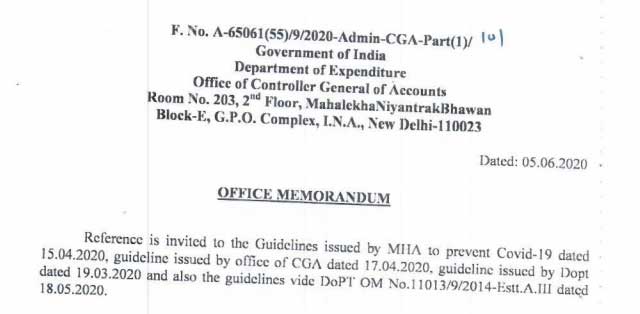
F. No. A-65061(55)/9/2020-Admin-CGA-Part(1)/ 101
Government of India
Department of Expenditure
Office of Controller General of Accounts ‘
Room No. 203, 2nd Floor, Mahalekha Niyantrak Bhawan
Block-E, G.P.O. Complex, I.N.A., New Delhi-110023
Dated: 05.06.2020
OFFICE MEMORANDUM
Reference is invited to the Guidelines issued by MIIA to prevent Covid-19 dated 15.04.2020, guideline issued by office of CGA dated 17.04.2020. guideline issued by Dopt dated 19.03.2020 and also the guidelines vide DoP’T OM No.11013/9/2014-Estt.A. III dated 18.05.2020.
All the verticals of O/o CGA. PFMS (Headquarters and State Directorates), INGA and CPAO are requested to revisit the rosters made for presence of staff in the office. It has to be ensured that 50 percent of officers (below the level of Dy. Secretary) and 50 percent of staff attend office on every alternate day. Leave may be sanctioned to those staff members who may not be in position to attend office during this period
F.No.11013/9/2014-Estt. A.III
Government of India
Ministry of Personnel, Public Grievances and Pensions
(Department of Personnel and Training)
North Block, New Delhi
Dated the 5th June, 2020
OFFICE MEMORANDUM
Subject: Preventive measures to be taken to contain the spread of Novel Coronavirus (COVID-19) – Attendance regarding.
The undersigned is directed to refer to OM of even number dated the
17th March, 2020, 18th May, 2020 and 19th May, 2020 whereby advisory for
well-being of Government employees and attendance in Government offices
with staggered timings were issued by Department of Personnel &
Training (DoPT).
2. Kind attention is also drawn to Ministry of Home Affairs’ Order
dated 30.05.2020 whereby ‘Additional Directives for Work Places’ have
been prescribed. Further, the Ministry of Health & Family Welfare
(MoH&FW) on 4th June, 2020 has issued Standard Operating Procedure
on preventive measures to contain spread of COVID-19 in workplace settings (copy enclosed).
3. It is emphasized that strict adherence to the practices of social
distancing norms and health & hygiene practices, as enunciated in
these guidelines, is of paramount importance and the Government servants
as responsible employees should abide by these practices so that the
Government offices function in the most efficient manner in the given
situation. All the Ministries / Departments/offices as well as the
Central Government employees are, therefore, directed to ensure strict
compliance of instructions issued by DoPT as well as MHA and MoH&FW.
(Umesh Kumar Bhatra)
Deputy Secretary to the Govt. of India
4th June, 2020
Government of IndiaMinistry of Health & Family Welfare
SOP on preventive measures to contain spread of COVID-19 in offices
1. Background
Offices and other workplaces are relatively close settings, with
shared spaces like work stations, corridors, elevators & stairs,
parking places, cafeteria, meeting rooms and conference halls etc. and
COVID-19 infection can spread relatively fast among officials, staffs
and visitors.
There is a need to prevent spread of infection and to respond in a
timely and effective manner in case suspect case of COVID-19 is detected
in these settings, so as to limit the spread of infection.
2. Scope
This document outlines the preventive and response measures to be
observed to contain the spread of COVID-19 in office settings. The
document is divided into the following sub-sections
(i) Generic preventive measures to be followed at all times
(ii) Measures specific to offices
(iii) Measures to be taken on occurrence of case(s)
(iv) Disinfection procedures to be implemented in case of occurrence of suspect / confirmed case.
Offices in containment zones shall remain closed except for medical
& essential sevices. Only those outside containment zones will be
allowed to open up.
3. Generic preventive measures
Persons above 65 years of age, persons with comorbidities, pregnant
women are advised to stay at home, except for essential and health
purposes. Office management to facilitate the process.
The generic preventive measures include simple public health measures
that are to be followed to reduce the risk of infection with COVID-19.
These measures need to be observed by all (employees and visitors) at
all times. These include:
i. Individuals must maintain a minimum distance of 6 feet in public places as far as feasible.
ii. Use of face covers/masks to be mandatory.
iii.
Practice frequent hand washing with soap (for at least 40-60 seconds)
even when hands are not visibly dirty. Use of alcohol-based hand
sanitizers (for at least 20 seconds) can be made wherever feasible.
iv.
Respiratory etiquettes to be strictly followed. This involves strict
practice of covering one’s mouth and nose while coughing/sneezing with a
tissue / handkerchief / flexed elbow and disposing off used tissues
properly.
v. Self-monitoring of health by all and reporting any illness at the earliest to the immediate supervisory officer.
vi. Spitting shall be strictly prohibited.
vii. Installation & use of Aarogya Setu App by employees.
4. Specific preventive measures for offices:
i. Entrance to have mandatory hand hygiene (sanitizes dispenser) and thermal screening provisions.
ii. Only asymptomatic staff/visitors shall be allowed.
iii.
Any officer and staff residing in containment zone should inform the
same to supervisory officer and not attend the office till containment
zone is denotified. Such staff should be permitted to work from home and
it will not be counted as leave period.
iv. Drivers shall maintain
social distancing and shall follow required dos and don’ts related to
COVID-19. It shall be ensured by the service providers/ officers/ staff
that drivers residing in containment zones shall not be allowed to drive
vehicles.
v. There shall be provision for disinfection of the
interior of the vehicle using 1% sodium hypochlorite solution/ spray. A
proper disinfection of steering, door handles, keys, etc. should be
taken up.
vi. Advise all employees who are at higher risk i.e. older
employees, pregnant employees and employees who have underlying medical
conditions, to take extra precautions. They should preferably not be
exposed to any front-line work requiring direct contact with the public.
Office management to facilitate work from home wherever feasible.
vii.
All officers and staff / visitors to be allowed entry only if using
face cover/masks. The face cover/mask has to be worn at all times inside
the office premises.
viii. Routine issue of visitors/ temporary
passes should be suspended and visitors with proper permission of the
officer who they want to meet, should be allowed after being properly
screened.
ix. Meetings, as far as feasible, should be done through video conferencing.
x. Posters/ standees/ AV media on preventive measures about COVID-19 to be displayed prominently.
xi. Staggering of office hours, lunch hours/coffee breaks to be done, as far as feasible.
xii. Proper crowd management in the parking lots and outside the premises – duly following social distancing norms be ensured.
xiii.
Valet parking, if available, shall be operational with operating staff
wearing face covers/ masks and gloves as appropriate. A proper
disinfection of steering, door handles, keys, etc. of vehicles should be
taken up.
xiv. Any shops, stalls, cafeteria etc., outside and within
the office premises shall follow social distancing norms at all times.
xv. Specific markings may be made with sufficient distance to manage the queue and ensure social distancing in the premises.
xvi. Preferably separate entry and exit for officers, staff and visitors shall be organised.
xvii.
Proper cleaning and frequent sanitization of the workplace,
particularly of the frequently touched surfaces must be ensured.
xviii. Ensure regular supply of hand sanitisers, soap and running water in the washrooms.
xix. Required precautions while handling supplies, inventories and goods in the office shall be ensured.
xx. Seating arrangement to be made in such a way that adequate social distancing is maintained.
xxi. Number of people in the elevators shall be restricted, duly maintaining social distancing norms.
xxii.
For air-conditioning/ventilation, the guidelines of CPWD shall be
followed which inter alia emphasises that the temperature setting of all
air conditioning devices should be in the range of 24-30°C, relative
humidity should be in the range of 40¬70%, intake of fresh air should be
as much as possible and cross ventilation should be adequate.
xxiii. Large gatherings continue to remain prohibited.
xxiv.
Effective and frequent sanitation within the premises shall be
maintained with particular focus on lavatories, drinking and hand
washing stations/areas.
xxv. Cleaning and regular disinfection (using
1% sodium hypochlorite) of frequently touched surfaces (door knobs,
elevator buttons, hand rails, benches, washroom fixtures, etc.) shall be
done in office premises and in common areas
xxvi. Proper disposal of face covers / masks / gloves left over by visitors and/or employees shall be ensured.
xxvii. In the cafeteria/canteen/dining halls:
a.Adequate crowd and queue management to be ensured to ensure social distancing norms.
b. Staff / waiters to wear mask and hand gloves and take other required precautionary measures.
c.The seating arrangement to ensure a distance of at least 1 meter between patrons as far as feasible.
d. In the kitchen, the staff to follow social distancing norms.
5. Measures to be taken on occurrence of case(s):
Despite taking the above measures, the occurrence of cases among the
employees working in the office cannot be ruled out. The following
measures will be taken in such circumstances:
i. When one or few person(s) who share a room/close office space
is/are found to be suffering from symptoms suggestive of COVID-19:
Place the ill person in a room or area where they are isolated
from others at the workplace. Provide a mask/face cover till such time
he/she is examined by a doctor.
Immediately inform the nearest medical facility (hospital/clinic) or call the state or district helpline.
A
risk assessment will be undertaken by the designated public health
authority (district RRT/treating physician) and accordingly further
advice shall be made regarding management of case, his/her contacts and
need for disinfection.
The suspect case if reporting very
mild/mild symptoms on assessment by the health authorities would be
placed under home isolation.
Suspect case, if assessed by health
authorities as moderate to severe, will be treated as per health
protocol in appropriate health facility.
The rapid response team of the concerned district shall be requisitioned and will undertake the listing of contacts.
The
necessary actions for contact tracing and disinfection of work place
will start once the report of the patient is received as positive. The
report will be expedited for this purpose.
ii. If there are large numbers of contacts from a pre-symptomatic /
asymptomatic case, there could be a possibility of a cluster emerging in
workplace setting. Due to the close environment in workplace settings
this could even be a large cluster (>15 cases). The essential
principles of risk assessment, isolation, and quarantine of contacts,
case referral and management will remain the same. However, the scale of
arrangements will be higher.
iii. Management of contacts:
The contacts will be categorised into high and low risk contacts by the District RRTas detailed in the Annexure I.
The high-risk exposure contacts shall be quarantined for 14 days.
These persons shall undergo testing as per ICMR protocol.
The low risk exposure contacts shall continue to work and closely monitor their health for next 14 days.
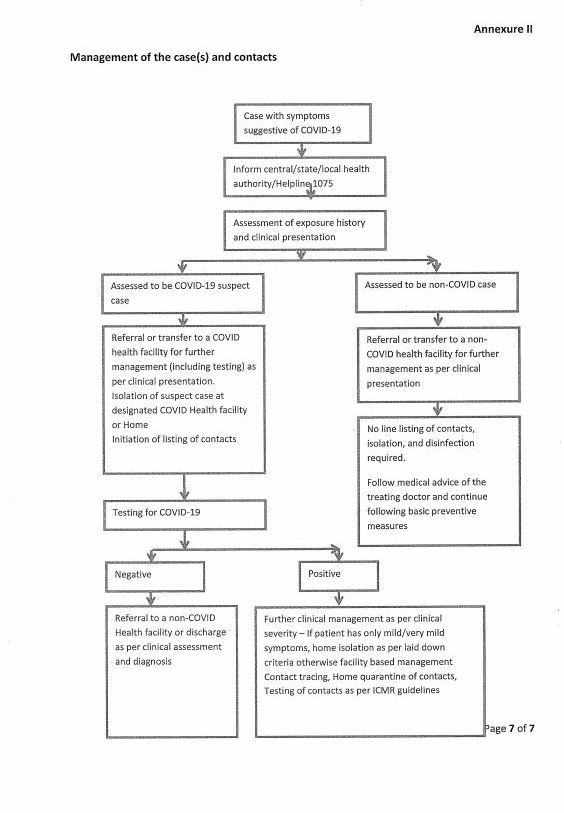
The flowchart for management of contact/ cases is placed at Annexure – II.
6. Closure of workplace
i. If there are one or two cases reported, the disinfection procedure
will be limited to places/areas visited by the patient in past 48 hrs.
There is no need to close the entire office building/halt work in other
areas of the office and work can be resumed after disinfection as per
laid down protocol.
ii. However, if there is a larger outbreak, the
building/block will have to be closed for 48 hours after thorough
disinfection. All the staff will work from home, till the building/block
is adequately disinfected and is declared fit for re-occupation.
7. Disinfection Procedures in Offices
Detailed guidelines on the disinfection as already issued by Ministry
of Health & Family Welfare as available on their website shall be
followed.
Annexure I
Risk profiling of contacts
Contacts are persons who have been exposed to a confirmed case
anytime between 2 days prior to onset of symptoms (in the positive case)
and the date of isolation (or maximum 14 days after the symptom onset
in the case).
High-risk contact
Touched body fluids of the patient (respiratory tract
secretions, blood, vomit, saliva, urine, faeces; e.g. being coughed on,
touching used paper tissues with a bare hand)
Had direct physical contact with the body of the patient including physical examination without PPE
Touched or cleaned the linens, clothes, or dishes of the patient.
Lives in the same household as the patient.
Anyone in close proximity (within 1 meter) of the confirmed case without precautions.
Passengers
in close proximity (within 1 meter) in a conveyance with a symptomatic
person who later tested positive for COVID-19 for more than 6 hours.
Low-risk contact
Shared the same space (worked in same room/similar) but not having a high-risk exposure to confirmed case of COVID-19.
Travelled in same environment (bus/train/flight/any mode of transit) but not having a high-risk exposure.
Confederation firmly condemns and rejects central government's unilateral decision. We call on the Government to urgently reconsider the decision and revoke the freezing orders for DA & DR.
CONFEDERATION OF CENTRAL GOVT EMPLOYEES & WORKERS
1st Floor, North Avenue PO Building, New Delhi - 110001
Website: www.confederationhq.blogspot.com
Email: confederationhq@gmail.com
President
RAVI NAIR
9718686800
Secretary General
R.N. PARASHAR
9969234999
No. Confd./DA-Covid-19/2020
Dated: 24.04.2020
CONFEDERATION OF CENTRAL GOVT EMPLOYEES AND WORKERS STRONGLY OPPOSE DA & DR FREEZING
Central Government’s decision to freeze three instalments of Dearness Allowance (DA) of Central Government Employees and Dearness Relief (DR) of Pensioners from 01.01.2020 to 30.06.2021 is a severe and unexpected blow to the Central Government Employees and Pensioners. Already most of the Central Government employees and Pensioners have contributed one day’s salary and Pension to PM CARES Fund.
Confederation strongly oppose and protest the unilateral decision of the Central Government. We demand the Government to review the decision immediately and withdraw the DA & DR freezing orders.
Confederation CHQ is in touch with National Council (JCM) Staff Side Secretary and other leaders. Efforts are being made to arrive at a united stand and convey the same to Government through Secretary, JCM Staff Side. Detailed statement of Confederation will be issued shortly.
R.N.PARASHAR
sd/-
Secretary General
Confederation of CGE& Workers
Attendance report during lockdown from 20th April to 3rd May, 2020 - COVID-19
F.No. C-35021(1)/MF.CGA/ ADMN/2020/ 2006 O/O CONTROLLER GENERAL OF ACCOUNTS MINISTRY Of FINANCE DEPARTMENT OF EXPENDITURE
NEW DELHI,
Dated: 21.04.2020
OFFICE MEMORANDUM
Subject: Attendance report during lockdown ( 20.04.2020 to 03.05.2020) - reg.
With reference to the Ministry of Finance, D/o, D/o Expenditure OM No. A- 60011/21/2019-Ad.J dated 20.04.2020, all Jt. Controller General of Accounts are requested to arrange to provide attendance statement in respect of their verticals, in the following format so that a compiled report could be sent to M/o Finance:
Sl. No.
Unit / Section Name
Name of Officers/ Officials
Designation
Attendance statement may be sent to Administration positively by 1.00 P.M. on every working day at admn3-cga[at]gov.in.
Consolidated Revised Guidelines on the measures to be taken by Ministries /Departments of Government of India, State / UT Governments and State / UT authorities for containment of COVID-19 in the country
[As per Ministry of Home Affairs (MHA) Order No. 40-3/2020-DM-I(A) dated 15th April, 2020]
No.40-3/2020-DM-I(A)
Government of India
Ministry of Home Affairs
North Block, New Delhi-110001
Dated 15th April 2020
ORDER
Whereas, in exercise of the powers, conferred under Section 10(2)(1)of the Disaster Management Act 2005, the undersigned, in his capacity as Chairperson, National Executive Committee, has issued an Order dated 14th April, 2020 that the lock down measures stipulated in the Consolidated Guidelines of Ministry of Home Affairs (MHA) for containment of COVID-19 epidemic in the country, will continue to remain in force upto 3rd May, 2020 to contain the spread of COVID-19 in the country;
Whereas, to mitigate hardship to the public, select additional activities will be allowed, which will come into effect from 20th April, 2020. However, these additional activities will be operationalized by States / Union Territories (UTs)/ District Administrations based on strict compliance to the existing guidelines on lockdown measures. Before operating these relaxations, States / UTs/ District Administrations shall ensure that all preparatory arrangements with regard to social distancing in offices, workplaces, factories and establishments, as also other sectoral requirements are in place. The consolidated revised guidelines incorporating these relaxations are enclosed;
Whereas, the consolidated revised guidelines will not apply in containment zones, as demarcated by States / UTs/ District administrations. If any new area is included in the category of a containment zone, the activities allowed in that area till the time of its categorization as a containment zone, will be suspended except for those activities as are specifically permitted under the guidelines of Ministry of Health and Family Welfare (MoHFW), Government of India;
Whereas, in exercise of the powers, conferred under Section 10(2)(1)of the Disaster Management Act, 2005, the undersigned, in his capacity as Chairperson, National Executive Committee, hereby issues directions to all the all Ministries/ Departments of Government of India, State/Union Territory Governments and State/Union Territory Authorities for the strict implementation of enclosed consolidated revised guidelines.
As per the revised guidelines issued by the Ministry of Home Affairs on 15 April 2020:
All domestic and international air travel of passengers, except for purposes enumerated in para 4 (ix), and for security purposes.
All passenger movement by trains, except for security purposes.
Buses for public transport.
Metro rail services.
Inter-district and inter-State movement of individuals except for medical reasons or for activities permitted under these guidelines.
All educational, training, coaching institutions etc. shall remain closed.
All industrial and commercial activities other than those specifically permitted under these guidelines.
Hospitality services other than those specifically permitted under these guidelines.
Taxis (including auto rickshaws and cycle rickshaws) and services of cab aggregators.
All cinema halls, malls. shopping complexes, gymnasiums, sports complexes, swimming pools, entertainment parks. theaters, bars and auditoriums, assembly halls and similar places
All social/ political/ sports/ entertainment/ academic/ cultural/ religious functions/ other gatherings.
All religious places/ places of worship shall be closed for public. Religious congregations are strictly prohibited
In case of funerals, congregation of more than twenty persons will not be permitted.
2. Operation of guidelines in Hotspots and containment zones
‘Hotspots’, i.e., areas of large COVID-19 outbreaks, or clusters with significant spread of COVID-19, will be determined as per the guidelines issued by Ministry of Health and Family Welfare (MoHFW), Government of India (GoI).
In these hotspots, containment zones will be demarcated by States UTs District administrations as per the guidelines of MoHFW.
In these containment zones, the activities allowed under these guidelines will not be permitted. There shall be strict perimeter control in the area of the containment zones to ensure that there is no unchecked inward outward movement of population from these zones except for maintaining essential services (including medical emergencies and law and order related duties) and Government business continuity. The guidelines issued in this regard by MoHFW will be strictly implemented by State/ UT Governments and the local district authorities.
3. Select permitted activities allowed with effect from 20th April, 2020:
i. To mitigate hardship to the public, select additional activities have been allowed which will come into effect from 20th April, 2020. These limited exemptions will be operationalized by States / UTs/ district administrations based on strict compliance to the existing guidelines. Also, before allowing these select additional activities, States / UTs/ district administrations shall ensure that all preparatory arrangements with regard to the Standard Operating Procedures (SOPs) for social distancing in offices, workplaces, factories and establishments, as also other sectoral requirements are in place.
ii. The consolidated revised guidelines incorporating these select permitted activities have been enumerated in paras 5-20 below.
4. Strict enforcement of the lockdown guidelines
i. State/ UT Governments shall not dilute these guidelines issued under the Disaster Management Act, 2005, in any manner, and shall strictly enforce the same.
ii. State/ UT Governments, may, however, impose stricter measures than these guidelines as per requirement of the local areas.
5. All health services (including AYUSH)to remain functional, such as:
i. Hospitals, nursing homes, clinics, telemedicine facilities.
ii. Dispensaries, chemists, pharmacies, all kinds of medicine shops including Jan Aushadhi Kendras and medical equipment shops.
iii. Medical laboratories and collection centres.
iv. Pharmaceutical and medical research labs, institutions carrying out COVID-19 related research.
v. Veterinary Hospitals, dispensaries, clinics, pathology labs, sale and supply of vaccine and medicine.
vi. Authorised private establishments, which support the provisioning of essential services, or efforts for containment of COVID-19, including home care providers, diagnostics, supply chain firms serving hospitals.
vii. Manufacturing units of drugs, pharmaceuticals, medical devices, medical oxygen, their packaging material, raw material and intermediates.
viii. Construction of medical health infrastructure including manufacture of ambulances.
ix. Movement (inter and intra State, including by air) of all medical and veterinary personnel, scientists, nurses, para-medical staff, lab technicians, mid-wives and other hospital support services, including ambulances.
6. Agricultural and related activities:
A. All agricultural and horticultural activities to remain fully functional, such as:
i. Farming operations by farmers and farm workers in field.
ii. Agencies engaged in procurement of agriculture products, including MSP operations.
iii. ‘Mandis’ operated by the Agriculture Produce Market Committee (APMC) or as notified by the State / UT Government (e.g., satellite mandis). Direct marketing operations by the State/ UT Government or by industry, directly from farmers / group of farmers, FPOs’ co-operatives etc. States/ UTs may promote decentralized marketing and procurement at village level.
iv. Shops of agriculture machinery, its spare parts (including its supply chain) and repairs to remain open.
v. ‘Custom Hiring Centres (CHC), related to farm machinery.
vi. Manufacturing, distribution and retail of fertilizers, pesticides and seeds.
vii. Movement (inter and intra State) of harvesting and sowing related machines like combined harvester and other agriculture/ horticulture implements.
B. Fisheries – the following activities will be functional:
i. Operations of the fishing (marine and inland)/ aquaculture industry, including feeding & maintenance, harvesting, processing, packaging, cold chain, sale and marketing.
ii. Hatcheries, feed plants, commercial aquaria.
iii. Movement of fish/ shrimp and fish products, fish seed/ feed and workers for all these activities.
C. Plantations- the following activities will be functional:
i. Operations of tea, coffee and rubber plantations, with maximum of 50% workers.
ii. Processing, packaging, sale and marketing of tea, coffee, rubber and cashew, with maximum of 50% workers.
D. Animal husbandry – the following activities will be functional:
i. Collection, processing, distribution and sale of milk and milk products by milk processing plants, including transport and supply chain.
ii. Operation of animal husbandry farms including poultry farms & hatcheries and livestock farming activity.
iii. Animal feed manufacturing and feed plants, including supply of raw material, such as maize and soya.
iv. Operation of animal shelter homes, including Gausha/as.
7. Financial sector: following to remain functional:
i. Reserve Bank of India (RBI) and RBI regulated financial markets and entities like NPCI, CCll, payment system operators and standalone primary dealers.
ii. Bank branches and ATMs, IT vendors for banking operations, Banking Correspondents (BCs), ATM operation and cash management agencies.
a. Bank branches be allowed to work as per normal working hours till disbursal of DBT cash transfers is complete.
b. local administration to provide adequate security personnel at bank branches and BCs to maintain social distancing, law and order and staggering of account holders.
iii. SEBI, and capital and debt market services as notified by the Securities and Exchange Board of India (SEBI).
iv. IRDAI and Insurance companies.
8. Social sector: following to remain functional:
i. Operation of homes for children/ disabled/ mentally challenged/ senior citizens/ destitutes/ women/ widows.
ii. Observation homes, after care homes and places of safety for juveniles.
iii. Disbursement of social security pensions, e.g., old agel widow/ freedom fighter pensions; pension and provident fund services provided by Employees Provident Fund Organisation (EPFO).
iv. Operation of Anganwadis – distribution of food items and nutrition once in 15 days at the doorsteps of beneficiaries, e.g., children, women and lactating mothers. Beneficiaries will not attend the Anganwadis.
9. Online teaching and distance learning to be encouraged:
i. All educational, training, coaching institutions etc. shall remain closed.
ii. However, these establishments are expected to maintain the academic schedule through online teaching.
iii. Maximum use of Doordarshan (DO) and other educational channels may be made for teaching purposes.
10. MNREGA works to be allowed:
i. MNREGA works are allowed with strict implementation of social distancing and face mask.
ii. Priority to be given under MNREGA to irrigation and water conservation works.
iii. Other Central and State sector schemes in irrigation and water conservation sectors may also be allowed to be implemented and suitably dovetailed with MNREGA works.
11. Public utilities: following to remain functional:
i. Operations of Oil and Gas sector, including refining, transportation, distribution, storage and retail of products, e.g., petrol, diesel, kerosene, CNG, LPG, PNG etc.
ii. Generation, transmission and distribution of power at Central and Statel UT levels.
iii. Postal services, including post offices.
iv. Operations of utilities in water, sanitation and waste management sectors, at municipal/ local body levels in States and UTs.
v. Operation of utilities providing telecommunications and internet services.
12. Movement, loading / unloading of goods / cargo (inter and intra State) is allowed, as under:
i. All goods traffic will be allowed to ply.
ii. Operations of Railways: Transportation of goods and parcel trains.
iii. Operations of Airports and related facilities for air transport for cargo movement, relief and evacuation.
iv. Operations of Seaports and Inland Container Depots (ICDs) for cargo transport, including authorized custom clearing and forwarding agents.
v. Operations of Land Ports for cross land border transportation of essential goods, including petroleum products and LPG, food products, medical supplies.
vi. Movement of all trucks and other goods/ carrier vehicles with two drivers and one helper subject to the driver carrying a valid driving license; an empty truck vehicle will be allowed to ply after the delivery of goods, or for pick up of goods.
vii. Shops for truck repairs and dhabas on highways, with a stipulated minimum distance as prescribed by the State/ UT authorities.
viii. Movement of staff and contractual labour for operations of railways, airports/ air carriers, seaports/ ships/ vessels, landports and ICDs is allowed on passes being issued by the local authority on the basis of authorizations issued by the respective designated authority of the railways, airports, seaports, land ports and ICDs.
13. Supply of essential goods is allowed, as under:
i. All facilities in the supply chain of essential goods, whether involved in manufacturing, wholesale or retail of such goods through local stores, large brick and mortar stores or e-Commerce companies should be allowed to operate, ensuring strict social distancing without any restriction on their timing of opening and closure.
ii. Shops (including Kirana and single shops selling essential goods) and carts, including ration shops (under PDS), dealing with food and groceries (for daily use), hygiene items, fruits and vegetables, dairy and milk booths, poultry, meat and fish, animal feed and fodder etc, should be allowed to operate, ensuring strict social distancing without any restriction on their timing of opening and closure.
iii. District authorities may encourage and facilitate home delivery to minimize the movement of individuals outside their homes.
14. Commercial and private establishments, as listed below, will be allowed to operate:
i. Print and electronic media including broadcasting, DTH and cable services. ii. IT and IT enabled Services, with upto 50% strength. iii. Data and call centres for Government activities only.
iv. Government approved Common Service Centres (CSCs) at Gram Panchayat level.
v. E-commerce companies. Vehicles used bye-commerce operators will be allowed to ply with necessary permissions.
vi. Courier services.
vii. Cold storage and warehousing services, including at ports, airports, railway stations, container Depots, individual units and other links in the logistics chain.
viii. Private security services and facilities management services for maintenance and upkeep of office and residential complexes.
ix. Hotels, home stays, lodges and motels, which are accommodating tourists and persons stranded due to lock down, medical and emergency staff, air and sea crew.
x. Establishments used earmarked for quarantine facilities.
xi. Services provided by self-employed persons, e.g., electrician, IT repairs, plumbers, motor mechanics, and carpenters.
15. Industries / Industrial Establishments (both Government and private), as listed below, will be allowed to operate:
Industries operating in rural areas, i.e., outside the limits of municipal corporations and municipalities.
Manufacturing and other industrial establishments with access control in Special Economic Zones (SEZs) and Export Oriented Units (EoUs), industrial estates, and industrial townships. These establishments shall make arrangements for stay of workers within their premises as far as possible and or adjacent buildings and for implementation of the Standard operating protocol (SOP) as referred to in para 21 (ii) below. The transportation of workers to work place shall be arranged by the employers in dedicated transport by ensuring social distancing.
Manufacturing units of essential goods, including drugs, pharmaceuticals, medical devices, their raw material and intermediates.
Food processing industries in rural areas, i.e., outside the limits of municipal corporations and municipalities.
Production units, which require continuous process, and their supply chain.
Manufacturing of IT hardware.
Coal production, mines and mineral production, their transportation, supply of explosives and activities incidental to mining operations.
Manufacturing units of packaging material.
Jute industries with staggered shifts and social distancing.
Oil and gas exploration refinery.
Brick kilns in rural areas i.e., outside the limits of municipal corporations and municipalities.
16. Construction activities, listed as below, will be allowed to operate:
Construction of roads, irrigation projects, buildings and all kinds of industrial projects, including MSMEs, in rural areas, i.e., outside the limits of municipal corporations and municipalities; and all kinds of projects in industrial estates.
Construction of renewable energy projects.
Continuation of works in construction projects, within the limits of municipal corporations and municipalities, where workers are available on site and no workers are required to be brought in from outside (in situ construction).
17. Movement of persons is allowed in the following cases:
Private vehicles for emergency services, including medical and veterinary care, and for procuring essential commodities. In such cases, one passenger besides the private vehicle driver can be permitted in the backseat, in case of four-wheeler ; however, in case of two-wheeler, only the driver of the vehicle is to be permitted.
All personnel travelling to place of work and back in the exempted categories, as per the instructions of the State/ UT local authority. 18. Offices of the Government of India, its Autonomous / Subordinate Offices will remain open, as mentioned below:
Defence, Central Armed Police Forces, Health and Family Welfare, Disaster management and Early Warning Agencies (IMD, INCOIS, SASE and National Centre of Seismology, CWC), National Informatics Centre (NIC), Food Corporation of India (FCI), NCC, Nehru Yuva Kendras (NYKs) and Customs to function without any restriction.
Other Ministries and Departments, and offices under their control, are to function with 100% attendance of Deputy Secretary and levels above that. Remaining officers and staff to attend upto 33% as per requirement.
19. Offices of the Statel Union Territory Governments, their Autonomous Bodies and Local Governments will remain open, as mentioned below:
Police, home guards, civil defence, fire and emergency services, disaster management, prisons and municipal services will function without any restrictions.
All other Departments of State/ UT Governments to work with restricted staff. Group ‘A’ and ‘B’ officers may attend as required. Group ‘C’ and levels below that may attend upto 33% of strength, as per requirement to ensure social distancing. However, delivery of public services shall be ensured, and necessary staff will be deployed for such purpose.
District administration and Treasury (including field offices of the Accountant General) will function with restricted staff. However, delivery of public services shall be ensured, and necessary staff will be deployed for such purpose.
iv. Resident Commissioner of States/ UTs, in New Delhi, only to the extent of coord inating COVI 0-19 related activities and internal kitchen operations.
Forest offices: staff/ workers required to operate and maintain zoo, nurseries, wildlife, fire-fighting in forests, watering plantations, patrolling and their necessary transport movement.
20. Persons to remain under mandatory quarantine, as under:
All such persons who have been directed by health care personnel to remain under strict home/ institutional quarantine for a period as decided by local Health Authorities.
Persons violating quarantine will be liable to legal action under Section 188 of the IPC, 1860.
Quarantined persons, who have arrived in India after 15.2.2020, after expiry of their quarantine period and being tested Covid-19 negative, will be released following the protocol prescribed in the SOP issued by MHA.
21. Instructions for enforcement of above lockdown measures:
All the district magistrates shall strictly enforce the National COVID 19 directives as specified in Annexure I. Penalties prescribed shall be levied and collected from all persons and entities violating these directives.
All industrial and commercial establishments, work places, offices etc. shall put in place arrangements for implementation of SOP as in Annexure II before starting their functioning.
In order to implement these containment measures, the District Magistrate will deploy Executive Magistrates as Incident Commanders in the respective local jurisdictions. The Incident Commander will be responsible for the overall implementation of these measures in their respective jurisdictions. All other line department officials in the specified area will work under the directions of such incident commander. The Incident Commander will issue passes for enabling essential movements as explained.
The Incident Commanders will in particular ensure that all efforts for mobilization of resources, workers and material for augmentation and expansion of hospital infrastructure shall continue without any hindrance.
Additional activities permitted in these guidelines shall be implemented in a phased manner, after making all arrangements necessary for strict implementation of the guidelines. These will come into force with effect from 20th April, 2020.
22. Penal provisions
Any person violating these lockdown measures will be liable to be proceeded against as per the provisions of Section 51 to 60 of the Disaster Management Act, 2005, besides legal action under Sec. 188 of the IPC, and other legal provisions as applicable. Extracts of these penal provisions are at
Annexure III.
All efforts have been made to ensure accuracy of the content on this blog, the same should not be construed as a statement of law or used for any legal purposes. Our blog "Central Government Staff news" accepts no responsibility in relation to the accuracy, completeness, usefulness or otherwise, of the contents. Users are advised to verify/check any information with the relevant department(s) and/or other source(s), and to obtain any appropriate professional advice before acting on the information provided in the blog.
Links to other websites that have been included on this blog are provided for public convenience only.
The blog "Central Government Staff news" is not responsible for the contents or reliability of linked websites and does not necessarily endorse the view expressed within them. We cannot guarantee the availability of such linked pages at all times.
Different Types of Leave available to central government staffs and a brief description of each leave.1. Earned Leave2. Half Pay Leave3. Commuted Leave4...
Copyright 2012 CENTRAL GOVERNMENT STAFF NEWS Central Government Staff News | Central Government Employees News | Central Government Servant | Government News | Central Government Staffs | Government Staffs | Central Government Staffs