Showing posts with label OPS. Show all posts

Tuesday, December 15, 2020

Retired employees of Navodaya Vidyalaya Samiti NVS for coverage under Old Pension Scheme OPS - Pensionary Benefit under CCS Pension Rules 1972

Retired employees of Navodaya Vidyalaya Samiti NVS for coverage under Old Pension Scheme OPS - Pensionary Benefit under CCS Pension Rules 1972

Retired employees of Navodaya Vidyalaya Samiti

Navodaya Vidyalaya Samiti
Ministry of Education, Govt. of India
(Deptt. of School Education & Literacy)
B-15, Institutional Area Sector 62, NOIDA, Gautam Budh Nagar (U.P.)- 201309


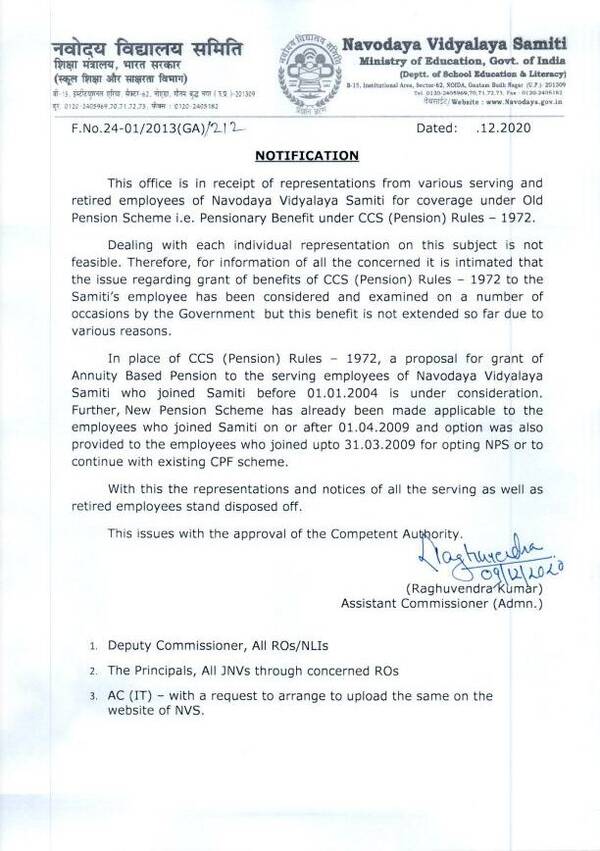
F.No.24-01/2013(GA)/212

Dated: 09.12.2020

NOTIFICATION

This office is in receipt of representations from various serving and retired employees of Navodaya Vidyalaya Samiti for coverage under Old Pension Scheme i.e. Pensionary Benefit under CCS (Pension) Rules -1972.

Dealing with each individual representation on this subject is not feasible. Therefore, for information of all the concerned it is intimated that the issue regarding grant of benefits of CCS (Pension) Rules – 1972 to the Samiti’s employee has been considered and examined on a number of occasions by the Government but this benefit is not extended so far due to various reasons.


In place of CCS (Pension) Rules – 1972, a proposal for grant of Annuity Based Pension to the serving employees of Navodaya Vidyalaya Samiti who joined Samiti before 01.01.2004 is under consideration. Further, New Pension Scheme has already been made applicable to the employees who joined Samiti on or after 01.04.2009 and option was also provided to the employees who joined upto 31.03.2009 for opting NPS or to continue with existing CPF scheme.

With this the representations and notices of all the serving as well as retired employees stand disposed off.

This issues with the approval of the Competent Authority.

(Raghuvendra Kumar)
Assistant Commissioner (Admn.)

1. Deputy Commissioner, All ROs/NLIs
2. The Principals, All JNVs through concerned ROs
3. AC (IT) – with a request to arrange to upload the same on the website of NVS.

Retired employees of Navodaya Vidyalaya Samiti

Source: NVS

Monday, September 21, 2020

NPS to OPS – Contract for Old Pension Scheme – Rajya Sabha – Central Government employees

NPS to OPS

Contract for Old Pension Scheme – Rajya Sabha

National Pension System (NPS) was introduced for Central Government employees by a Notification of Ministry of Finance (Department of Economic Affairs) dated 22nd December, 2003. NPS is mandatory for all new recruits to the Central Government service from 1st January, 2004 (except the armed forces). However, in some specific court cases, like WP(C) No. 3834/2013 titled Permanand Yadav Vs. Union of India and WP(C) No. 2810/2016 viz.Rajendra Singh Vs. Union of India, where the selection of candidates had been made before 01.01.2004 but their actual appointment in the Government service could be made on or after 01.01.2004 due to various reasons, on the direction of the Hon’ble High Court of Delhi, the benefit of Old Pension Scheme was allowed to the petitioners.

After considering all the relevant aspects and to extend the benefit to similarly placed Government servants in order to reduce further litigation, the Government has decided, vide an Office Memorandum No. 57/04/2019-P&PW(B) dated 17th February, 2020 of the Department of Pension & Pensioners’ Welfare, that in all cases where the results for recruitment were declared before 01.01.2004 against vacancies occurring on or before 31.12.2003, the candidates declared successful for recruitment shall be eligible for coverage under the Central Civil Services (Pension) Rules, 1972. Accordingly, such Government servants who were declared successful for recruitment in the results declared on or before 31.12.2003 against vacancies occurring before 01.01.2004 and covered under the National Pension System on joining service on or after 01.01.2004, may be given a one – time option to be covered under the Central Civil Services (Pension) Rules, 1972.

The advertisements issued before the introduction of the National Pension System may or may not have contained a clause regarding the pension scheme applicable to the selected candidates. In its order dated 27.03.2019 in W.P.(C) 10306/2016 – Union of India & others versus Dr. Narayan Rao Battu& another, Hon’ble High Court of Delhi observed that since the new pension scheme was in effect and a policy decision had already been taken to make the said scheme applicable to all incumbents joining government service on or after 01.01.2004, the Respondent, who was appointed on 25.02.2005, cannot claim the right to be covered by the old pension scheme, merely because the vacancy against which he was appointed was initially advertised at a time when the old pension scheme was in force. Hon’ble Court also observed that once the new pension scheme unambiguously and specifically provided that since all incoming office bearers, whose date of appointment is on or after 01.01.2004, would be governed by the new pension scheme, no reference can be made to either the date of vacancy, or the date of advertisement.

In view of the specific provisions of the Notification dated 22.12.2003, the date of advertisement for the vacancies or the date of examination for selection against those vacancies is not considered relevant for determining the eligibility for coverage under the Old Pension Scheme or the National Pension System. There is no proposal to revise the orders issued vide aforesaid Office Memorandum dated 17.02.2020.

This information was given by the Union Minister of State (Independent Charge), Development of North Eastern Region (DoNER), MoS PMO, Personnel, Public Grievances, Pensions, Atomic Energy and Space, Dr Jitendra Singh in a written reply in Rajya Sabha today.

Wednesday, February 19, 2020

NPS to OPS Latest News - Amendment in CCS (Pension) Rules 1972 - DoPPW Order Dated 17 February 2020

Latest News on NPS: Old Pension Scheme for 2004 CG Employees

Latest News on NPS: Old Pension Scheme for 2004 CG Employees

The Department of Pension and Pensioners ' Welfare released a significant order on 17 February 2020 on extending the benefit to Central government employees whose appointment has been postponed after 31 December 2003.

Under this Order, a single right to be protected under CCS (Pension) Rules (1972) may be given to government officers who have been deemed effective to obtain the results declared before or on 31.12.2003 against vacancies that take place before 01.01.2004 for joints on or after 01.01.2004. The Central government employees in question can exercise this option by 31.05.2020 at the earliest.

Latest news on NPS to OPS

Amendment in CCS (Pension) Rules 1972 - Central Government Employees

No. 57/04/2019-P&PVW/(B)
Government of India
Department of Pension and PW

Lok Nayak Bhawan, Khan Market,
New Delhi, the 17 February, 2020

OFFICE MEMORANDUM

Subject: Coverage under Central Civil Services (Pension) Rules, 1972, in place of National Pension System, of those Central Government employees whose selection for appointment was finalized before 01.01.2004 but who joined Government service on or after 01.01.2004.

The undersigned is directed to say that consequent on introduction of National Pension System (NPS) vide Ministry of Finance (Department of Economic Affairs) Notification No. 5/7/2003-ECB & PR dated 22.12.2003, all Government servants appointed on or after 01.01.2004 to the posts in the Central Government service (except armed forces) are mandatorily covered under the said scheme. The Central Civil Services (Pension) Rules, 1972 and other connected rules were also amended vide Notification dated 30.12.2003 and, after the said amendment, those rules are not applicable to the Government servants appointed to Government service after 31.12.2003.

2. Representations have been received in this Department from the Government servants appointed on or after 1.1.2004 requesting for the benefit of the pension scheme under Central Civil Services (Pension) Rules, 1972 on the ground that their appointment was delayed on account of administrative reasons or lapses. Similar references have been received from Ministries/Departments seeking advice of this Department on the question whether the Government servants who were appointed on or after 1.1.2004 could also be extended the benefit of pension scheme under CCS (Pension) Rules, if their appointment was delayed beyond 31.12.2003 on account of administrative reasons and the delay in appointment was beyond the control of the said Government servants.

Also check: Benefit of gratuity in respect of Central Government Employees counting of service on joining new service covered under National Pension System (NPS)

3. From the representations of the Central Government employees and the references received from Ministries /Departments, it has been observed that in many of the cases referred to this Department, selection process (including written examination, interview and declaration of result) for recruitment had been completed before 01.01.2004 but the employee joined the Government service on or after 01.01.2004. A few illustrations where the selection was finalized before 01.01.2004 but actual joining took place on or after 01.01.2004 are as under:
(i) The result for recruitment was declared before 01.01.2004 but the offer of appointment and actual joining of the Government servant was delayed on account of police verification, medical examination etc.;
(ii) Some of the candidates selected through a common selection process were issued offers of appointments and were also appointed before 01.01.2004 whereas the offers of appointment to other selected candidates were issued on or after 1.1.2004 due to administrative reasons/constraints including pending Court/ CAT cases.
(iii) Candidates selected before 01.01.2004 through a common competitive examination were allocated to different Departments/ organization. While recruitment process was completed by some Department(s) / organizations on or before 31.12.2003 in respect of one or more candidates, the offers of appointment to the candidates allocated to the other Departments / organization were issued on or after 01.01.2004.
(iv) Offers of appointment to selected candidates were made before 01.01.2004 with a direction to join on or after 01.01.2004.
(v) Offers of appointment were issued to selected candidates before 01.01.2004, and many/ most candidates joined service before 01.01.2004. However, some candidate(s) were allowed extension of joining time and they joined service on or after 01.01.2004. However, their seniority was either unaffected or was depressed in the same batch or to a subsequent batch, the result for which subsequent batch was declared before 01.01.2004.
(vi) The result for recruitment was declared before 01.01.2004 but one or more candidates were declared disqualified on the grounds of medical fitness or verification of character and antecedents, caste or income certificates. Subsequently, on review, they were found fit for appointment and were issued offers of appointment on or after 01.01.2004.
In all the above illustrative cases, since the result for recruitment was declared before 01.01.2004, denial of the benefit of pension under CCS (Pension) Rules, 1972 to the affected Government servants is not considered justified.

4. The matter has been examined in consultation with the Department of Personnel & Training, Department of Expenditure and Department of Legal Affairs in the light of the various representations/references and decisions of the Courts in this regard. It has been decided that in all cases where the results for recruitment were declared before 01.01.2004 against vacancies occurring on or before 31.12.2003, the candidates declared successful for recruitment shall be eligible for coverage under the CCS (Pension) Rules, 1972. Accordingly, such Government servants who were declared successful for recruitment in the results declared on or before 31.12.2003 against vacancies occurring before 01.01.2004 and are covered under the National Pension System on joining service on or after 01.01.2004, may be given a one-time option to be covered under the CCS(Pension) Rules, 1972. This option may be exercised by the concerned Government servants latest by 31.05.2020.

5. Those Government servants who are eligible to exercise option in accordance with para-4 above, but who do not exercise this option by the stipulated date, shall continue to be covered by the National Pension system (NPS).

6. The option once exercised shall be final.

7. It is clarified, that the above option would be available to only those Government servants who were declared successful for recruitment before 01.01.2004, against vacancies pertaining to the period prior to that date. This option shall, however, not be available to the Government servants appointed on or after 01.01.2004 if they fall in any of the following categories:
(i) Government servants whose names were included in a panel of selected candidates before 01.01.2004 for recruitment against vacancies occurring on or after 01.01.2004 and were, accordingly, recruited on or after 01.01.2004.
(ii) A Government servant whose name was included in a panel of selected candidates prepared before 01.01.2004 for vacancies arising before and after 01.01.2004 but was actually appointed after 31.12.2003 against a vacancy arising on or after 01.01.2004.
(iii) Government servants who were selected against vacancies pertaining to the period prior to 01.01.2004 on the basis of an advertisement / notification issued before 01.01.2004 or a written examination / interview held before 01.01.2004 but results for recruitment were declared on or after 01.01.2004.
(iv) Government servants who joined on or after 01.01.2004 after they were granted extension of joining time on their own request and, in accordance with the instructions issued by the Department of Personnel & Training, their seniority was depressed on account of such extension of joining time to a batch for which the result for recruitment was declared on or after 01.01.2004.
8. The matter regarding coverage under the CCS (Pension) Rules, 1972 based on the option exercised by the Government servant shall be placed before the appointing authority for consideration in accordance with these instructions. In case the Government servant fulfils the conditions for coverage under the CCS (Pension) Rules, 1972, in accordance with these instructions, necessary order in this regard shall be issued latest by 30 September, 2020. The NPS account of such Government servants shall, consequently, be closed w.e.f. 01st November, 2020.

9. The Government servants who exercise option to switch over to the pension scheme under CCS (Pension) Rules, 1972, shall be required to subscribe to the General Provident Fund (GPF). Regarding accountal of the corpus in the NPS account of the Government servant, Controller General of Accounts (CGA) has furnished the following clarification vide letter No. 1(7)(2)/2010/cla./TA III/390 dated 14.11.2019:
i. Adjustment of Employees’ contribution in Accounts: Amount may be credited to individual’s GPF account and the account may be recasted permitting up-to-date interest (Authority-FR-16 &Rule 11 of GPF Rules).
ii. Adjustment of Government contribution under NPS in Accounts: To be accounted for as (-) Dr. to object head 70 – Deduct Recoveries under Major Head 2071 - Pension and other Retirement benefit – Minor Head 911- Deduct Recoveries of overpayment (GAR 35 and para 3.10 of List of Major and Minor Heads of Accounts).
iii. Adjustment of increased value of subscription on account of appreciation of investments - May be accounted for by crediting the amount to Govt. account under M.H. 0071- Contribution towards Pension and Other Retirements Benefits 800- Other Receipts ( Note under the above Head in LMMHA).
10. All Ministries / Departments are requested to give wide publicity to these orders. The cases of those Government servants who fulfil the conditions mentioned in this O.M. and who exercise option to switch over to the pension scheme under CCS (Pension) Rules may be settled by the administrative Ministries / Departments in accordance with these orders.

11. These orders issue with the concurrence of Ministry of Finance, Department of Expenditure, vide their I.D. Note No. 1(7) EV/2019 dated 08.01.2020.

12. In their application to the employees of Indian Audit and Accounts Department, these orders are issued after consultation with Comptroller and Auditor General of India, as mandated under Article 148(5) of the Constitution.

13. Hindi version will follow.

(Ruchir Mittal)
Deputy Secretary to the Government of India

Saturday, January 11, 2020

13 lakhs Central Government Employees participated in the nationwide one day strike on 8th January 2020

13 lakhs Central Government Employees participated in the nationwide one day strike on 8th January 2020


PRESS STATEMENT

Dated 8th January, 2020

About thirteen (13) lakhs Central Govt. Employees participated in the nationwide one day strike on 8th January 2020 as per the call given by Confederation of Central Government Employees & Workers. The main demand of the strike is “Scrap New Contributory Pension Scheme (NPS) & Restore Old defined Pension Scheme (OPS)”. The strike is also to express the anger and protest of the Central Government employees and Pensioners against the neo-liberal policies being implemented by the Central Government in the Central Government services, as a result of which the job security, wage structure, social security and the trade union rights of the employees are in danger. None of the 10 points Charter of Demands submitted to the Government by Confederation are settled.

In Postal department about four and half lakhs employees participated in the strike all over the country. 1,55,000 Post Offices and about 400 RMS offices remained closed. Gramin Dak Sevaks of rural post offices also went on strike. Delivery work also affected as Postmen joined the strike.

In Income Tax Department the strike is total in all the States. Work of all Income Tax Offices came to a standstill. Employees of Audit & Accounts department, Civil Accounts, Atomic Energy, Geological Survey of India, Customs and Central Excise, Survey of India, Botanical Survey of India, Postal Accounts, Indian Space Research Organisation (ISRO), Printing and Stationery, Indian Bureau of Mines (IBM), AGMARK, Central Government Health Scheme (CGHS), Medical Stores Depots, Film Division of India, Indian Council for Medical Research, Indian Council for Agricultural Research, Central Food Processing Laboratory, Census Department, National Sample Survey Organisation (NSSO), Defence Accounts, Rehabilitation Department, Central Public Works Department (CPWD), Canteen Employees, Institute of Physics, LNCPE, Sree Chitra Tirunal Institute of Medical Sciences, Employees Provident Fund Organisation (EPFO), Passport Department, Zoological survey of India, Patent Office, Central Drug Laboratory, NADMO, National Library, Marketing Inspection, Commercial Intelligence, Homeopathy Department, Archeological Survey of India and various other autonomous and Scientific Research Institutions participated in the nationwide strike.

Strike is near total in Kerala, West Bengal, Tamilnadu, Maharashtra, Karnataka, Odisha, Telangana, Andhra Pradesh, Chattisgarh, Jharkhand, Assam, North Eastern States including Tripura. 70 to 80% participation in Uttar Pradesh, Madhya Pradesh, Punjab, Haryana and Rajasthan. 60 to 70% strike in Uttarakhand, Bihar, Delhi, Himachal Pradesh, Gujrat and J & K.

Solidarity demonstrations and dharnas are conducted by Central Government Pensioners Organizastions in various states.

National Secretariat of the Confederation thanked and congratulated the Central Government employees for their massive participation and for making the one day nationwide strike a resounding success.

M.Krishnan
Secretary General
Confederation
Email: mkrishnan6854@gmail.com

Tuesday, September 3, 2019

Long pending demands of the Central Government employees - CHARTER OF DEMANDS OF CONFEDERATION

Long pending demands of the Central Government employees - CHARTER OF DEMANDS OF CONFEDERATION

No.Confdn/Memorandum/ 2016-19
05th September 2019
To
Shri. Narendra Modiji,
Hon’ble Prime Minister of India,
South Block,
New Delhi - 110 001.

Respected Prime Minister,

Sub: Memorandum on the long pending demands of the Central Government employees - Request for kind intervention - regarding.

This Memorandum is submitted with the most fervent hope that the Hon’ble Prime Minister will be condescend to intercede on our behalf to settle the following long pending issues agitating the minds of 32 lakhs Central Government employees and 33 lakhs Central Govt. Pensioners.

1. Scrap New Contributory Pension Scheme (NPS) and restore Defined benefit Old Pension Scheme (OPS). Guarantee 50% of the last pay drawn as Minimum Pension.

Government of India has implemented New Contributory Pension Scheme (NPS) for all Central Govt. employees entering service on or after 01-01-2004. When compared to the Old Defined Benefit Pension Scheme (OPS) there are many adverse factors in the NPS. The monthly pension amount being received under the Insurance Annuity Scheme under NPS is less than Rs.3000/- per month, to those NPS employees who had already retired from service during 2018 and 2019, after completing 14 to 15 years of service, whereas as per the Old Pension Scheme an employee who completes minimum ten years qualifying service will get 50% of the last pay drawn as Minimum Pension which in any case will not be less than Rs.12,000/- for a lowest level employee (Multi Tasking Staff) with ten years service in Central service. Thus the very principle laid down by the Hon’ble Supreme Court of India that “Pension is a social welfare measure rendering socio-economic justice to those, who in the hey day of their life ceaselessly toiled for the employer on an assurance that in their old age, they would not be left in lurch”, stands defeated.

Seventh Central Pay Commission headed by Retired Justice of Supreme Court Shri. Ashok Kumar Mathur, in its report made the following observations about NPS:

Almost a whole lot of Government employees appointed on or after 01-01-2004, were unhappy with the New Pension Scheme. Government should take a call to look into their grievances”.
Govt. appointed a Secretary level committee called “NPS Committee” for streamlining the NPS, but that committee was not empowered to look into the main demand of the NPS employees i.e., scrap NPS, restore OPS and guarantee 50% of the last pay drawn as monthly pension. It is true that as per the recommendations of the NPS Committee, Govt’s contribution to NPS is increased to 14% from 10% and some other cosmetic changes are also made in the NPS Rules. But the basic grievance still remained unattended and unsettled, as a result uncertainty about the social security and Pension looms large over the head of every NPS employee, and the discontentment among the NPS employees (as correctly observed by 7th CPC) is growing day by day. We request the Hon’ble Prime Minister to have a relook into the entire matter, so that NPS will be scrapped and OPS will be restored and at least 50% of the last pay drawn will be guaranteed under Rules as Minimum monthly Pension on retirement.

2. Honour the assurances given by Group of Ministers on 30-06-2016 to National Council (JCM) Standing Committee members regarding increase in Minimum Pay and fitment factor recommended by Seventh Central Pay Commission (CPC) :

All the Federations/Unions/Associations in the Central Govt. Employees sector including Railways, Defence and Confederation had given a call for nationwide indefinite strike from 11th July 2016, demanding increase in Minimum Pay and Fitment formula recommended by Seventh CPC and other 7th CPC related issues. A goup of Cabinet Ministers including Shri. Rajnath Singh, then Home Minister, Shri. Arun Jaitley, then Finance Minister, Shri. Suresh Prabhu, then Railway Minister discussed the demands with the leaders of National Joint Council of Action (NJCA) and assured that Minimum Pay and Fitment formula will be increased and a High Level Committee will be appointed to submit recommendations in this regard. The assurances were reiterated by Shri. Rajnath Singh, then Home Minister on 6th July 2016 in the second round of discussion and Finance Ministry issued a press statement confirming the assurances. Accordingly, the proposed indefinite strike call of the NJCA was deferred, taking in good faith the assurances given by the Group of Ministers. We are sorry to bring it to the notice of the Hon’ble Prime Minister that even after a lapse of three years, neither the promised High Level Committee is constituted by the Govt. nor the Minimum Pay and fitment formula is increased. The entire employees feel betrayed. We request the Hon’ble Prime Minister to take immediate necessary action for implementing the assurances given by the Group of Ministers.

3. Grant “Option-I Parity” recommended by the 7th CPC to all Central Government Pensioners.

7th CPC has recommended a new formula called “Option-1” for refixing the existing pension of Central Government Pensioners retired prior to 01-01-2016. Government accepted the recommendation in principle and constituted a Secretary level committee to examine and recommend regarding the feasibility of implementing ''option-1'' recommended by 7th CPC. The Committee was not, ready to heed the valid and scientific pleadings made by the staff-side in favour of the recommendation mode by 7th CPC which is an ''Expert Body'' headed by retired Justice of Supreme Court, instead viewed the case with a closed mind and gave recommendation to the Government that implementation of Option-I is not feasible. Govt accepted the recommendations of the Secretary Level Committee and rejected ''option-I'' recommended by 7th CPC.

The entire Pension community is very much aggrieved of the decision of the Government. We request the Hon’ble Prime Minister to review the case dispassionately, so that the ''option-I party'' recommended by the 7th CPc will be accepted by the Government.

4. Regularisation of Gramin Dak Sevaks working in Postal Department and casual/contract workers working in all Central Govt Establishments.

(a) About 2.76 lakhs Gramin Dak Sevaks are employed in the Postal Department. Govt. appointed a one man committee headed by retired Postal Board Member Shri Kamalesh Chandra, to examine their wages and service conditions. The final report submitted by the Committee includes certain positive recommendations. As abnormal delay took place in implementing the recommendations of the Report, the entire Gramin Dak Sevaks went on indefinite strike for 16 days in 2018. Finally Govt issued orders, but many recommendations are either modified, diluted or rejected, including payment of arrears from 01-01-2016 as per the formula recommended by the Committee, Children education Allowance, Promotions, etc, etc., We request the Hon’ble Prime Minister to take a lenient view to rederess the grievances of the low-paid Gramin Dak Sevaks which includes regularisation of their services and also implementation of the pending positive recommendations of the Kamalesh Chandra Committee report.

(b) There are thousands of causal/contract employees and workers engaged in all Central Govt departments and working for years together. They are not paid equal wages and not extended any benefits of regular employees. Even after working for more than ten years continuously, their request for regularisation is not considered favourably. There is no scheme to absorb them in regular service. We request the Hon’ble Prime Minister to consider their case sympathetically so that a scheme will be worked out to regularise all casual/contract workers and extend them all the benefits of regular employees.

5. Stop Corporatisation/ Privatisation of Railways, Defence and Postal Departments. Withdraw the orders for closure/reorganisation of Govt. of India Printing Presses, Geological Survey of India (GSI), Central Public Works Department (CPWD), Salt Department, Stationery Offices etc.

The no holds barred big bang reforms unleashed by the Central Government has given rise to an alarming situation in the Central Government Departments. The proposed move to Corporatize Railway Production Centres and allowing private passenger trains, Corporatisation of Defence Ordinance Factories, Life Insurance and Parcel Sector of Postal department, closure of Govt. of India Printing Presses, proposed reorganisation of Salt Department, Geological Survey of India (GSI), Central Public Works Department (CPWD), Stationary Offices etc. has put in danger the very existence of various Central Govt. Departments and also the job security of lakhs of Central Govt. Employees, Gramin Dak Sevaks and Casual/Contract Workers. The present fate of the Telecom Department which was corporatized in 2000 into different companies is a bitter lesson for all of us. We request the Hon’ble Prime Minister to desist from the proposed move to corporatisation, privatisation, closure and reorganisation of Central Govt. departments.

6. Filling up of seven lakhs vacancies existing in various Central Govt. Departments:
As per the 7th CPC report (Annexure to Chapter-3) there are 7,47,171 vacancies in the Central Govt. Departments as on 01-01-2014. More retirements has taken place after 01-01-2014 and now the figure may go upto 8 lakhs. During the period from 2001 to 2008, thousands of posts are abolished in all Departments as per the downsizing orders issued by the Government in 2001. Only very few posts are filled up after 2014 and most of the Departments are running with 30 to 40% shortage of manpower. This has resulted in heavy increase in workload on the existing employees and has adversely affected the efficiency of all Central Govt. Departments to a great extent. We request the Hon’ble Prime Minister to take immediate necessary action for filling up all vacant posts in all departments of Central Government.

7. Revision of Wages from 01-01-2016 and payment of arrears of pay and Bonus from 2016 onwards to the employees of Autonomous bodies:
We regret to inform the Hon’ble Prime Minister, that due to the stringent conditions imposed by the Finance Ministry, the pay revision from 01-01-2016 and payment of arrears is still pending in most of the Autonomous bodies under Central Government. Further they are denied Bonus from 2015-16 onwards. We request the Hon’ble Prime Minister to take necessary action to redress the long pending genuine grievances of the Autonomous body employees.

There are other issues also which is already submitted to the Cabinet Secretary and the Heads of various Ministries/Departments earlier by us. We are enclosing herewith a copy of the Charter of Demands containing the important problems faced by the Central Govt. Employees and Pensioners.
Concludingly, we once again request the Hon’ble Prime Minister to be sympathetic enough to redress the grievances mentioned in this memorandum and enclosed Charter of Demands.

With profound regards,
Yours faithfully,
M. Krishnan,
Secretary General,
Confederation.
Mob: 09447068125
Email: mkrishnan6854@gmail.com

10 Points Charter of Demands of Confederation

  1. Scrap New Contributory Pension scheme (NPS). Restore Old defined benefit Pension Scheme (OPS) to all employees. Guarantee 50% of the last pay drawn as Minimum Pension.
  2. Honour assurance given by Group of Ministers (GoM) to NJCA leaders on 30-06-2016. Increase Minimum Pay and Fitment formula. Withdraw the proposed move to modify the existing time-tested methodology for calculation of Minimum wage. Grant HRA arrears from 01-01-2016. Withdraw “Very Good” bench mark for MACP, Grant promotional hierarchy and date of effect from 01-01-2006. Grant Option-I parity recommended by 7th CPC to all Central Govt. Pensioners. Settle all anomalies arising out of 7th CPC implementation.
  3. Stop corporatization / privatisation of Railways, Defence and Postal Departments. Withdraw closure orders of Govt. of India Printing Presses. Stop proposed move to close down Salt Department. Stop closure of Govt. establishments and outsourcing.
  4. Fill up all six lakhs vacant posts in the Central Government Departments in a time bound manner. Reintroduce Regional Recruitment for Group B & C posts.
  5. (a) Regularisation of Gramin Dak Sevaks and grant of Civil servant status. Implement remaining positive recommendations of Kamalesh Chandra Committee report.
    (b) Regularise all casual and contract workers including those joined on or after 01-09-1993.
  6. Ensure equal pay for equal work for all. Remove disparity in pay scales between Central Secretariat staff and similarly placed staff working in field units of various departments.
  7. Implement 7th CPC Wage Revision and Pension revision of remaining Autonomous bodies. Ensure payment of arrears without further delay. Grant Bonus to Autonomous body employees pending from 2016-17 onwards.
  8. Remove 5% condition imposed on compassionate appointments. Grant appointment in all eligible cases.
  9. Grant five time bound promotions to all Group B & C employees. Complete Cadre Review in all departments within a time-frame.
  10. (a) Withdraw the anti-worker wage/labour codes and other anti-worker Labour reforms. Stop attack on trade union rights. Ensure prompt functioning of various negotiating forums under the JCM Scheme at all levels.
    (b) Withdraw the draconian FR 56 (j) and Rule 48 of CCS (Pension Rules 1972.
Source: confederation

Wednesday, April 24, 2019

NPS to OPS - Extension of old pension scheme under CCS(Pension) Rules 1972 to the employees who were selected During the year 2003 and who had joined service On or after 01-01-2004

NPS to OPS - Extension of old pension scheme under CCS(Pension) Rules 1972 to the employees who were selected During the year 2003 and who had joined service On or after 01-01-2004
Shiva Gopal Mishra
Secretary
National Council (Staff Side)
Joint Consultative Machinery
for Central Government Employees
13C, Ferozshah Road, New Delhi - 110001
E-Mail : nc.jcm.np@gmail.com
No.NC-JCM-2019/Pension/NPS
April , 2019
The Secretary
Government of India
Department of Pension and Pensioners welfare
3rd Floor, Lok Nayak Bhawan.
Khan Market, New Delhi.

Sub: Extension of old pension scheme under CCS(Pension) Rules 1972 to the employees who were selected During the year 2003 and who had joined service On or after 01/01/2004.

Ref: 1) Judgment of the Hon’ble High Court of Delhi
Judgment in WP (C)3834/2013 & in WP(C) 28/10/2016 dtd. 27/03/2017.
2) Min. of Home Affairs (Pay & Accounts Office)
CRPF Lt. No.PAO/CRPF/MHA/NPS/DA-9(1)/ 2018-19/797, dtd. 15th March 2019.

Sir,
You are aware that the Staff Side of National Council(JCM) is representing in various forums to withdraw the National Pension System and to restore the old Pension Scheme under CCS(Pension) Rules 1972, to the Defence Civilian Employees recruited on or after 01/01/2004, since the NPS is determental to the employees as there is no defined guarantee for Pension during the old age. This was one of the important demand, for which the NJCA has served Strike notice on the Govt. For observing In-definite Strike. However due to the assurance given by the Group of Ministers, the proposed In-Definite Strike was deferred.

Sir, at present based on the Judgment of the Hon’ble High Court of Delhi in the above referred cases, the Ministry of Home Affairs have decided to extend the benefits of the old pension scheme under CCS(Pension) Rules 1972, to the Para-Military forces who were selected during the year 2003, but joined service on or after 01/01/2004. In this regard your kind attention is drawn to the letter of Ministry of Home Affairs, dtd. 15th March 2019 referred at (2) above (copy enclosed for ready reference). The Ministry of Home Affairs have decided to transfer the NPS contribution of the concerned employees to the GPF Scheme and also to bring the employees who were selected during 2003 on the basis of notification issued during 2002/2003 and joined service on or after 2004, under the coverage of CCS(Pension) Rules 1972.

A large number of Central Govt. Employees in various Departments Like Railways, Defence, Postal and other Departments are similarly placed. These employees were selected for appointment during the year 2003, based on the employment notification issued during 2002/2003 however due to delay in receiving the Attestation Forms(Police Verification Report), Medical fitness etc., they were forced to join service on or after 01/01/2004. Due to no mistake of theirs’ they were brought under the coverage of NPS, thereby denying them the benefit of GPF and Defined Guaranteed Pension under the CCS(Pension) Rules 1972. These employees also have now started representing for extending the benefit given to the Home Ministry Staff for them, and their demand is fully justified and is covered under the Judgment of Hon’ble High Court of Delhi.

Sir, in view of the above, it is requested that you may kindly look into the matter and arrange to issue instructions for extending the benefit given to the Para-Military forces in the Home Ministry to the similarly placed Central Govt. Employees by extending them the benefit of Old Pension Scheme under CCS(Pension) Rules 1972. A copy of your instruction may please be endorsed to this office.

Thanking you
Yours faithfully,
sd/-
(Shiva Gopal Mishra)
Secretary
Encl: 1) Copy of Ministry of Home Affairs Lt. Dtd. 15th March 2019.
2) Copy of the Judgment of High Court of Delhi, dtd. 12th Feb. 2015 and 27 March 2017.

Monday, March 25, 2019

NPS to OPS: Abolition of National Pension System and for restoration of Old Pension Scheme

NPS to OPS: Abolition of National Pension System and for restoration of Old Pension Scheme
Annexure-I
F.No-20/07/2017-PR
18.03.2019
To
Shri C. Srikumar, General Secretary,
All India Defence Employees' Federation,
S.M. Joshi BhavanI, Survey No. 81 ,
Dr. Babasaheb Ambedkar Road,
Khadki, Pune - 411 003.

Subject: Representation received for abolition of National Pension System and for restoration of Old Pension Scheme - reg.

Sir,
Kindly refer, to your representation dated 03.11.2018 on the subject cited above.

In this connection, it is started that the introduction of National Pension System (NPS) was a policy decision of the Government of India in view of the Increasing pension liability on the economy.
Your concerns In this regard have been noted. It Is informed that based on the feedback received from time to time from the subscribers covered under NPS and other stakeholders, the Government of India, based on the Committee of Secretaries recommendations, has recently approved the following proposals for streamlining NPS for Central Government employees.
  • Enhancement of the Government's contribution from the existing 10% to 14% of the employee's pay + DA While keeping the employee's contribution at the existing 10%
  • Providing freedom of choice for selection of Pension Funds and pattern of investment to subscribers
  • Payment of compensation for non-deposit or delayed deposit of NPS contributions during 2004-2012
  • Providing tax deduction to the contribution made under Tier-II of NPS under Section 80 C for deduction up to Rs. 1.50 Iakh provided that there is a lock in period of 3 years
  • Increase In the tax exemption limit for lump sum withdrawal on exit from the existing 40% to 60% making the entire withdrawal exempt from Income tax.
It Is further assured that keeping in view the concerns of NPS subscribers, the Government will continue to do its best to ensure that the Interests of the subscribers are protected to the best extent.

Yours faithfully,
(Abhay Garg)
Under Secretary to the Government of India

Tuesday, January 8, 2019

Two day strike Banking ops partially affected due to trade union strike

Two day strike Banking ops partially affected due to trade union strike

Banking operations Tuesday have been affected in some parts of the country as a section of employees refrained from work in support of the two-day strike call given by 10 central trade unions to protest against alleged anti-labour policies of the government.

All India Bank Employees' Association (AIBEA) and Bank Employees' Federation of India (BEFI) have supported the strike, which has impacted banking operation where these two unions are strong.
However, the operation in SBI and private sector banks remained unaffected as other seven unions in the banking sector are not part of the strike.

Many public sector banks have already informed their customers about likely impact on services if strike materialises.

"If the strike materialises, a section of the bank's employees may take part in the proposed strike on the said dates, in which case, the normal functioning of the branches/offices of the bank may get affected," Indian Bank said in a statement.

A two-day strike on January 8 and 9 has been called by the central trade unions against the alleged repressive policies for workers adopted by the government.

Source: PTINews

Monday, December 31, 2018

Whether the Government is planning to reconsider the Old Pension Scheme on optional basis for Central Government Employees?

NPS To OPS - Revert to Old Defined Benefit Pension System - Parliament Q&A on 28.12.2018

NPS-to-OPS-New-Pension-System-Old-Pension-System

National Pension System to Old Pension Scheme

In Parliament on 28th December 2018, the Minister of State in the Ministry of Finance Shri Shiv Pratap Shukla said that there is no proposal to replace the National Pension System (NPS) with old pension scheme in respect of Central Government employees recruited on or after 01.01.2004.
The detailed report of Questions and Answers are given below for your information…

Lok Sabha Un Starred Question No.2954

(a) Whether the Government is planning to reconsider the Old Pension Scheme on optional basis for Central Government Employees on heavy demand of employee associations across the country and if so, the details thereof;

(b) Whether the Government has received any representation from various State Governments and employees' associations in this regard and if so, the details thereof along with the other major changes demanded by the employee associations and the reaction of the Government thereon;
Representations have been received which inter alia also include the demand that the Government may revert to old defined benefit pension system. However, due to rising and unsustainable pension bill and competing claims on the fiscal, there is no proposal to replace the National Pension System (NPS) with old pension scheme in respect of Central Government employees recruited on or after 01.01.2004.

(c) Whether the Government has decided to raise the Government contribution in National Pension System (NPS) to 14 per cent from existing 10 per cent and if so, the details thereof along with the increased financial liabilities of the Government thereon;
Yes, the mandatory contribution by the Central Government for Tier I accounts of its employees covered under NPS has been enhanced from the existing 10% to 14%. The employees' contribution rate would remain at the existing 10%. As informed by the Department of Expenditure, the impact on Government exchequer on account of enhancing the mandatory contribution by the Government for its employees covered under NPS from 10% to 14% is estimated to entail an additional financial impact of Rs. 2840 crores on Central Government in the next immediate financial year (2019 2020).

(d) The details of cases of family pension sanctioned so far to the families of deceased Central Government employees and the payment of compensation made for non-deposit or delayed deposit of contributions under the NPS;
Number of Family Pensioners getting pension through Central Pension Accounting Office (CPAO) by authorised Bank under National Pension System- Additional Relief (NPS-AR) as on 30.11.2018 is 4,779.

(e) whether the Government has decided to stop pension scheme to all the Government employees including Government/Public Undertakings organization, if so, the details thereof and the reasons therefor; and
The Government of India vide notification dated 22.12.2003 had introduced the National Pension System (NPS) (earlier known as New Pension Scheme) for its employees and made it mandatory for all new recruits of the Central Government (excluding armed forces) who joined service on or after 01.01.2004. The old defined benefit scheme was withdrawn by the Government for Central Government employees (excluding armed forces) joining service on or after 01.01.2004. There is no proposal to stop the pension scheme for Government employees.

(f) The amount/percentage of the budget consumed every year to pay pensions to employees serving in Government jobs in the country?
As informed by the Department of Expenditure, the details of Budget consumed during 2017-18 to pay pension to pensioners and Budget for financial year 2017-18 are as under:

Budget consumed
HEAD OF ACCOUNTSAMOUNT (IN CRORES) (PROVISIONAL)
2071 Pension & other retirement benefits145745.07
3001-101 Indian Railways Pensionary charges 366.85
3002-11 Indian Railways Pensionary charges1996.97
3003-11 Indian Railways Pensionary charges21.07
3201-07 Pension-Postal Services8511.33
Grand Total156641.29

Budget for the financial year 2017-18 under NPS-AR is as under:
Budget Estimate 2018-19Expenditure 2018-19Budget Estimate 2017-18Expenditure 2017-18
Rs. 90.20 crRs. 59.71 cr (as on 30.11.2018)Rs. 66.21 crRs. 65.65 cr

Source: https://loksabha.nic.in/

Friday, December 14, 2018

NPS To OPS: Karnataka Government Employees Protest against NPS


NPS To OPS: Karnataka Government Employees Protest against NPS

New Pension System To Old Pension Scheme
Karnataka Government Employees Protest against NPS

Karnataka State Government Employees demanded to scrap NPS and on Wednesday they took a streets in Karnataka's Belgaum City. As per the media news, thousands of agitating employees assembled in Kondaskoppa area of the city, opposite the Suvarna Vidhana Soudha (State Assembly) where he winter session of the Karnataka Assembly is in session.

Earlier the members of the Karnataka State NPS Employees Association demanded scrapping of NPS.
Nothing More…
Nothing Less…
We Want
OLD PENSION SCHEME
Yesterday (12.12.2018), National Secretariat of Confederation decided to observe as DEMANDS DAY raising the demand "SCRAP NPS & RESTORE OPS" through out the country.

Thursday, December 13, 2018

STRIKE: Scrap New Contributory Pension Scheme (NPS) Restore old defined benefit pension scheme (OPS) to all employees

Strike notice from Confederation - 8th & 9th January 2019

No. Confdn/Strike/2016-19
Dated - 12th December 2018
To,
The Cabinet Secretary
Cabinet Secretariat
Government of India
Rashtrapati Bhawan
New Delhi - 110001

Sir,
This is to give notice that employees who are members of the affiliated organisations of the Confederation of Central Government Employees and Workers will go on Two-days strike on 8th & 9th January 2019. The Charter of demands in pursuance of which the employees will embark upon the Two-days strike action is enclosed.

Thanking you,
Yours faithfully,
(M. Krishnan)
Secretary General
Mob: 09447068125
Email: mkrishnan6854@gmail.com
Encl:  Charter of Demands
Annexure - 1

CHARTER OF DEMANDS

1. Scrap New Contributory Pension Scheme (NPS). Restore old defined benefit pension scheme (OPS) to all employees.

2. Settle 7th CPC related issues including increase in Minimum Pay and Fitment formula, HRA arrears from 01-01-2016, MACP Bench Mark, promotional hierarchy and date of effect of MACP from 01-01-2006. Implement Option-1 for pensioners and settle all anomalies arising out of implementation of 7th CPC recommendations.

3. Fill up all vacant posts. Reintroduce Regional Recruitment for Group B & C posts. Withdraw orders for abolishing posts lying vacant for more than five years. Revive all posts abolished during 2001 to 2008 under Annual Direct Recruitment Plan (ADR) as per May 2001 orders of the former NDA Government.

4. (a) Regularisation of Gramin Dak Sevaks and grant of Civil Servant Status. Implement remaining positive recommendations of Kamlesh Chandra Committee report.
(b) Regularise all casual and contract workers including those appointed on or after 01-09-1993.

5. Ensure equal pay for equal work for all. Remove disparity in pay scales between Central Secretariat staff and similarly placed staff working in field units of various departments.

6. Stop closure of Government establishments and outsourcing of Government functions. Withdraw closure orders of Govt. of India Printing Presses. Stop proposed move to close down salt department. Stop Foreign Direct Investment (FDI) in Railways and Defence departments.

7. Implement 7th CPC Wage revision and pension revision of Autonomous body employees and pensioners. Grant Bonus to Autonomous body employees pending from 2016-17 onwards.

8. Remove 5% condition imposed on compassionate appointments and grant appointment in all deserving cases. Rejected cases for want of 5% quota vacancies may be reviewed and appointment to dependents may be granted.

9. Grant five time bound promotions to all Group C & B employees on completion of 8,7,6,5 and 4 years of service respectively. Complete Cadre Reviews in all departments within a time frame.

10. (a) Stop attack on trade union rights. Ensure prompt functioning of various negotiating forums under JCM scheme at all levels.
(b) Withdraw the draconian FR 56(j) and Rule 48 of CCS (Pension) Rules, 1972

Source: confederationhq.blogspot.com

Sunday, December 9, 2018

New Pension Scheme Demand To Scrap it: NPS to OPS

NPS to OPS: New Pension Scheme Demand To Scrap it

New Pension Scheme Demand To Scrap it

New-Pension-Scheme-Scrap-NPS-OPS

NEW PENSION SCHEME (NPS): The New Pension Scheme is made compulsory for Government employees was brought into effect 2004, this has effected them a lot, lot of agitations are being carried out on scrapping the New Pension Scheme, this agitations has forced many State Governments such as Karnataka, Kerala, Andhra Pradesh, Delhi State Governments to reconsider this New Pension Scheme and formed an expert committee to review this New Pension Scheme. This New Pension Scheme was not implemented by West Bengal State Government. In this angle an analysis is made all about New Pension Scheme and ways to scarp or modify the New Pension Scheme to benefit the Government employees at large is suggested.

Need for Pension : The Pension System thus started in India was finalized by the Indian Pension Act of 1871. It appears that the British Government had the conception of providing its pensioners increase in their pensions to neutralize the effect of inflation.

Pension is a reward for past service. It is undoubtedly a condition of service but not an incentive to attract new entrants, the Pension is paid for past satisfactory service rendered, and to avoid destitution in old age as well as a social welfare or socio-economic justice measure, the fact that the cost of living has shot up and correspondingly the possibility of savings has gone down and consequently the drop in wages on retirement.

That pension is neither a bounty nor a matter of grace depending upon the sweet will of the employer and that it creates a vested right subject to 1972 rules which are statutory in character because they are enacted in exercise of powers conferred by the proviso to Art. 309 and clause (5) of Art. 148 of the Constitution; (ii) that the pension is not an ex-gratia payment but it is a payment for the past service rendered; and (iii) it is a social welfare measure rendering socio-economic justice to those who in the hey-day of their life ceaselessly toiled for the employer on an assurance that in their old age they would not be left in lurch.

As on 01-01-2018 there were 51.96 lakh pensioners in the country, including from Central Civil Services, Railways, and Post, Defence and Defence civilians.

EVOLUTION OF NEW PENSION SCHEME (NPS) IN INDIA:

In 1991 Government of India as introduced diverse economic reforms to pull the country out of economic crisis and to accelerate the rate of growth. These reforms are often described as the New economic policy (NEP) or policy of LPG where L for liberalisation; P for privatisation; G for globalisation. The Congress Government under the Prime Ministership of Hon’ble Prime Minister Shri P. V. Narasimha Rao, the signed an agreement with the International Monetary Fund (IMF) to get the IMF loan in which the IMF had imposed various conditions to get the soft loan which includes pension reforms , which the Indian Government Congress Government had accepted it to reform in a 10 years period .

On the basis of the decision taken in the Eleventh Conference of State Finance Secretaries held in the Reserve Bank of India (RBI) during January 2003, a Group was constituted by the RBI in February 2003 to study the pension liabilities of the State Governments and make suitable recommendations.
The "Pension Fund" to be created under the proposed revised schemes should be kept completely outside the States' Consolidated Fund and the Public Account

The pension systems, both for Civil Servants and other citizens, as evolved over the years have begun to show signs of financial stress in many countries, including India. Since the pension benefits of Government employees are usually paid from the general revenue of the Governments, the steep rise in such liabilities adversely affect the fiscal soundness of the Government entities. In India too, the increasing pension liabilities of the Central and State Governments have emerged as a major area of concern, especially in the wake of fiscal deterioration in recent years. About 20% of the state Government funds are spent on pension.

During the Hon'ble Prime Minister Shri Atal Bihari Vajpayee of NDA was in power from 1998 to 2004 which implemented this agreement of IMF on pension reforms . The NDA Government constituted two committees namely B.K.Bhattacharya committee headed by Shri B.K.Bhattacharya, Former Chief Secretary, Government of Karnataka as chairman and under the Chairmanship of Shri Biju Patnaik, Chief Minister of Orissa , both these committees recommended introduction of New Pension Scheme (NPS) & Hon'ble Prime Minister Shri Manmohan Singh of Congress (UPA) was in power from 2004 to 2014 continued to accept these pension reforms.
The New Pension Scheme (NPS) was announced on December 22, 2003 by the NDA Government, for all new government employees excepting those in the Armed Forces. This brand new system replaces the defined benefit system of pension and this includes GPF. Contributory pension scheme is for entrants who joined after 1st January 2004.

While the NPS is mandatory for the Central government employees, it has potentially a much wider reach. As of March 2007, 19 states which have decided to introduce similar schemes, mandating newly recruited civil servants to mandatorily join the NPS‐type scheme.

The NPS started with the decision of the Government of India to stop defined benefit pensions for all its employees who joined after 1 January 2004. While the scheme was initially designed for government employees only, it was opened up for all citizens of India in 2009. Over 15 lakhs Government employees are currently registered in NPS scheme.

The Department of Economic Affairs (DEA) at the Ministry of Finance, notified a new pensions regulator in August 2003, before the NPS commenced operations in January 2004. The PFRDA bill was presented in 2005, and was finally passed in Parliament in 2013.
Let us analyse why Government is adopting the pension reforms:

Sl. noIndian Government ViewEmployees view
1The ratio of retirees to workers is on continuous rise and further by 2030 the 25% of the population (200 million pensioners) will be above 60 years of age.The large number of employees are effected by the New Pension reforms, hence Government should keep it in mind the interest of the large chunk   of employees
2The Pension system shall put enormous financial pressure on the Government and take away funds meant for social cause spending, this will cause a drain on the state of economy.About 80 % of employees are Group "C" workers, the pension amount is ultimately spent by them for their daily needs and money flows into the market and economy will not be effected , secondly Government is a model employer and it has social responsibility towards its employees.
After a decade of existence, there is need to examine the existing NPS and compare the performance of this system to the goals with which it was created.

*One of the key bottlenecks has been the lack of a sound regulatory framework, put in place by an empowered and independent regulator. The PFRDA Bill that had been pending since 2002 was finally passed in 2013. This enables the formal institutionalisation of the PFRDA as the regulator of the NPS. The PFRDA can now take on the task of both the relatively short term agenda of closing the gap between the current NPS and the original design.
*Central government employees can invest in these assets only through their Tier II account which get higher returns on longer period.
  • After the enactment of the Pension Fund Regulatory and Development Act, 2013, it is not the exclusive liability of the government to pay the pension."
    The Ministry of Finance will oversee and supervise the Pension Funds through a new and independent Pension Fund Regulatory and Development Authority.”
WHAT IS THE NATIONAL PENSION SCHEME?
Each Government employee contributes 10 % of his salary (Basic Pay + DA + DP) to the pension account , which is then matched by a Government contribution of an equal amount .
National Pension Scheme or New Pension scheme is a pension plan offered by the government. Investment in this scheme is via debt and equity market. The invested amount is locked until retirement. At retirement age, you can withdraw 60% of the maturity amount while the balance40% must be invested in annuity. The maturity amount is taxable. The NPS is regulated by the PFRDA and fund management is by designated fund managers from the private and public sector. NPS has the lowest charges.

From our salaries and daily allowance, 10 per cent is cut towards pension and an equal amount is given by the government. This amount is invested into the share markets under the new scheme.
An NPS subscriber can withdraw 25% of his contribution to the corpus for emergencies before retirement. Instead of withdrawing the entire amount at retirement, you can withdraw Rs 25,000, or 25% of your contribution, earlier, without any tax incidence. The remaining Rs 1.75 lakh is withdrawn on retirement.

New Pension Scheme extension of benefits of Retirement Gratuity and Death Gratuity to the Central Government employees covered by New Defined Contribution Pension System (National Pension System)-regarding. All these condition would be equally applicable for grant of gratuity to employees covered under New Pension Scheme.

An individual can claim tax deduction of upto 10 percent of the salary contributed towards NPS under Section 80 C. For those contributing through the corporate scheme, an employee can claim tax deduction on contribution made by the employer, not exceeding 10 percent of his basic salary plus dearness allowance (if any) Under Section 80 CCD (2). This is above the overall limit of Rs.1 lakh offered under Section 80C.

How New Pension Scheme (NPS) is affecting the Government employees.

The New Pension Scheme is highly disadvantageous to the Government employees under the present situation the pension amount is invested into the share markets under the new scheme. If the markets are doing well, the employees will get a good pension if the share market fails no pension is available to them. Under the old system, employees would get a fixed amount as pension that was 50 per cent of their last basic salary. When the salary was hiked, the pension amount too would be revised. Under the present NPS system, there is no security as pensions depend on market conditions. Secondly the NPS is highly disadvantageous if the length of the Government service is less if a employee serves for 20 years, he draws a pension of about Rs 3,000/- to Rs 5,000/ only. If he completes 33 years of service he draws about Rs 12,000/- to Rs 15,000/- compared to Rs 15,000/- to Rs 20,000/- in the old pension system, this new pension system needs a deep study and its minimum pension should be at least 50% of the last pay drawn. It is upto the Government how and where the money is invested, but a minimum guarantee of 50% of the last pay drawn should be assured by the Government to the employee.

Under New Pension Scheme is in reality much steeper than what the quantum of pension would indicate the differential treatment for those retiring under Old Pension scheme and New Pension Scheme, would be according differential treatment to pensioners who form a class irrespective of the type of retirement and, therefore, would be violate of Art. 14. It was also contended that classification based on fortuitous circumstance of retirement in old or New Pension Scheme, fixing of which is not shown to be related to any rational principle, would be equally violate of Art. 14.

Pension Scheme around the Globe : The USA, Canada, United Kingdom, China , Germany etc. Governments have a scheme of a Defined Benefit (DB) pension is where you receive a specific amount of pay out that is guaranteed by employer, regardless of how their pension investment performs. Your defined benefit amount depends on how much is paid into the plan and your years of service with that employer.

CONCLUSION:The Indian Government should also have a similar Defined Benefit (DB) pension scheme like other major countries in the world have, as many state Governments are re thinking on the New Pension Scheme, hence this New Pension Scheme should be remodelled to suit the Government employees. The Government should take up more social responsibilities of protecting its employees.
We request the government to reintroduce the old pension system. For this a greater movement should take place amongst the New Pension Scheme employees forcing Central Government to rethink the new pension policy adopted after 2004.
P.S.Prasad
Working President
COC Karnataka
Source: http://karnatakacoc.blogspot.com/

Friday, November 30, 2018

NPS To OPS: Government of Andhra Pradesh Issued Orders based on Expert Committee

NPS To OPS: Government of Andhra Pradesh Issued Orders based on Expert Committee

National Pension System To Old Pension Scheme

Govt of AP Issued Orders based on Expert Committee

"In case it is to withdraw the Contributory Pension Scheme and in lieu of it to implement the Statutory Pension Scheme, what will be the legality of such a decision with respect to those who have already retired from service after serving under the Contributory Pension Scheme? or expired while in service?"

GOVERNMENT OF ANDHRA PRADESH

ABSTRACT

Contributory Pension Scheme (CPS/NPS)- An Expert Committee for review of the Contributory Pension Scheme and examining demand for continuing Old Pension Scheme - Constituted - Orders - Issued.

FINANCE (HR.3-PENSION-I) DEPARTMENT
G.O.R .RT.No. 2052
Dated: 28-11-2018
Read the following : -
1. G.O.Ms.No.653 Finance(Pen-1) Department, dated: 22.09.2004.
2. G.O.Ms.No.654 Finance(Pen-1) Department, dated: 22.09.2004.
3. G.O.Ms.No.655 Finance(Pen-1) Department, dated: 22.09.2004.
4. Representations from various Service Associations, public representatives for restoration of Old Pension Scheme.

ORDER :

In G.O. 1st to 3rd read above, Government of Andhra Pradesh adopted the Government of India's New Pension Scheme based on Defined Contributions for the employees of the State, who are newly recruited on or after 01.09.2004.

2. Several representations and requests have been received from various service associations and people representatives for de-adoption of Contributory Pension Scheme and restoration of Old Pension Scheme for the State Government employees.

3. Keeping in view of the representations from the service associations and people representatives, the Government hereby constitute an Expert committee with the following composition.

1Sri. S.P.Tucker, IAS (Retd),Former Chief Secretary to Government:Chairperson
2Sri. Peeyush Kumar, IAS ,Secretary to Govt (FP), Finance Department:Member Secretary
3Sri. D.Venkata Ramana,
Secretary to Government, Law Department
:Member
4Prof. K. Muniratnam Naidu(Retd),
Professor in Economics, S.P.Mahila University, Tirupathi
:Member
5Prof GalabProfessor in Economics,
Director, CESS, Hyderabad
:Member
4. Terms of reference for the committee:
i. To submit a detailed report analysing the repercussions, both legal and financial of reviewing the Contributory Pension Scheme now in force.
ii. To submit a detailed report analysing the impact of Contributory Pension Scheme on the State Finances.
iii. To suggest propositions regarding the liabilities and risks that may arise out of the agreements entered into with NPS trust and NSDL.
iv. In case it is to withdraw the Contributory Pension Scheme and in lieu of it to implement the Statutory Pension Scheme, suggest propositions for refund of the contributions made by the employees & employer so far?
v. In case it is to withdraw the Contributory Pension Scheme and in lieu of it to implement the Statutory Pension Scheme, what will be the legality of such a decision with respect to those who have already retired from service after serving under the Contributory Pension Scheme? or expired while in service?.
vi. To analyse the status of the scheme in detail and the experiences and current scenarios of other states that have implemented the Contributory Pension Scheme.
vii. In case if the scheme is continued, what are the various steps that can be taken to make it more attractive/beneficial?
viii. To make suggestions in other matters that the committee finds relevant with regard to the review of the Contributory Pension Scheme.
5. The term of the committee shall be 3 months from the date of issue of orders.
(BY ORDER AND IN THE NAME OF THE GOVERNOR OF ANDHRA PRADESH)
ANIL CHANDRA PUNETHA
CHIEF SECRETARY TO GOVERNMENT
Andhra Pradesh Issued Orders
Source: Confederation

Thursday, November 29, 2018

NPS to OPS: Proceeding on adoption of Resolution on Abolishing NPS by Delhi Assembly

National Pension System to Old Pension Scheme
Proceeding on adoption of Resolution on Abolishing NPS
Proceeding on adoption of Resolution on Abolishing NPS by Delhi Assembly- एन.पी.एस को समाप्त करने के संकल्प पर दिल्ली विधान सभा की कार्यवाही
LEGISLATIVE ASSEMBLY
NATIONAL CAPITAL TERRITORY OF DELHI
delhi-assembly-proceeding-on-nps-resolution


Bulletin Part-I
(Brief summary of proceedings)
Monday, 26 November 2018 / 05 Margshirsha 1940 (Saka)
No. 91
10. 6.51 PM Calling Attention (Rule-54) :

Shri Ajay Dutt called the attention of the Government towards "Abolishing National Pension System (NPS) and reinstate the old Pension System in the interest of lakhs of Government Servants".

Sh. Arvind Kejriwal, Hon'ble Chief Minister made a brief statement.
The following Resolution moved by Sh. Ajay Dutt was put to vote and adopted by voice-vote :

"The Legislative Assembly of NCT of Delhi, having its sitting on 26 November 2018 :
Taking note of the negative consequences of the anti-employee National Pension System (NPS) that is imposed on the Government Servants by the then NDA Government in 2004 and sustained by the UPA-I, UPA-II and NDA-II Governments,

Given the fact that, unlike the old pension scheme, the NPS :
  • does not give any guarantee to the employees either for assured returns on investments or for minimum pension.
  • does not provide for family pension or social security,
  • does not provide for loan facility when in dire need,
  • does not provide for annual increments and hike in DA,
  • does not allow the employees to withdraw enough money from their own pension fund to meet the medical emergencies,
  • leaves the employees at the mercy of volatile markets and the forces that have notoriously been manipulating the markets,
  • imposes draconian restrictions on withdrawals from pension fund,
  • allows the insurance companies to exploit employees by way of forcing them to buy annuity for a minimum of ten years even after retirement, and
  • runs contrary to the spirit of welfare state as enshrined in the Constitution,
Given the fact that the pro-people and welfare oriented Government of NCT of Delhi is strongly in favour of restoring the rights and privileges of its employees by way of replacing the NPS with the time tested old pension scheme,

Resolves to urge upon the Government of India to scrap the NPS with immediate effect and bring at once all the Government Servants working under the Government of NCT of Delhi under the old pension scheme and restore to them all the benefits of the old pension scheme wherein the fair and legitimate pensions’ benefits are disbursed through the Consolidated Fund of India, so that the dedicated work force of the Government of NCT of Delhi and their families will be able to lead their lives with sense of security and dignity, and

Further resolves to urge upon the Government of India to restore t he old pension scheme in place of NPS or the benefit of all the Government Servants working under the Government of India and also to actively encourage other States to follow this true welfare measure"

Source: Delhi Assembly

Wednesday, November 28, 2018

Resolution adopted by the Legislative Assembly of NCT of Delhi to call the attention of Hon'ble Deputy Chief Minister to abolish National Pension System (NPS) and reinstate the Old Pension System in the interest of lakhs of Government Servants

NPS to OPS: Resolution adopted by Legislative Assembly of NCT of Delhi

National-Pension-System-Old-Pension-System


Resolution adopted by the Legislative Assembly of NCT of Delhi - Abolish National Pension System (NPS) and reinstate the old Pension System

NPS to OPS: Resolution adopted by Legislative Assembly of NCT of Delhi
Resolution adopted by the Legislative Assembly of NCT of Delhi - Abolish National Pension System (NPS) and reinstate the old Pension System

LEGISLATIVE ASSEMBLY SECRETARIAT
NATIONAL CAPITAL TERRITORY OF DELHI
Old Secretariat, Delhi - 110054

No.F.22(3)/Resolutions/2015/LAS-VI/Leg./
Dated: /11/2018
To
1. The Hon'ble Minister of Personnel, Public Grievances and Pensions
Government of India
North Block, New Delhi - 110 001
2. The Hon'ble Deputy Chief Minister,
Government of NCT of Delhi
I.P. Estate, New Delhi - 110002

Sub: Resolution adopted by the Legislative Assembly of NCT of Delhi to call the attention of Hon'ble Deputy Chief Minister to abolish National Pension System (NPS) and reinstate the Old Pension System in the interest of lakhs of Government Servants'.

Sir,
The Legislative Assembly of the National Capital Territory of Delhi unanimously adopted the following resolution moved by Shri Ajay Dutt, Hon'ble Member of Legislative Assembly in its sitting held on 26/11/2018:
"The Legislative Assembly in its sitting on 26 November 2018 resolves that:
Taking note of the negative consequences of the anti-employee National Pension System (NPS) that is imposed on the Government Servants by the then NDA Government in 2004 and sustained by the UPA-1, UPA-II and NDA-II Governments,
given that fact that, unlike the old pension scheme, the NPS;
does not give any guarantee to the employee either for assured returns on investments or for minimum pension,
does not provide for family pension or social security,
does not provide for loan facility when in dire need,
does not provide for annual increments and hike in DA,
does not allow the employees to withdraw enough money from their own pension fund to meet their medical emergencies,
leaves the employees at the mercy of volatile markets and the forces that have notoriously being manipulating the markets,
imposes draconian restrictions on withdrawals from pension fund,
allows the insurance companies to exploit employees by way of forcing them to buy annuity for minimum of ten years even after retirement, and
runs contrary to the spirit of welfare state as enshrined in the Constitution.
Given the fact that the pro-people and welfare oriented Government of NCT of Delhi is strongly in favour of restoring the rights and privilleges of its employees by way of replacing the NPS with the time tested old pension scheme.
Resolves to urge upon the Government of India to scrap the NPS with immediate effect and bring at once all the Government Servants working under the Government of NCT of Delhi under the old pension scheme and restore to them all the benefits of the old pension scheme wherein the fair and legislative pensions benefits are disbursed through the Constitutinal Fund of India, so that the dedicated work force of the Government of NCT of Delhi and their families will be able to lead their lives with sense of security and dignity, and further resolves to urge upon the Government of India to restore the old pension scheme in place of NPS or the benefit of all the Government Servants working under the Government of India and also to activity encourage other States to follow this true welfare measure."
Yours sincerely,
(C.Velmurugan)
Secretary (L.A.)
No.F.22(3)/Resolutions/2015/LAS-VI/Leg./2982
Dated: 27.11.2018

Copy for information and necessary action to:
1. Chief Secretary, Govt. of NCT of Delhi, Delhi.
2. Principal Secretary to Lt. Governor, Govt. of NCT of Delhi, Delhi.
3. Principal Secretary (Services), Govt. of NCT of Delhi, Delhi.
4. Additional Secretary to the Chief Minister, Govt. of NCT of Delhi, Delhi.
sd/-
(Shnil Dutt Sharma)
Deputy Secretary (Legislation)
Source: Confederation

Tuesday, November 27, 2018

Old Pension Scheme (OPS) Will Be Restored in Delhi

Old Pension Scheme (OPS) Will Be Restored in Delhi
OLD-PENSION-SCHEME-OPS

Kejriwal said a resolution to restore the old pension scheme would be passed in a special session of the assembly. "It will then be sent to the Centre for approval. I will fight with the Centre to get it implemented."

Delhi chief minister Arvind Kejriwal announced on Monday, November 26, that the old pension scheme will be restored by his government and he will write to his counterparts in other states to follow suit.

Kejriwal said a resolution to restore the old pension scheme in the city will be passed in a special session of the legislative assembly.

"It will then be sent to the Centre for approval. I will fight with the Centre to get it implemented," Kejriwal said while addressing a rally organised by the All Teachers, Employees Welfare Association (ATEWA) at Ramlila Ground here.

He said that he would also speak to his counterparts in West Bengal, Kerala, Andhra Pradesh and Karnataka for implementation of the scheme.

"The government employees have the power to change the government of the country. I want to warn the Centre, if the demand of employees is not accepted in three months, there will be an apocalypse in 2019," the Aam Aadmi Party (AAP) convener said.

Slogans like "desh ka neta kaisa ho, Kejriwal jaisa ho" greeted the Delhi chief minister as he made the announcement at the rally.

Kejriwal slammed the new pension scheme as "betrayal and cheating" with government employees.
"I want to request Modiji that you cannot accomplish nation-building by disappointing the government employees," he said, adding that the AAP government could perform in the areas of education, health, power and water supply only because of the cooperation of its employees.

The new pension scheme was introduced by the Centre in 2004. Under it, employees contribute towards pension from their monthly salary along with an equal contribution from their employer. The funds are then invested in earmarked investment schemes through pension fund managers.

PTI

Why Government Employees Are Up in Arms About the New Pension Scheme (NPS)

Why Government Employees Are Up in Arms About the New Pension Scheme (NPS)
Unlike the old scheme, government employees are now forced to fund half of their pension themselves. This has caused indignation and sparked widespread protests.

On November 16, Union minister Piyush Goyal was reportedly hounded out of an event in Lucknow by railway employees. Among other issues, the protesters were angry about the new pension scheme and demanded the restoration of the old system.

Not just Uttar Pradesh, unrest against the scheme has been brewing across the country and often manifests in mass protest demonstrations.

Forget sustenance, several recently retired government employees say they can’t even pay their monthly electricity bills with the pension amount.

Many of these employees covered under the new contribution-based pension system are receiving as little as Rs 700-800 as monthly pension while the minimum guaranteed amount in the old defined benefit scheme is Rs 9,000. They are now required to pay 10% of their monthly wages which is matched by the government and invested in equity shares. Retirement pensions are dependent on the returns on that accumulated investment.

In the old system, the entire pension amount was borne by the government while fixed returns were guaranteed for employee contribution to the General Provident Fund (GPF). The government pays 50% of the last drawn salary plus dearness allowance (DA) as pension to employees after retiring, and to their dependent family members in case of death.

What is the new pension scheme and how is it different from the old one?
The National Pension System (NPS) is a defined contribution scheme mandatory for all new recruits to the Central government (except armed forces) joining on or after January 1, 2004. All state governments, except West Bengal, have also made it mandatory.

In 2009, the scheme was extended to all Indian citizens from 18-60 years of age, however, the 10% government contribution is only for government employees. An independent Pension Fund Regulatory and Development Authority (PFRDA), set up in 2013, regulates the NPS.
The NPS has two tiers - Tier 1 is mandatory for all government employees and has a fixed lock-in period. Subscribers can only withdraw the accumulated wealth after they retire, i.e., are 60 years old. A recent amendment allows them to withdraw 25% of the employee contribution in case of emergencies.

Even at the time of retirement, subscribers can withdraw only 60% of the total amount, which is taxable, and it’s mandatory to invest the rest 40% to buy a lifelong annuity scheme through an IRDA-regulated insurance company. If they leave the scheme or retire before attaining the age of 60, 80% of the pension wealth has to be invested in the annuity scheme.

Tier 2 is a voluntary account, more of a substitute for the GPF where one can withdraw any amount at any time. The government does not contribute anything in the tier 2 account.

Unlike the pension and GPF in the old scheme, the NPS does not guarantee any fixed returns as it is market-linked.

Teething troubles or discriminatory by design?
Since the NPS covers employees recruited after December 2003 and the age of retirement is 60, most employees are yet to avail the new pension benefits.

On being asked why they were protesting more than a decade after the old scheme was replaced, the employees say they initially had little understanding of the scheme as there were no active efforts to educate them or raise awareness about it.

They were told that NPS was better as the government was also matching their contributions. “Many employees have been protesting from the start but NPS was forced on us nevertheless. Such large-scale movements take time. We were fewer in number and it took time to organise,” Manjeet Singh Patel, Delhi state president of the National Movement for Old Pension Scheme (NMOPS)
Many experts and supporters of the scheme argue that just like a standard Systematic Investment Plan, long-term capital gains under NPS would be better than before. However, protesting employees argue that for those retiring after 10-12 years under NPS, the accumulated wealth is too less to provide substantial amount as pensions.

“The total accumulated wealth in my NPS account on retirement was Rs 3.25 lakhs even when I got 13% interest rate on it. After 60% of it was paid to me on retirement, I am receiving less than Rs 700 every month as pension through the annuity scheme,” R.P. Bhatia, a former employee of the Haryana electricity board, told The Wire.

Bhatia was made permanent in November 2006 and retired in 2013. NPS was enforced in Haryana from 2006 itself. He says his colleagues who were recruited not long before him are receiving over Rs 15,000 as pension under the old scheme.

To be sure, employees did not need to contribute anything to avail pension in the earlier scheme. Under NPS, employees have to fund half of their pension themselves.

If they want a GPF-like option where there's no strict lock-in period, they have to additionally deposit money in the tier 2 account. They say this leaves them with less disposable income and even then, they live in constant anxiety of losing their money in the equity market.

"If the government wanted to encourage us to invest in mutual funds, we should have been educated about it and it should be optional for those willing to risk it. The government is forcing us into it instead of providing a safety net," Patel added.

In addition to these issues, government employees from many parts of Uttar Pradesh allege their contribution hasn’t even started being deducted from their salaries. “How will we get returns from the market when our money hasn’t even been deducted from our accounts to be invested,” Ajit Verma, a 32-year-old government employee from Lakhimpur Kheri in UP, told The Wire. He adds that this is the case in many blocks of his district.

Speculative benefits instead of safety net
"The minimum pension amount under the old scheme is Rs 9,000 which has been calculated keeping in mind entry-level minimum wages. Real pension amounts are much higher as nobody retires on entry-level wages. In the new scheme, even those who have worked for a decade are getting as little as Rs 1,000-2,000. This is a disastrous policy," Tapan Sen, general secretary, Center of Indian Trade Unions, told The Wire.

Sen also alleges that both the Congress and BJP governments, through this scheme, have been using public money to help those who profit through speculation in the share market at the cost of vulnerable government employees.

In addition to nervousness because of a mistrust in market-linked schemes, the employees also feel they are being discriminated against as armed forces recruits are still covered under the old scheme and they feel their fellow colleagues covered under the old scheme are getting a better deal.
Clearly defined pension amounts and a safety net in the form of fixed interest rates on GPF were the main attractions for a government job for these employees who typically spend their whole working lives in the public sector.

Current state of economy adding to woes
The current state of the economy does nothing to inspire confidence in these employees as they see their interest rates dip in the aftermath of events like demonetisation and Goods and Services Tax.
"We were told that our money in the market would also help avoid a 2008-like economic slowdown. How are we to trust this logic when people like Vijay Mallya and Nirav Modi run away with thousands of crores of public money? When even our pension fund managers like SBI goes into massive losses?" Vijay Kumar, national president of the NMOPS, told The Wire.

A rare moment of unity among government employees
As word spreads of an organised movement against the new pension scheme, employees from various government departments and states are joining in. Leaders of the movement say this is one of the rare issues that has united government employees from very diverse sectors and geographical locations.
Workers from the banking sector are also lending their voice to the protest. A charter of demands submitted to the Indian Banks’ Association by the All India Bank Officers’ Confederation also demands scrapping of the NPS.

"Either we go to the old scheme or this scheme can itself be converted into an assured pension scheme. We have also given a workaround on how it can be done. If invested properly, it is possible to guarantee assured income. Instead of investing in the market, the fund can be used in lending activities. Retail lending can alone fetch 12-15% interest and we can avoid the whims of the market," Thomas Franco, former general secretary of AIBOC, told The Wire. Even while suggesting how to ease anxieties regarding market volatility, Franco’s preference remains going back to the old scheme.
Since no concrete action was taken to address their concerns even after multiple appeals to all concerned authorities, the NMOPS has planned to mobilise lakhs of government employees from across India and march to the parliament on Monday.

Source: thewire.in

Now Trending

34% DA Order for Central Govt Employees wef 01.01.2022 - Latest CG Employees DA Order Jan 2022

 DA Order for Central Government Employees from Jan 2022 - Finmin Order 2022 Latest CG Employees DA Order Jan 2022 Dearness Allowance payabl...

Disclaimer:

All efforts have been made to ensure accuracy of the content on this blog, the same should not be construed as a statement of law or used for any legal purposes. Our blog "Central Government Staff news" accepts no responsibility in relation to the accuracy, completeness, usefulness or otherwise, of the contents. Users are advised to verify/check any information with the relevant department(s) and/or other source(s), and to obtain any appropriate professional advice before acting on the information provided in the blog.

Links to other websites that have been included on this blog are provided for public convenience only.

The blog "Central Government Staff news" is not responsible for the contents or reliability of linked websites and does not necessarily endorse the view expressed within them. We cannot guarantee the availability of such linked pages at all times.

Any suggestions write to us
centralgovernmentnews@gmail.com