Sunday, January 3, 2021

Persmin Year End Review 2020 - Ministry of Personnel, Public Grievances and Pensions - PIB News

Persmin Year End Review 2020 - Ministry of Personnel, Public Grievances and Pensions - PIB News

Persmin Year End Review 2020

Persmin Year End Review 2020 - Ministry of Personnel, Public Grievances and Pensions - PIB News
Persmin Year End Review 2020
Ministry of Personnel, Public Grievances & Pensions

Year End Review 2020- Ministry of Personnel, Public Grievances and Pensions

Cabinet approved creation of National Recruitment Agency (NRA), paving the way for a transformational reform in the recruitment process for central government jobs

Centre launched “Mission Karmayogi”- National Programme for Civil Services Capacity Building (NPCSCB)

Doorstep Service for submission of Digital Life Certificate through Postman launched

Revamped Scheme for PM’s Awards for Excellence in Public Administration 2020 launched

Interviews for jobs abolished in 23 States and 8 UTs in India so far

31 DEC 2020

Following are the initiatives of the Ministry of Personnel, Public Grievances and Pensions during the year 2020:

  1. Cabinet approved creation of National Recruitment Agency (NRA), paving the way for a transformational reform in the recruitment process for central government jobs

The Union Cabinet chaired by the Prime Minister, Shri Narendra Modi has given its approval in August, 2020 for creation of National Recruitment Agency (NRA), paving the way for a transformational reform in the recruitment process for central government jobs.

Recruitment Reform – a major boon for the youth

At present, candidates seeking government jobs have to appear for separate examinations conducted by multiple recruiting agencies for various posts, for which similar eligibility conditions have been prescribed. Candidates have to pay fee to multiple recruiting agencies and also have to travel long distances for appearing in various exams. These multiple recruitment examinations are a burden on the candidates, as also on the respective recruitment agencies, involving avoidable /repetitive expenditure, law and order/security related issues and venue related problems. On an average, 2.5 crore to 3 crore candidates appear in each of these examinations. A common eligibility Test would enable these candidates to appear once and apply to any or all of these recruitment agencies for the higher level of examination. This would indeed be a boon to all the candidates.

National Recruitment Agency (NRA)

A multi-agency body called the National Recruitment Agency (NRA) will conduct a Common Eligibility Test (CET) to screen/shortlist candidates for the Group B and C (non-technical) posts. NRA will have representatives of Ministry of Railways, Ministry of Finance/Department of Financial Services, the SSC, RRB & IBPS. It is envisioned that the NRA would be a specialist body bringing the state-of-the-art technology and best practices to the field of Central Government recruitment.

Access to Examination Centres

Examination Centres in every District of the country would greatly enhance access to the candidates located in far-flung areas. Special focus on creating examination infrastructure in the 117 Aspirational Districts would go a long way in affording access to candidates at a place nearer to where they reside. The benefits in terms of cost, effort, safety and much more would be immense. The proposal will not only ease access to rural candidates, it will also motivate the rural candidates residing in the far-flung areas to take the examination and thereby, enhance their representation in Central Government jobs. Taking job opportunities closer to the people is a radical step that would greatly enhance ease of living for the youth.

Major Relief to poor Candidates

Presently, the candidates have to appear in multiple examinations conducted by multiple agencies. Apart from the examination fees, candidates have to incur additional expenses for travel, boarding, lodging and other such. A single examination would reduce the financial burden on candidates to a large extent.

Women candidates to benefit greatly

Women candidates especially from rural areas face constraints in appearing in multiple examinations as they have to arrange for transportation and places to stay in places that are far away. They sometimes have to find suitable persons to accompany them to these Centres that are located far away. The location of test centres in every District would greatly benefit candidates from rural areas in general and women candidates in particular.

Bonanza for Candidates from Rural Areas

Given the financial and other constraints, the candidates from rural background have to make a choice as to which examination they want to appear in. Under the NRA, the candidates by appearing in one examination will get an opportunity to compete for many posts. NRA will conduct the first-level /Tier I Examination which is the stepping stone for many other selections.

CET Score to be valid for three years, no bar on attempts

The CET score of the candidate shall be valid for a period of three years from the date of declaration of the result. The best of the valid scores shall be deemed to be the current score of the candidate. There shall be no restriction on the number of attempts to be taken by a candidate to appear in the CET subject to the upper age limit. Relaxation in the upper age limit shall be given to candidates of SC/ST/OBC and other categories as per the extant policy of the Government. This would go a long way in mitigating the hardship of candidates who spend a considerable amount of time, money and effort preparing and giving these examinations every year.

Standardised Testing

NRA shall conduct a separate CET each for the three levels of graduate, higher secondary (12th pass) and the matriculate (10th pass) candidates for those non-technical posts to which recruitment is presently carried out by the Staff Selection Commission (SSC), the Railway Recruitment Boards (RRBs) and by the Institute of Banking Personnel Selection (IBPS). Based on the screening done at the CET score level, final selection for recruitment shall be made through separate specialised Tiers (II, III etc) of examination which shall be conducted by the respective recruitment agencies. The curriculum for this test would be common as would be the standard. This would greatly ease the burden of candidates who are at present required to prepare for each of the examinations separately as per different curriculum.

Scheduling Tests and choosing Centres

Candidates would have the facility of registering on a common portal and give a choice of Centres. Based on availability, they would be allotted Centres. The ultimate aim is to reach a stage wherein candidates can schedule their own tests at Centres of their choice.

OUTREACH ACTIVITIES BY NRA

Multiple languages

The CET would be available in a number of languages. This would greatly facilitate people from different parts of the country to take the exam and have an equal opportunity of being selected.

Scores – access to multiple recruitment agencies

Initially the scores would be used by the three major recruitment agencies. However, over a period of time it is expected that other recruitment agencies in the Central Government would adopt the same. Further, it would be open for other agencies in the public as well as private domain to adopt it if they so choose. Thus, in the long run, the CET score could be shared with other recruiting agencies in the Central Government, State Governments/Union Territories, Public Sector Undertaking and Private Sector. This would help such organizations in saving costs and time spent on recruitment.

Shortening the recruitment cycle

A single eligibility test would significantly reduce the recruitment cycle. Some Departments have indicated their intention to do away with any second level test and go ahead with recruitment on the basis of CET scores, Physical Tests and Medical examination. This would greatly reduce the cycle and benefit a large section of youth.

Financial Outlay

The Government has sanctioned a sum of Rs. 1517.57 crore for the National Recruitment Agency (NRA). The expenditure will be undertaken over a period of three years. Apart from setting up the NRA, costs will be incurred for setting up examination infrastructure in the 117 Aspirational Districts.

  1. Cabinet approved “Mission Karmayogi”- National Programme for Civil Services Capacity Building (NPCSCB)

The Union Cabinet chaired by the Prime Minister, Shri Narendra Modi has approved launching of a National Programme for Civil Services Capacity Building (NPCSCB) with the following institutional framework in September, 2020: –

  • Prime Minister’s Public Human Resources (HR) Council,
  • Capacity Building Commission.
  • Special Purpose Vehicle for owning and operating the digital assets
  • and the technological platform for online training,
  • Coordination Unit headed by the Cabinet Secretary.

Salient Features

NPCSCB has been carefully designed to lay the foundations for capacity building for Civil Servants so that they remain entrenched in Indian Culture and sensibilities and remain connected, with their roots, while they learn from the best institutions and practices across the world. The Programme will be delivered by setting up an Integrated Government Online Training- iGOT Karmayogi Platform. The core guiding principles of the Programme will be:

Supporting Transition from ‘Rules based’ to ‘Roles based* HR Management.Aligning work allocation of civil servants by matching their competencies tothe requirements of the post.

  • To emphasize on ‘on-site learning’ to complement the ‘off-site’ learning,
  • To create an ecosystem of shared training infrastructure including that of learning materials, institutions and personnel,
  • To calibrate all Civil Service positions to a Framework of Roles, Activities and Competencies (FRACs) approach and to create and deliver learning content relevant to the identified FRACs in every Government entity,
  • To make available to all civil servants, an opportunity to continuously build and strengthen their Behavioral, Functional and Domain Competencies in their self-driven and mandated learning paths.
  • To enable all the Central Ministries and Departments and their Organizations to directly invest their resources towards co-creation and sharing the collaborative and common ecosystem of learning through an annual financial subscription for every employee,
  • To encourage and partner with the best-in-class learning content creators including public training institutions, universities, start-tips and individual experts,
  • To undertake data analytics in respect of data emit provided by iGOT- Karmayogi pertaining to various aspects of capacity building, content creation, user feedback and mapping of competencies and identify areas for policy reforms.

Objectives

It is also proposed to set up a Capacity Building Commission, with a view to ensure a uniform approach in managing and regulating the capacity building ecosystem on collaborative and co-sharing basis.

The role of Commission will be as under-

  • To assist the PM Public Human Resources Council in approving the Annual Capacity Building Plans.
  • To exercise functional supervision over all Central Training Institutions dealing with civil services capacity building.
  • To create shared learning resources, including internal and external faculty and resource centers.
  • To coordinate and supervise the implementation of the Capacity Building Plans with the stakeholder Departments.
  • To make recommendations on standardization of training and capacity building, pedagogy and methodology
  • To set norms for common mid-career training programs across all civil services.
  • To suggest policy interventions required in the areas of HR Management and Capacity Building to the Government.

iGOT- Karmayogi platform brings the scale and state-of-the-art infrastructure to augment the capacities of over two crore officials in India. The platform is expected to evolve into a vibrant and world-class market place for content where carefully curated and vetted digital e-learning material will be made available. Besides capacity building, service matters like confirmation after probation period, deployment, work assignment and notification of vacancies etc. would eventually be integrated with the proposed competency framework.

Mission Karmayogi aims to prepare the Indian Civil Servant for the future by making him more creative, constructive, imaginative, innovative, proactive, professional, progressive, energetic, enabling, transparent and technology-enabled. Empowered with specific role-competencies, the civil servant will be able to ensure efficient service delivery of the highest quality standards.

Financial implications

To cover around 46 lakh Central employees, a sum of Rs.510.86 crore will be spent over a period of 5 years from 2020-21 to 2024-25. The expenditure is partly funded by multilateral assistance to the tune of USD 50 million. A wholly owned Special Purpose Vehicle (SPV) for NPCSCB will be set up under Section 8 of the Companies Act, 2013. The SPV will be a “not-for-profit” company and will own and manage iGOT- Karmayogi platform. The SPV will create and operationalize the content, market place and manage key business services of iGOT- Karmayogi platform, relating to content validation, independent proctored assessments and telemetry data availability. The SPV will own all Intellectual Property Rights on behalf of the Government of India. An appropriate monitoring and evaluation framework will also be put in place for performance evaluation of all users of the iGOT– Karmayogi platform so as to generate a dashboard view of Key Performance Indicators.

Background

Capacity of Civil Services plays a vital role in rendering a wide variety of services, implementing welfare programs and performing core governance functions. A transformational change in Civil Service Capacity is proposed to be affected by organically linking the transformation of work culture, strengthening public institutions and adopting modern technology to build civil service capacity with the overall aim of ensuring efficient delivery of services to citizens.

A Public Human Resources Council comprising of select Union Ministers, Chief Ministers, eminent public HR practitioners, thinkers, global thought leaders and Public Service functionaries under the Chairmanship of Hon’ble Prime Minister will serve as the apex body for providing strategic direction to the task of Civil Services Reform and capacity building.

  1. Doorstep Service for submission of Digital Life Certificate through Postman launched
    Huge relief for pensioners to submit Life certificate while staying at home.

Doorstep Collection of Life Certificate from the Pensioners by Banks – DOP&PW Circular

India Post Payments Bank, IPPB of Department of Posts & Meity have successfully launched the initiative of the Department of Pension & Pensioners’ Welfare: “Doorstep Service for submission of Digital Life Certificate through Postman” in November, 2020. The facility to submit life certificate online through Jeevan Pramaan Portal was launched by the Hon’ble Prime Minister in November, 2014 with the objective to provide a convenient and transparent facility to pensioners for submission of Life Certificate.

Ever since, DoPPW, under the able guidance of Dr. Jitendra Singh, Minister of State, Ministry of Personnel, PG & Pensions, has been leveraging technology year after year, to make the system seamless and more and more convenient for the elderly Pensioners.

In order to make this facility available across the country, DoPPW roped in the India Post Payments Bank (IPPB) and utilise its huge network of Postmen and Gramin Dak Sevaks in providing doorstep facility to pensioners for submission of life certificate digitally.

IPPB has customized its Bank software and dovetailed the same with Jeevan Pramaan software of Ministry of Electronics & Information Technology (MeitY) and UIDAI, to provide DLC services at the doorstep of Pensioners. This facility shall be in addition to other facilities such as withdrawal of money from bank account etc. while sitting at home. IPPB is utilising its national network of more than 1,36,000 access points in Post Offices and more than 1,89,000 Postmen & Gramin Dak Sevaks with smart phones and biometric devices to provide Doorstep Banking Services. As a result a huge number of pensioners across the country shall be able to avail doorstep service through Postmen/ Gramin Dak Sevak, without visiting to bank branch or standing in a queue outside the bank branches.

In order to avail “doorstep service for submission of DLC” through IPPB, pensioners can get detailed information on ippbonline.com. It is a chargeable service and will be available to all Central Government Pensioners across the country irrespective of the fact their pension accounts are in different bank. The process to avail “doorstep service of DLC” through IPPB can be viewed @ Youtube(Pension DOPPW) and facebook of D/o Pension & Pensioners Welfare . In view of current pandemic, it is a huge relief for pensioners to submit Life certificate while staying at home.

  1. Union Minister Dr. Jitendra Singh launched the revamped Scheme for PM’s Awards for Excellence in Public Administration 2020 and web portal www.pmawards.gov.in

In July, 2020, the Union Minister of State (Independent Charge) Development of North Eastern Region (DoNER), MoS PMO, Personnel, Public Grievances, Pensions, Atomic Energy and Space, Dr Jitendra Singh launched the revamped PM’s Awards for Excellence in Public Administration and the web portal www.pmawards.gov.in. Addressing the Central Ministries and State/ UT Governments on this occasion, Dr. Jitendra Singh said that the Scheme has been revamped in tune with Prime Minister Shri Narendra Modi’s governance model of citizen participation. He said that the Mantra of “Maximum Governance, Minimum Government” is incomplete without citizen participation and citizen centricity and added that transparency and accountability are its twin hallmark.

The Scheme Prime Minister’s Awards for Excellence in Public Administration 2020, has been revamped to recognize the performance of the District Collectors towards outcome indicators, economic development, peoples’ participation and redressal of public grievances. Nominations have been called in four major categories – District Performance Indicators Programme, Innovation General Category, Aspirational Districts Program and Namami Gange Program. Under the District Performance Indicators Programme, District Collectors would be evaluated on their contribution to Inclusive Development through credit flow to priority sector, Promoting peoples movements – Jan Bhagidari through effective implementation of priority sector schemes of SBM (Gramin) and SBM (Urban) programs, Improving service delivery and redressal of Public Grievances. The Innovations category of the Scheme has been broad-based to provide separate award categories for innovations at National, State and District level. The period of consideration for the awards is 1st April 2018 to 31st March 2020. In all 15 Awards would be conferred under the Scheme in 2020.

  1. Interviews for jobs abolished in 23 States and 8 UTs in India so far

Interview for jobs has been abolished in 23 States and 8 Union Territories of India. This is a follow up to the abolition of interview for Group-B (Non- Gazetted) and Group – C posts in the Central Government ever since 2016.

It was on the 15th of August 2015, while speaking from the rampart of Red Fort on the occasion of Independence Day, Prime Minister Narendra Modi had suggested abolition of interview and making the job selection totally on the basis of written test because whenever an interview call was received by a candidate, his entire family would get disturbed with apprehension and anxiety. On a quick follow up to the Prime Minister’s advice, the DoPT undertook an expeditious exercise and within three months completed the entire process to announce abolition of interview for recruitment in Central Government with effect from 1st January, 2016.

  1. Three new Information Commissioners administered oath of office in November

The Chief Information Commissioner Shri Y.K. Sinha administered the oath of office to Information Commissioners Shri Heeralal Samariya, Ms. Saroj Punhani and Shri Uday Mahurkar at a swearing-in ceremony organized in Central Information Commission in November this year. With their induction, the total number of Information Commissioners including the Chief Information Commissioner has risen to 8 in the Central Information Commission.

Shri Heeralal Samariya, a former IAS officer, was Secretary, Ministry of Labour & Employment in Government of India before retirement. He holds a Bachelor’s degree in Civil Engineering. His area of expertise includes Administration and Governance.

Ms. Saroj Punhani, an IA&AS officer, before joining as Information Commissioner in the Central Information Commission, was holding the post of Deputy Comptroller & Auditor General (HR & Training) in Government of India. She holds a Bachelor’s degree in Humanities. Her area of expertise includes Administration and Governance.

Shri Uday Mahurkar, a veteran journalist, before joining as Information Commissioner in the Central Information Commission, was functioning as Senior Deputy Editor with a leading media house. He graduated from Maharaja Sayajirao University in Indian History, Culture and Archaeology. His area of expertise includes his vast experience in media.

PIB
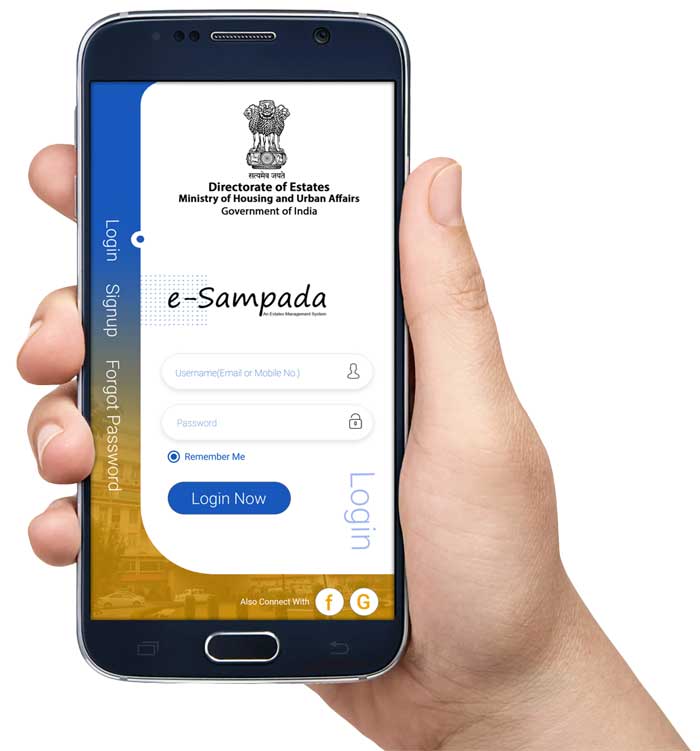
Booking of Central GovtHoliday Homes - Allotment for over One Lakh Government Residential Accommodations Integrated on New Platform - E-Sampada

Booking of Central GovtHoliday Homes - Allotment for over One Lakh Government Residential Accommodations Integrated on New Platform - E-Sampada

Booking of Holiday Homes

Ministry of Housing & Urban Affairs

Booking of Holiday Homes, Social Function Venues Like 5 Ashoka Road, Allotment for over One Lakh Government Residential Accommodations Integrated on New Platform

E-Sampada- New Web Portal & Mobile App Launched on Good Governance Day – To Simplify Processes & Bring Uniformity In Systems Across India

Four Websites & Two Mobile Apps of Directorate of Estates Integrated into one – all services on same Platform throughout Country

E-Governance to Boost Transparency & Accountability in Providing Various Estate Services

25 DEC 2020

Good governance day is celebrated annually on 25 December, the anniversary of the birth of former Prime Minister Atal Bihari Vajpayee.

In line with the objectives of boosting transparency and accountability while ensuring ease of living for the citizens, the Directorate of Estates, Ministry of Housing and Urban Affairs today dedicated to the nation, a new Web Portal and Mobile App, e-Sampada. The new application provides a single window for all these services including allotment for over one lakh government residential accommodations, office space allotment to government organisations in 45 office complexes in 28 cities, booking of 1,176 holiday home rooms and venues like 5, Ashoka Road for social functions etc.

In its endeavour to provide ‘One Nation, One System’, the erstwhile four websites (gpra.nic.in, eawas.nic.in, estates.gov.in, holidayhomes.nic.in), and two Mobile Apps (m-Awas & m-Ashoka5) of the Directorate of Estates have been integrated into one, which paves the way for all services on the same platform throughout the country. The website and mobile app was launched by Shri Hardeep S Puri, Minister of State(I/C) for Housing & Urban Affairs in the presence of Shri Durga Shanker Mishra, Secretary, MoHUA and other senior officials here today.

Addressing the media in a program organised on virtual platform, Shri Hardeep S Puri said that this is a significant step towards promotion of e-governance to boost transparency and accountability in providing various Estate Services like allotment, retention, regularisation, no dues certificate etc.

He further said that E-Sampada is developed to simplify processes and bring uniformity in the system across India. This will promote ease of living for Government of India officers / Departments as all services can be availed online on a single window with a live tracking of applications. Real time information on utilisation of assets and delivery of service will facilitate optimum utilisation of resources. The automated processes will minimize human intervention and will lead to greater transparency.

Shri Durga Shanker Mishra, Secretary said that E-Sampada equips users with very specialised features like personalised dashboard, service usage archive and real time status on licence fees/dues. All payments / dues are to be made cashless through digital modes. It is user friendly and is device responsive. Users will have visual experience of services and will be able to give feedback online.

The portal provides online facility to users across India to lodge complaints, submit documents and appear for virtual hearing. It will reduce administrative cost and will save time and resources by reducing visits to Directorate of Estate. e-Sampada Mobile App and Chatbot facility has been provided for better user experience. Service level benchmarks and activity log for officials are incorporated to ensure accountability.

E-Sampada to benefit all services, across India : Online, Paperless, Cashless

e-sampada Government Residential Accommodation
  • 1,09,474 Government Residential Accommodation at 40 locations
  • 1.25 crore sq.ft Office Space Allotment in 45 office complexes at 28 locations
  • 1,176 Holiday Home Rooms/Suits at 62 locations
  • Booking of Vigyan Bhawan
  • Booking of venues for social functions
  • The new Web Portal and Mobile App have been developed by NIC. The Mobile App will be available for Android as well as iOS platforms. The Web Portal can be accessed at www.esampada.mohua.gov.in and Mobile App can be downloaded from Android Play Store / Apple App Store.

Source: PIB

Expected DA January 2021 - AICPIN for November 2020 increased by 0.4 points

 Expected DA January 2021 - AICPIN for November 2020 increased by 0.4 points

Expected DA January 2021

Consumer Price Index for Industrial Workers (2016=100) – November 2020

The All-India CPI-IW for November, 2020 increased by 0.4 points and stood at 119.9 (one hundred nineteen and point nine). On 1-month percentage change, it increased by (+) 0.33 per cent between October and November, 2020 compared to (+) 0.92 per cent increase between corresponding months of previous year.

The maximum upward pressure in current index came from Food & Beverages group contributing (+) 0.25 percentage points to the total change. At item level, Rice, Arhar Dal, Fish Fresh, Milk, Mustard Oil, Soyabean Oil, Sunflower Oil, Onion, Potato, Chillies Dry, Tea Leaf, Cooked Meal, etc. are responsible for the increase in index. However, this increase was checked by Poultry (Chicken), Tomato, Brinjal, Carrot, Cauliflower, Ginger, Gourd, Green Coriander Leaves, Lady Finger, Peas, Orange, etc., putting downward pressure on the index.

At centre level, Puducherry recorded the maximum increase of 4 points. Among others, 3 points increase was observed in 4 centres, 2 points in 7 centres and 1 point in 30 centres. On the contrary, Guntur, Bhilai, Udham Singh Nagar and Vadodara recorded a maximum decrease of 2 points each. Among others, 1 point fall was observed in 17 centres. Rest of 25 centres’ indices remained stationary.

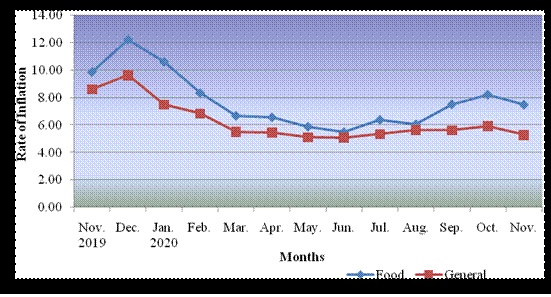
Year-on-year inflation based on all-items stood at 5.27 per cent for November, 2020 as compared to 5.91 per cent for the previous month and 8.61 per cent during the corresponding month of the previous year. Similarly, Food inflation stood at 7.48 per cent against 8.21 per cent of the previous month and 9.87 per cent during the corresponding month a year ago.

Y-o-Y Inflation based on CPI-IW (Food and General)

Inflation chart - AICPIN for November 2020

All-India Group-wise CPI-IW for October and November, 2020

Sr. No.GroupsOct, 2020Nov, 2020
IFood & Beverages123.0123.6
IIPan, Supari, Tobacco & Intoxicants  132.5*133.1
IIIClothing & Footwear117.4117.4
IVHousing  113.5*  113.5*
VFuel & Light126.4126.8
VIMiscellaneous117.0117.2
 General Index119.5119.9
Expected DA January 2021 – AICPIN for November 2020 increased by 0.4 points

*Rounded up from second decimal place.

CPI-IW: Groups Indices

Speaking about the latest index, Shri Santosh Gangwar, Minister of State (I/C) for Labour and Employment said, “The rise in index coupled with fall in annual inflation will have dual impact in terms of increasing income and purchasing power of the workers. He added that the effect is mainly due to vegetables which had good supply in the market and provided respite to the consumers.

Shri DPS Negi, Director General of Labour Bureau while releasing the index said, “The rise in index during November, 2020 and fall in inflation rate are in line with other price indices compiled and released by other Government agencies”.

He further said that Rise in index is mainly on account of increase in prices of Rice, Arhar Dal, Fish Fresh, Milk, Mustard Oil, Soyabean Oil, Sunflower Oil, Onion, Potato, Chillies Dry, Tea Leaf, Cooked Meal, Cooking Gas, Household Goods & Services etc.

The next issue of CPI-IW for the month of December, 2020 will be released on Friday 29th January, 2021. The same will also be available on the office website www.labourbureaunew.gov.in.

The Labour Bureau, an attached office of the M/o Labour & Employment, has been compiling Consumer Price Index for Industrial Workers every month on the basis of retail prices collected from 317 markets spread over 88 industrially important centres in the country. The index is compiled for 88 centres and All-India and is released on the last working day of succeeding month.

Source: PIB

Tuesday, December 15, 2020

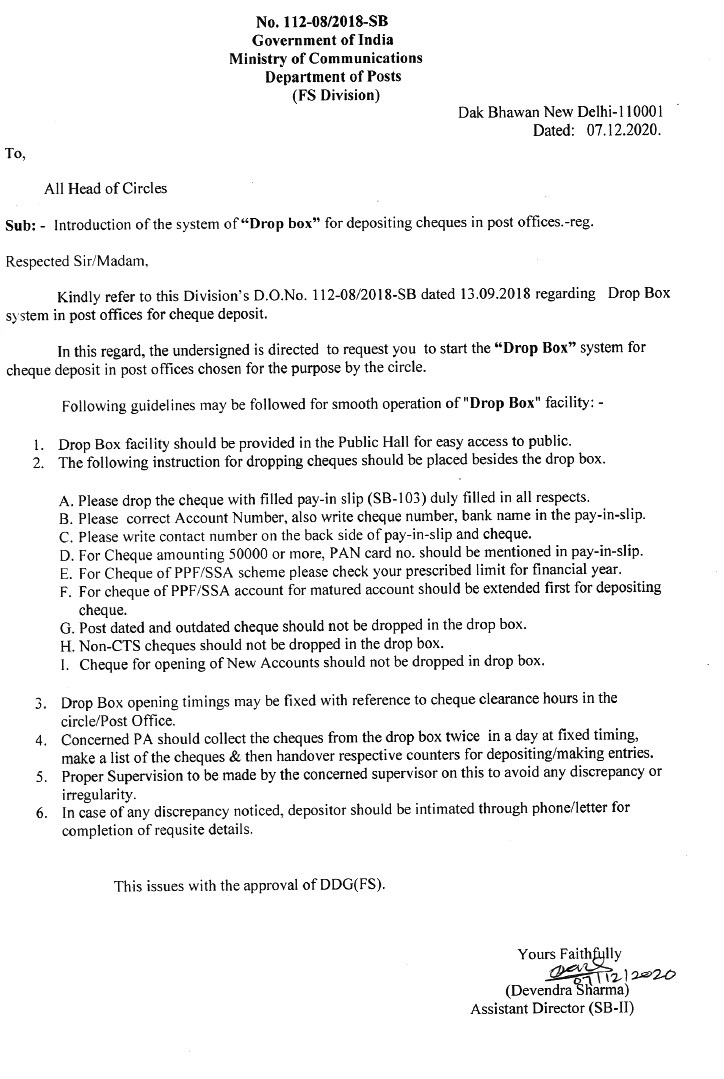
Guidelines of Drop box for depositing cheque in post offices

Guidelines of Drop box for depositing cheque in post offices

No. 112-08/2018-SB
Government of India
Ministry of Communications
Department of Posts
(FS Division)

Dak Bhawan New Delhi-110001
Dated: 07.12.2020

To,
All Head of Circles

Sub: Introduction of the system of “Drop box” for depositing cheques in post offices. -reg.

Respected Sir/Madam.

Kindly refer to this Division’s D.O.No. 112-08/2018-SB dated 13.09.2018 regarding Drop Box system in post offices for cheque deposit.

In this regard, the undersigned is directed to request you to start the “Drop Box” system for cheque deposit in post offices chosen for the purpose by the circle.


Following guidelines may be followed for smooth operation of “Drop Box” facility :

1. Drop Box facility should be provided in the Public Hall for easy access to public.
2. The following instruction for dropping cheques should be placed besides the drop box.

  • A. Please drop the cheque with filled pay-in slip (SB-103) duly filled in all respects.
  • B. Please correct Account Number, also write cheque number, bank name in the pay-in-slip.
  • C. Please write contact number on the back side of pay-in-slip and cheque.
  • D. For Cheque amounting 50000 or more, PAN card no. should be mentioned in pay-in-slip.
  • E. For Cheque of PPF/SSA scheme please check your prescribed limit for financial year.
  • F. For cheque of PPF/SSA account for matured account should be extended first for depositing cheque.
  • G. Post dated and outdated cheque should not be dropped in the drop box.
  • H. Non-CTS cheques should not be dropped in the drop box.
  • I. Cheque for opening of New Accounts should not be dropped in drop box.

3. Drop Box opening timings may be fixed with reference to cheque clearance hours in the circle/Post Office.

4. Concerned PA should collect the cheques from the drop box twice in a day at fixed timing, make a list of the cheques & then handover respective counters for depositing/making entries.

5. Proper Supervision to be made by the concerned supervisor on this to avoid any discrepancy or irregularity.

6. In case of any discrepancy noticed, depositor should be intimated through phone/ letter for completion of requsite details.

This issues with the approval of DDG(FS).

Yours Faithfully

(Devendra sharma)
Assistant Director (SB-II)

Drop box for depositing cheque in post offices

Pension Adalat 2020 - CPAO organised facilities for all central civil pensioners to interact in video conferencing

Pension Adalat 2020 - CPAO organised facilities for all central civil pensioners to interact in video conferencing

Pension Adalat 2020

Central Pension Accounting office (CPAO)
Ministry of Finance, Department of Expenditure
Trikoot-II, Bhikaji Cama place-110066

All Central Civil Pensioners are informed that the Central pension Accounting office is going to organize a Pension Adalat, which will be held on 28th Dec, 2020 through video conferencing facility.


Therefore, all Central Civil Pensioners/ Family Pensioners (except Railway, Defence, Post and Telegraph) may visit to register their grievance on CPAO website https://cpao.nic.in or send their grievance filled in the prescribed format through e-mail to Sr. Accounts Officers, Grievance Cell at cccpao@nic.in or via post to this office by 18th Dec, 2020. The prescribed format is available at CPAO website. To participate in Pension Adalat, a link will be sent one day before the Pension Adalat on your registered mobile number or e-mail. The resolution of grievance registered through this link will be done through video conferencing facility in the Pension Adalat to be organized on 28th Dec, 2020. Kindly mention your PPO Number, Account Number, Contact Address and telephone Number along with your grievance. If the grievance is being sent by post, the “Pension Adalat-2020” may be superscribed on top of envelope.

CPAO – Holding of Pension Adalats in the month of December, 2020

Dated:
New Delhi

Chief Controller (Pensions)

Source: CPAO

Retired employees of Navodaya Vidyalaya Samiti NVS for coverage under Old Pension Scheme OPS - Pensionary Benefit under CCS Pension Rules 1972

Retired employees of Navodaya Vidyalaya Samiti NVS for coverage under Old Pension Scheme OPS - Pensionary Benefit under CCS Pension Rules 1972

Retired employees of Navodaya Vidyalaya Samiti

Navodaya Vidyalaya Samiti
Ministry of Education, Govt. of India
(Deptt. of School Education & Literacy)
B-15, Institutional Area Sector 62, NOIDA, Gautam Budh Nagar (U.P.)- 201309


F.No.24-01/2013(GA)/212

Dated: 09.12.2020

NOTIFICATION

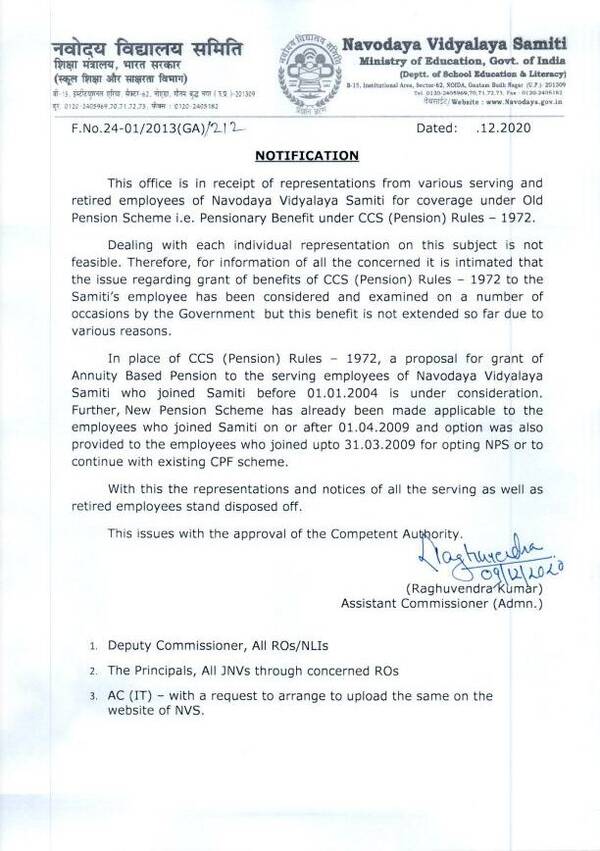
This office is in receipt of representations from various serving and retired employees of Navodaya Vidyalaya Samiti for coverage under Old Pension Scheme i.e. Pensionary Benefit under CCS (Pension) Rules -1972.

Dealing with each individual representation on this subject is not feasible. Therefore, for information of all the concerned it is intimated that the issue regarding grant of benefits of CCS (Pension) Rules – 1972 to the Samiti’s employee has been considered and examined on a number of occasions by the Government but this benefit is not extended so far due to various reasons.


In place of CCS (Pension) Rules – 1972, a proposal for grant of Annuity Based Pension to the serving employees of Navodaya Vidyalaya Samiti who joined Samiti before 01.01.2004 is under consideration. Further, New Pension Scheme has already been made applicable to the employees who joined Samiti on or after 01.04.2009 and option was also provided to the employees who joined upto 31.03.2009 for opting NPS or to continue with existing CPF scheme.

With this the representations and notices of all the serving as well as retired employees stand disposed off.

This issues with the approval of the Competent Authority.

(Raghuvendra Kumar)
Assistant Commissioner (Admn.)

1. Deputy Commissioner, All ROs/NLIs
2. The Principals, All JNVs through concerned ROs
3. AC (IT) – with a request to arrange to upload the same on the website of NVS.

Retired employees of Navodaya Vidyalaya Samiti

Source: NVS

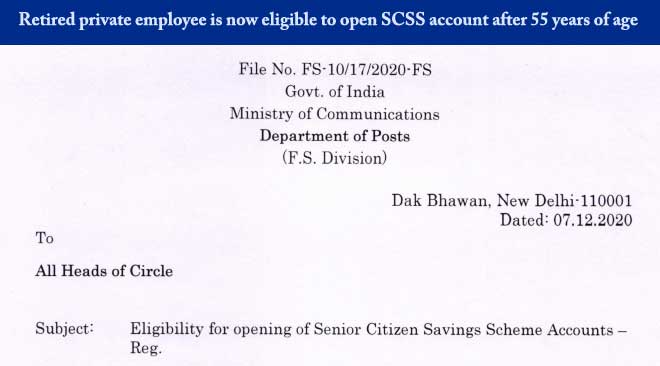
DoP - Retired private employee is now eligible to open SCSS account after 55 years of age

Retired private employee is now eligible to open SCSS account after 55 years of age

Retired private employee is now eligible to open SCSS account after 55 years of age - DoP orders
SCSS account

File No. FS-10/17/ 2020-FS
Govt. of India
Ministry of Communications
Department of Posts
(F.S. Division)

Dak Bhawan, New Delhi- 110001
Dated: 07.12.2020

To
All Heads of Circle

Subject: Eligibility for opening of Senior Citizen Savings Scheme Accounts – Reg.

Sir / Madam,

A POSB customer, formerly employed with M/s. Abbott Healthcare, Tanjore has sought for clarification through email whether he being a retired from a private company and 58 years of age is eligible to open SCSS account.

Detailed procedure related to opening of SCSS accounts have been laid down in Senior Citizen Savings Scheme notified vide G.S.R. 916(E) dated 12.12.2019. More specifically, Rule 3 (ii) of Senior Citizen Savings Scheme 2019 specifies, “an individual who has attained the age of fifty-five years or more but less than sixty years, and who has retired on superannuation or otherwise on the date of opening of an account under this Scheme is eligible to open the account, subject to the condition that the account is opened by such individual within one month of the date of receipt of the retirement benefits and proof of date of disbursal of such retirement benefit(s) along with a certificate from the employer indicating the details of retirement on superannuation or otherwise, retirement benefits, employment held and period of such employment with the employer, is attached with the application form”.

Central Government pensioners need not visit office of Pension department or pension disbursing agency for submission of Life Certificate

The rule doesn’t specify category of employer. Any customer fulfilling the conditions laid out in the Scheme is allowed to open SCSS account in the post office of his choice. This may be circulated to all the post offices.

This issues with the approval of DDG (FS).

(T C VIJAYAN)
Asst. Director (SB-I)

Source: DoP

Wednesday, December 2, 2020

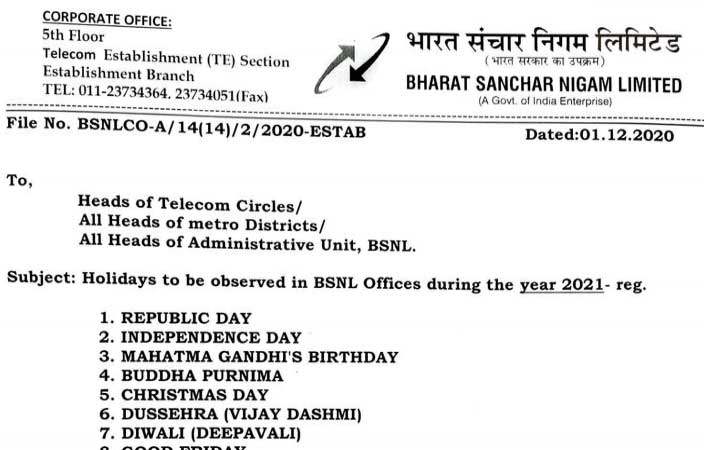
Holidays to be observed in BSNL Offices during the year 2021 - BSNL Holidays 2021

Holidays to be observed in BSNL Offices during the year 2021 - BSNL Holidays 2021

BSNL Holidays 2021

BHARAT SANCHAR NIGAM LIMITED
(A Govt. of India Enterprise)

File No. BSNLCO-A/ 14(14)/2/2020-ESTAB

Dated: 01.12.2020

To,
Heads of Telecom Circles/
All Heads of metro Districts/
All Heads of Administrative Unit, BSNL.

Subject: Holidays to be observed in BSNL Offices during the year 2021- reg.

In accordance with Ministry of Personnel, Public Grievances & Pensions (Deptt. of Personnel & Training O.M. No. 12/9/2020-JCA-2 dated 10th June 2020, it has been decided by the Competent Authority that the holidays as specified in the Annexure I to this O.M. will be observed in all the BSNL Offices located at Delhi / New Delhi during the year 2021. In addition, each employee will also be allowed to avail himself/ herself of any two holidays to be chosen by him/her out of the list of Restricted Holidays in Annexure II.

BSNL Administrative Offices located outside Delhi / New Delhi shall observe the following holidays compulsorily in addition to three holidays as per para 3.1 below:

  1. REPUBLIC DAY
  2. INDEPENDENCE DAY
  3. MAHATMA GANDHI’S BIRTHDAY
  4. BUDDHA PURNIMA
  5. CHRISTMAS DAY
  6. DUSSEHRA (VIJAY DASHMI)
  7. DIWALI (DEEPAVALI)
  8. GOOD FRIDAY
  9. GURU NANAK’S BIRTHDAY
  10. IDUL FITR
  11. IDU’L ZUHA
  12. MAHAVIR JAYANTI
  13. MUHARRAM
  14. PROPHET MOHAMMAD’S BIRTHDAY (ID-E-MILAD)

3.1 In addition to the above 14 Comnpulsory holidays mentioned in para 2, three holidays shall be decided from the list indicated below by the Circle Heads of Territorial Circles in consultation with the Circle Staff Welfare Board and the representative Union and keeping in view the recommendation of the Central Government Employees Coordination Committee in the State Capitals. The final list applicable uniformly to all BSNL offices within the territorial jurisdiction of the concerned State shall be notified accordingly and a copy endorsed to the Corporate Office within a period of 4 weeks of issue of this letter and no change can be carried out thereafter. It is also clarified that no change is permissible in regard to festivals and dates as indicated.

  1. AN ADDITIONAL DAY FOR DUSSEHRA
  2. HOLI
  3. JANAMASHTAMI (VAISHNAVI)
  4. RAM NAVAMII
  5. MAHA SHIVRATRI
  6. GANESH CHATURTHI / VINAYAK CHATURTHI
  7. MAKAR SANKARANTI
  8. RATH YATRA
  9. ONAM
  10. PONGAL
  11. SRI PANCHAMI / BASANT PANCHAMI
  12. VISHU / VAISAKHI / VAISAKHADI / BHAG BIHU / MASHADI UGADI/ CHAITRA SUKLADI / CHETI CHAND / GUDI PADAVA /1ST NAVRATRA/ NAORAZ/ CHHATH POOJA / KARVA CHAUTH.

3.2 No substitute holiday should be allowed if any of the festival holidays, initially declared, subsequently happens to fall on a weekly off or any other non-working day or in the event of more than one festival falling on the same day.

4. The list of Restricted Holidays appended to this O.M. is meant for BSNL Offices located in Delhi/ New Delhi. The Heads of Territorial Circle in consultation with the Circle Staff Welfare Board and the representative Union and keeping in view the recommendations of the Central Government Employees Co-ordination Committee in the State Capitals may draw up separate list of Restricted Holidays keeping in view the occasions of local importance but the 9 occasions left over, after choosing the 3 variable holidays in para 3.1 above, are to be included in the list of restricted holidays.


5.1 For offices in Delhi New Delhi, any change in the date of holidays in respect of Idu’l Fitr, Idu’l Zuha, Muharram and Id-e-Milad, if necessary, depending upon sighting of the Moon, would be declared by the Ministry of Personnel, Public Grievances and Pensions after aScertaining the position trom the Govt. of NCT of Delhi (DCP, Special Branch, Delhi Police).

5.2 For offices outside Delhi / New Delhi, the Heads of Territorial Circles are authorized to change the date of holiday, if necessary, based on the decision of the concerned State Governments / Union Territories, in Muharram respect of ldu’l Fitr, Idu’l Zuha, and Id-e-Milad.

5.3 It may happen that the change of date of the above occasions has to be declared at a very short notice. In such a situation, announcement could be made through P.I.B/ T.V. /A.l.R. / Newspapers and the Heads of Territorial Circles may take action according to such an announcement without waiting for a formal order, about the change of date.

6. During 2021, Diwali (Deepavali) falls on Thursday, November 4, 2021 (kartika 13). In certain States, the practice is to celebrate the occasion a day in advance, i.e., on “Naraka Chaturdasi Day”. In view of this, there is no objection if holiday on account of Deepavali is observed on- “Naraka Chaturdasi Day (in place of Deepavali Day) compulsory for the holiday BSNL Offices for Diwali in a State if in that State that day alone is declared as a for the offices of the State Government.

7. BSNL Offices which include industrial, commercial and would observe upto 16 trading establishments holidays in a Republic Day, year including three national holidays viz. Independence Day and Mahatma Gandhi’s birthday, as holidays. The compulsory of Circle remaining holidays / occasions may be determined by respective Heads themselves for the year 2021, subject to para 3.2 above.

Keshav Kumar)
Assistant General Manager (Estt.II)
Enc: Lists of Holidays.

BSNL Holidays 2021

Source: aibsnloa.org


Railway Employees under the Medical Insurance Scheme for obtaining treatment in private hospitals – IRMS

Railway Employees under the Medical Insurance Scheme for obtaining treatment in private hospitals - IRMS

Medical Insurance Scheme for Railway Employees

INDIAN RAILWAYS TECHNICAL SUPERVISORS ASSOCIATION
(Estd. 1965, Regd. No.1329, Website http://irtsa.net)

M. Shanmugam,
Central President, IRTSA
# 4, Sixth Street, TVS Nagar, Padi,
Chennai – 600050.
Email- cpirtsa@yahoo.com
Mob:09443140817

Harchandan Singh,
General Secretary, IRTSA,
C.Hq. 32, Phase 6, Mohali,
Chandigarh-160055.
Email gsirtsa@ yahoo.com
(Ph: 0172-2228306, 9316131598)

No: IRTSA/CHQ/Memo .2020-13

Date: 27.11.2020

DIRECTOR GENERAL (HR)
Railway Board
New Delhi

Sub: PROPOSAL OF MEDICAL INSURANCE SCHEME FOR RAILWAY EMPLOYEES.

Ref: 1) Railway Board letter No.E(W)2020/Misc/ Dashboard- GIS, dated 27.10.2020
2) Railway Board order No.ERB-1I/2020/23/30, dated 20.10.2020.

1) Ministry of Railways constituted a committee to examine and tender their recommendations to bring all Railway Employees under the Medical Insurance Scheme for obtaining treatment in private hospitals. IRTSA submits the following for the kind consideration of Railway Board.


2) Indian Railways Medical Service (IRMS) is spread across the length and breadth of the country. IRMS is having 125 hospitals and 586 dispensaries, manned by 33,300 medical staff catering to approximately 66 lakh beneficiaries including 12.27 lakh serving employees. In the year 2018-19 Railway Hospitals treated 2.01 crore OPD patients, 5.08 lakh in-patients and performed 1.02 lakh major and specialty surgeries.

7th CPC Transport Allowance and DA granted for Indian Railway Medical Service (IRMS) officers drawing Grade Pay of Rs.10,000/- under DACP Scheme

3) Railway Hospitals performed pre-placement medical examination for 38,000 candidates and carried out periodical medical examination for 1.14 lakh employees. They also examined 12.51 lakh food and water samples.

4) Indian Railways total medical services expenses for the year 2018-19 including cost of medical staff is Rs. 6888.34 crore. That makes average medical expense per beneficiary as Rs.10,500.

5) No medical insurance company in India handles 66 lakh beneficiaries. Medical Insurance doesn’t cover OPD. Since Railway is catering 2.01 crore OPD patients in a year, it may not be possible to include huge OPD beneficiaries in private managed medical insurance.

6) In existing Railway medical system all medical services like OPD, diagnosing, medicines, Surgeries, in-patient care, major treatment/surgeries carried out in referral private/ CGHS hospitals and follow-up checking are part of employees’ welfare scheme offered to employees and their dependents. It is a part of service condition. For retired employees and their dependents who opted for RELHS on onetime payment, same medical services are extended.

7) In the Railway Medical system, no cost ceiling is fixed for entitlement of any required treatment. On the other hand, medical insurance cover is basically extended to in-patient treatments and for surgeries with a ceiling based on the premium paid.

8) For example, United India Insurance Company Limited offers Rs.10 lakh sum insured at premium rate per member Rs.12,386 in age group 41-45. If all 66 lakh Railway beneficiaries are covered under above premium Rs.8370.78 crore will be paid as total premium. Whereas total medical expense of Indian Railways for the year 2018-19 is Rs. 6888.34 crore which is for diverse services given in the Annexure.

9) In the same time there is a need for addition of more private empanelled hospitals in Indian Railways Medical Services with seamless cashless treatment, since large number of serving and retired health care beneficiaries live in the newly developed suburbs of various cities throughout India. It is pertinent to note that in case of emergency, beneficiaries first require to approach Railway Hospital, then they are referred to private hospitals and in many cases precious golden hours are lost in mere formalities endangering the life.

10) Beneficiaries living in faraway places from Railway Hospitals also find it difficult to get their regular treatments and minor treatments occasionally, since they are required to travel long distance to reach Railway Hospitals. These beneficiaries will be benefited if cashless treatment is extended to them in the hospitals available near their living place.

11) Hence it is requested that,

a. Existing Indian Railways Medical Service facilities may please be continued.

b. The proposal for Medical Insurance Scheme for Railway employees / Pensioners and their depended may please be made as additionally facility to the beneficiaries to get their regular treatments including OPD & IPD in empaneled private hospitals, premium thereof may please be borne by Railways.

Thanking You

Yours faithfully,
(Harchandan Singh),
General Secretary, IRTSA

Annexure

List of diverse services performed by Indian Railways Medical Service (IRMS)

1) Attending Railway accidents and similar incidents;
2) Emergency medical treatment for sick passengers;
3) Pre-employment medical examination for prospective employees;
4) Periodical medical examination for employees;
5) Medical boards and other medical certification for employees;
6) Safe water supply at Railway stations;
7) Safe food supply at Railway stations;
8) Running medical first-aid posts for IR factories under the Factories Act;
9) Certification of dead bodies;
10) Certification of perishable goods;
11) Curative healthcare; and
12) Preventive healthcare.

Expected DA - AICPIN for the month of October 2020 increased by 1.4 points

Expected DA - AICPIN for the month of October 2020 increased by 1.4 points

AICPIN for the month of Oct 2020

Expected DA 2020
Expected DA 2020

GOVERNMENT OF INDIA
MINISTRY OF LABOUR & EMPLOYMENT
LABOUR BUREAU

F.No. 5/1/2020-CP/I

CLEREMONT SHIMLA- 17 1004
DATED: 27th November, 2020

Press Release

Consumer Price Index for Industrial Workers (2016=100) – October 2020

AICPIN for the month of Oct 2020

The Labour Bureau, an attached office of the M/o Labour & Employment, has been compiling Consumer Price Index for Industrial Workers every month on the basis of retail prices collected from 317 markets spread over 88 industrially important centres in the country. The index is compiled for 88 centres and All-India and is released on the last working day of succeeding month. The index for the month of October, 2020 is being released in this press release.

The All-India Consumer Price Index for Industrial Workers (CPI-IW) for October, 2020 increased by 1.4 points and stood at 119.5 (one hundred nineteen and point five). On 1-month percentage change, it increased by (+) 1.19 per cent between September and October, 2020 compared to (+) 0.93 per cent increase between corresponding months of previous year.

The maximum upward pressure in current index came from Food & Beverages group contributing (+) 1.29 percentage points to the total change. At item level, Arhar Dal, Poultry (Chicken), Eggs (Hen), Goat Meat, Mustard Oil, Sunflower Oil, Brinjal, Cabbage, Carrot, Cauliflower, Chillies Green, Gourd, Lady Finger, Onion, Peas, Potato, Electricity Domestic, Doctor’s Fee, Bus Fare, etc. are responsible for the increase in index. However, this increase was checked by Wheat, Fish Fresh, Tomato, Apple, etc., putting downward pressure on the index.

At centre level, Doom-Dooma Tinsukia, Patna and Ramgarh recorded the maximum increase of 4 points each. Among others, 3 points increase was observed in 9 centres, 2 points in 24 centres and 1 point in 33 centres. Rest of 19 centres’ indices remained stationary.

Year-on-year inflation based on all-items stood at 5.91 per cent for October, 2020 as compared to 5.62 per cent for the previous month and 7.62 per cent during the corresponding month of the previous year. Similarly, Food inflation stood at 8.21 per cent against 7.51 per cent of the previous month and 8.60 per cent during the corresponding month a year ago.

All-India Group-wise CPI-IW for July and August, 2020

Sr. No.GroupsAugust, 2019Jul, 2020August, 2020
IFood Group330119.7123.0
IIPan, Supari, Tobacco & Intoxicants391131.6132.5*
IIIFuel & Light282117 .6117 .4
IVHousing434113.5113.5*
vClothing, Bedding & Footwear226125.6126.4
VIMiscellaneous Group254116.8117 .0

General Index320118.1119.5

The next issue of CPI-IW for the month of November, 2020 will be released on Thursday 31st December, 2020. The same will also be available on the office website labourbureaunew.gov.in.

Key Points:-

  1. All-India CPI for Industrial Workers (2016=100) for October, 2020 increased to 119.5 points compared to 118.1 points for September, 2020.
  2. In percentage terms, it rose by 1.19% w.r.t. previous month mainly due to Food group items having a share of 39.17% in the total weight which recorded a rise of 76% between these two months. During the period, increase in prices of food items viz. Arhar Dal, Poultry Chicken, Goat Meat, Egg, Mustard Oil, Onion, Potato, Brinjal, Peas, Doctor’s Fee, Bus Fare, etc., had greater impact.
  3. Year-on-year inflation based on all-items stood at 5.91 per cent for October, 2020 compared to 5.62 per cent for September, 2020 and 7.62 per cent during the corresponding month of the previous year. Similarly, Food inflation stood at 8.21 per cent against 7.51 per cent of the previous month and 8.60 per cent during the corresponding month a year ago.

Now Trending

34% DA Order for Central Govt Employees wef 01.01.2022 - Latest CG Employees DA Order Jan 2022

 DA Order for Central Government Employees from Jan 2022 - Finmin Order 2022 Latest CG Employees DA Order Jan 2022 Dearness Allowance payabl...

Disclaimer:

All efforts have been made to ensure accuracy of the content on this blog, the same should not be construed as a statement of law or used for any legal purposes. Our blog "Central Government Staff news" accepts no responsibility in relation to the accuracy, completeness, usefulness or otherwise, of the contents. Users are advised to verify/check any information with the relevant department(s) and/or other source(s), and to obtain any appropriate professional advice before acting on the information provided in the blog.

Links to other websites that have been included on this blog are provided for public convenience only.

The blog "Central Government Staff news" is not responsible for the contents or reliability of linked websites and does not necessarily endorse the view expressed within them. We cannot guarantee the availability of such linked pages at all times.

Any suggestions write to us
centralgovernmentnews@gmail.com