Showing posts with label CPI-IW. Show all posts

Thursday, August 31, 2017

Expected DA from January 2018 - AICPIN for the month of July 2017, 5 Points Increased (285)

AICPIN for the month of July 2017 - 5 Points Increased (285)

Consumer Price Index for Industrial Workers (CPI-IW) - July 2017

The All India CPI-IW for July, 2017 increased by 5 points and pegged at 285.

The Index increased by 1.79% between June, 2017 and July, 2017 when compared with the increase of 1.08% for the corresponding months of last year.

No. 5/1/2017-CPI
GOVERNMENT OF INDIA
MINISTRY OF LABOUR & EMPLOYMENT
LABOUR BUREAU
CLEREMONT, SHIMLA-171004
DATED: 31st August, 2017
Press Release

Consumer Price Index for Industrial Workers (CPI-IW) - July 2017

The All-India CPI-IW for July, 2017 increased by 5 points and pegged at 285 (two hundred and eighty five). In terms of monthly change, it increased by (+) 1.79 per cent between June, 2017 and July, 2017 when compared with the increase of (+) 1.08 per cent for the corresponding months of last year.

 The maximum upward pressure to the change in current index came from Food group contributing (+) 3.12 percentage points to the total change. The House Rent index further accentuated the overall index by (+) 0.70 percentage points. At item level, Rice, Pure Ghee, Chillies (Green), Onion, Bitter Gourd, Brinjal, Gourd, Lady’s Finger, Palak, Parwal, Potato, Pumpkin, Tomato, Torai, Banana, Cucumber, Mango, Tea (Readymade), Bidi, Cooking Gas, Kerosene Oil, etc. are responsible for the increase in index. However, this increase was checked by Wheat, Arhar Dal, Masur Dal, Urd Dal, Coconut Oil, Mustard Oil, Poultry (Chicken), Coconut, Lemon, Petrol, etc., putting downward pressure on the index.

The year-on-year inflation measured by monthly CPI-IW stood at 1.79 per cent for July, 2017 as compared to 1.08 per cent for the previous month and 6.46 per cent during the corresponding month of the previous year. Similarly, the Food inflation stood at (-) 0.32 per cent against (-) 1.28 per cent of the previous month and 9.34 per cent during the corresponding month of the previous year.

At centre level, Jamshedpur reported the maximum increase of 12 points followed by Delhi and Ranchi-Hatia (11 points each), Raniganj and Jaipur (10 points each) and Varanasi and Amritsar (9 points each). Among others, 8 points increase was observed in 2 centres, 7 points in 7 centres, 6 points in 7 centres, 5 points in 11 centres, 4 points in 10 centres, 3 points in 13 centres, 2 points in 9 centres and 1 point in 5 centres. On the contrary, Goa recorded a decrease of 1 point. Rest of the 6 centres indices remained stationary.

The indices of 34 centres are above All-India Index and 42 centres indices are below national average. The indices of Amritsar and Lucknow centres remained at par with All-India Index.

The next issue of CPI-IW for the month of August, 2017 will be released on Friday, 29th September, 2017. The same will also be available on the office website www.labourbureaunew.gov.in.

(SHYAM SINGH NEGI)
DEPUTY DIRECTOR GENERAL


AICPIN-EXPECTED-DA-FROM-January-2018

Wednesday, February 1, 2017

AICPIN for the month of December 2016

AICPIN for the month of December 2016

No. 5/1/2014- CPI
GOVERNMENT OF INDIA
MINISTRY OF LABOUR & EMPLOYMENT
LABOUR BUREAU


CLEREMONT, SHIMLA-171004
DATED: 31st January, 2017
 Press Release

Consumer Price Index for Industrial Workers (CPI-IW)-December, 2016

The All-India CPI-IW for December, 2016 by 2 points and stood 275 (two hundred and seventy five). On 1-month percentage change, it decreased by (-) 0.72 per cent November and December, 2016 when compared with the decease of (-) 0.37 per cent between the same two months a year ago.

The maximum downward pressure to the change in current index came from Food group conuibuting (-) 2.74 percentage points to the total change. At item level, Arhar Dal, Gram Dal, Masur Dal, Urd Dal, Groundnut Oil, Muslard Oil, Chillies Green, Ginzer, Brinjal, Cabbage, Carrot, Cauliflower, French Beans, Gourd, Green Coriander Leaves, Methi, Palak, Peas, Potato, Radish, Tomato, Banana, Lemon, etc. are responsible for the decrease in index. However, this decrease checked by Rice, Wheal, Wheat Alta, Coconut OiL Fish Fresh, Goat Meat, Milk Snack Saltish, Cooking Gas, ESI Premium Contribution, Petrol, Flowe/Flower Garlands, Toilet Soap, etc., putting upward on the index.

The year-on-year inflation measured by monthly CPI-IW stood at 2.23 per cent for December, 2016 as compared to 2.59 per cent for the pervious month and 6.32 per cent during the corresponding month of the previous year. Similarly, the Food inflation stood at 0.67 per cent against 1.66 per cent of the previous month and 7.94 per cent during the corresponding month or the previous year.

At centre level, Rourkela reported the maximum decrease or 10 points followed by Vadodara (9 points), Nagpur and Lucknow (8 points each) and Amritsar, Varanasi and Monger Jamalpur (6 points each). Among others, 5 points decrease was observed in 7 centres, 4 points in 12 centres, 3 points in 9 centres, 2 points in 15 centres and 1 point in 10 centres. On the contrary, Quilon recorded maximum increase of 6 points followed by Ernakulam and Mundakkayam (3 points each). Among others, 2 points increase was observed in 4 centres and 1 point in 4 centres. Rest or the 7 centres indices remained stationary.

The indices or centres are above All-India Index and other 43 centres indices are below national average. The index or Vishakhapathnam centre remained at par with All-India Index. The next or CPI-IW fer the month of January, 2017 will be released on Tuesday, 28th February, 2017. The same will also be available on the office website www.labourbureaunew.gov.in

sd/-
(SHYAM SINGH NEGI)
DEPUTY DIRECTOR GENERAL
Authority: www.labourbureaunew.gov.in

Monday, January 4, 2016

Expected DA from January 2016 – 2 Point increase in December 2015 may change 7th Pay Commission fitment formula

Expected DA from January 2016 and its impact on 7th Pay Commission Pay fixation formula and Multiplication Factor – If CPI-IW for December reaches 272 then 7th Pay Commission multiplication factor will have to be revised to 2.58

Expected DA from January 2016 – 2 Point increase in December 2015 may change 7th Pay Commission fitment formula

Expected DA from January 2016 – Two Point increase in CPI for Dec 2015 could take it to 126% which is 1% more than what was reckoned for 7th Pay Commission revised Pay fixation.

If DA from January 2016 touches 126%, 7th Pay Commission fitment formula and Multiplication factor of 2.57 may require upward revision

Consumer Price Index (Industrial Workers) for the month of November 2015 has been released recently by Govt. We have one point increase in CPI for November 2015 which has moved from 269 to 270.

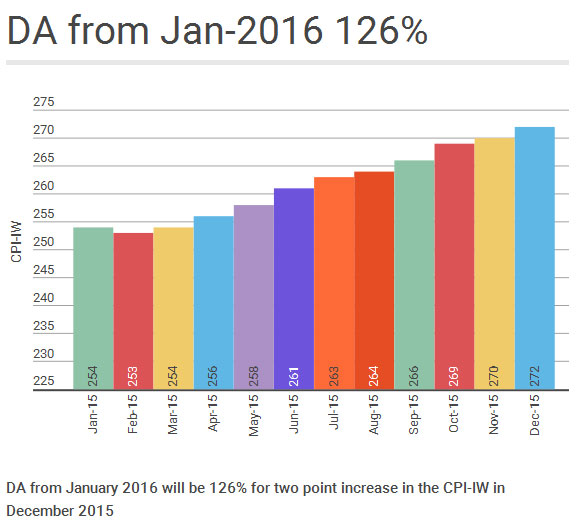
Consumer Price Index from January 2015 to November 2015

Month Actual AICPI-IW
Jan-2015 254
Feb-2015 253
Mar-2015 254
Apr-2015 256
May-2015 258
Jun-2015 261
July-2015 263
Aug-2015 264
Sep-2015 266
Oct-2015 269
Nov-2015 270
Dec-2015 Not released

DA from January 2016 – Estimation for 125%:

estimated-DA-expectedDA-dearness-allowance


DA from Jan 2016= [(254+253+254+256+258+261+263+264+266+269+270+258)-115.76]*100/115.76
= 125 % (6% increase in DA from Jan 2016)

Based on actual CPI-IW for 11 months from January 2015 to November 2015 which span from 254 to 270 and estimated index for the month of December 2015, it is almost certain that Dearness Allowance from January 2016 payable to Central Government Employees including Railway Employees and Defence Personnel will not be less than 125% (6% increase).

Even a 12 point fall in CPI-IW from 270 to 258 in December 2015 will not affect the DA from January 2016 clocking 125%.

DA from January 2016 – Estimation for 126%:


Our Proposition discussed in the earlier article on the chances for DA from January 2015 reaching 126% (7% increase) still holds good as two point increase in the CPI-IW in December 2015 would take DA from January 2016 to 126%.


DA from January 2016 126%

DA from Jan 2016= [(254+253+254+256+258+261+263+264+266+269+270+272)-115.76]*100/115.76
= 126 % (7% increase in DA from Jan 2016)

DA from January 2016 – Estimation for 127%:


At the same time possibility of DA from January 2016 reaching 127% or more is remote as CPI-IW has to reach 286 in December 2015 from the present level of 270 for getting DA of 127%.

DA from Jan 2016= [(254+253+254+256+258+261+263+264+266+269+270+286)-115.76]*100/115.76
= 127% (8% increase in DA from Jan 2016)


So, DA from January 2016 will be either 125% (6% increase) or 126% (7% increase). One might think that 1% additional DA from January 2016 is negligible. However, it will be 1% more than what was reckoned for 7th Pay Commission revised Pay fixation.

7th Pay Commission has estimated DA from January 2016 as 125% for the purpose of Revision of Pay and Allowances

Now, if Consumer Price Index (Industrial workers) for the month of December 2015 reaches 172 from the present level of 170, it is certain that DA from January 2016 will be 126%. In that case, 7th Pay Commission pay fitment formula and allowances which are DA indexed will have to be revised accordingly.

For instance, 7th Pay Commission’s uniform multiplication factor of 2.57 includes a factor of 2.25 on account of DA neutralisation, assuming that the rate of Dearness Allowance would be 125 percent at the time of implementation of the new pay. If DA from January 2016 reaches 126% then this multiplication factor will have to revised as 2.58.

Source: gconnect

Friday, October 30, 2015

Expected DA January 2016 – AICPIN for September 2015

Expected DA January 2016 – AICPIN for September 2015

Expected DA January 2016 – AICPIN for September 2015

No.5/1/2015-CPI
GOVERNMENT OF INDIA
MINISTRY OF LABOUR & EMPLOYMENT
LABOUR BUREAU
CLEREMONT, SHIMLA-171004
DATED : 30th October, 2015
Press Release

Consumer Price Index for Industrial Workers (CPI-IW) – September, 2015

The All-India CPI-IW for September, 2015 increased by 2 points and pegged at 266 (two hundred and sixty six). On 1-month percentage change, it increased by (+) 0.76 per cent between August and September, 2015 which was static between the same two months a year ago.

The maximum upward pressure to the change in current index came from Food group contributing (+) 1.78 percentage points to the total change. At item level, Arhar Dal, Masur Dal, Moong Dal, Urd Dal, Mustard Oil, Onion, Cauliflower, Green Coriander Leaves, Potato, Tea (Readymade), Sugar, Electricity Charges, Private Tuition Fee, Flower/Flower Garlands, etc. are responsible for the increase in index. However, this increase was restricted by Wheat, Fish Fresh, Poultry (Chicken), Eggs (Hen), Apple, Coconut, Tomato, Petrol, Washing Soap, etc., putting downward pressure on the index.

The year-on-year inflation measured by monthly CPI-IW stood at 5.14 per cent for September, 2015 as compared to 4.35 per cent for the previous month and 6.30 per cent during the corresponding month of the previous year. Similarly, the Food inflation stood at 5.71 per cent against 3.55 per cent of the previous month and 6.46 per cent during the corresponding month of the previous year.

At centre level, Chhindwara reported the highest increase of 10 points followed by Varanasi (9 points), Pune, Tripura, Jalpaiguri and Bhilwara (6 points each). Among others, 5 points rise was observed in 5 centres, 4 points in 7 centres, 3 points in 8 centres, 2 points in 16 centres and 1.point in 19 centres. On the contrary, Goa recorded a maximum decrease of 4 points followed by Ernakulam 3 points. Among others, 2 points decrease was observed in 4 centres and 1 point in 2 centres. Rest of the 9 centres’ indices remained stationary.

The indices of 36 centres are above All India Index and other 42 centres’ indices are below national average.

The next issue of CPI-IW for the month of October, 2015 will be released on Monday, 30th November, 2015. The same will also be available on the office website www. labourbureau.gov. in.

(S.S.NEGI)
DEPUTY DIRECTOR GENERAL
Authority: http://labourbureau.nic.in/

Sunday, May 31, 2015

Expected DA July 2015: AICPIN for the month of April 2015

Expected DA July 2015: AICPIN for the month of April 2015
No. 5/1/2015- CPI
GOVERNMENT OF INDIA
MINISTRY OF LABOUR & EMPLOYMENT
LABOUR BUREAU
`CLEREMONT’, SHIMLA-171004
DATED : 29th May, 2015
Press Release

Consumer Price Index for Industrial Workers (CPI-IW) – April, 2015

The All-India CPI-IW for April, 2015 increased by 2 points and pegged at 256 (two hundred and fifty six). On 1-month percentage change, it increased by (+) 0.79 per cent between March, 2015 and April, 2015 when compared with the increase of (+) 1.26 per cent between the same two months a year ago.

The maximum upward pressure to the change in current index came from Food group contributing (+) 1.24 percentage points to the total change. At item level, Rice, Arhar Dal, Gram Dal, Urd Dal, Fish Fresh, Goat Meat, Poultry (Chicken), Milk (Buffalo & Cow), Vegetable & Fruit items, Tea (Readymade), Snack (Sweet & Saltish), Country Liquor, Electricity Charges, Doctor’s Fee, Private Tuition Fee, Tailoring Charges, etc. are responsible for the increase in index. However, this increase was restricted by Eggs (Hen), Onion, Chillies Green, Sugar, Petrol, Flower/Flower Garlands, etc., putting downward pressure on the index.
The year-on-year inflation measured by monthly CPI-IW stood at 5.79 per cent for April, 2015 as compared to 6.28 per cent for the previous month and 7.08 per cent during the corresponding month of the previous year. Similarly, the Food inflation stood at 5.68 per cent against 6.98 per cent of the previous month and 7.76 per cent during the corresponding month of the previous year.

At centre level, Srinagar reported the highest increase of 9 points followed by Bhilai (5 points). Among others, 4 points increase was observed in 14 centres, 3 points in 9 centres, 2 points in 14 centres and 1 point in 18 centres. On the contrary, Giridih centre recorded a maximum decrease of 6 points followed by Guntur (3 points) and Ranchi-Hatia and Godavarikhani (2 points each). Among others, 1 point decrease was observed in 8 centres. Rest of the 9 centres’ indices remained stationary.

The indices of 36 centres are above All India Index and other 42 centres’ indices are below national average.

The next index of CPI-IW for the month of May, 2015 will be released on Tuesday, 30th June, 2015. The same will also be available on the office website www.labourbureau.gov.in.
sd/-
(S.S.NEGI)
Director
Source: http://www.labourbureau.gov.in/Press%20Note%20English%20Apr%202015.pdf

Saturday, February 1, 2014

Dearness Allowance/Relief from January, 2014 will be 100%: December, 2013 AICPIN issued

Dearness Allowance/Relief from January, 2014 will be 100%: December, 2013 AICPIN issued

As already mentioned and calculated in our previous post that Dearness Allowance from January-2014 will be 100% now continued in view of All India Consumer Price Index Number [http://labourbureau.nic.in/indtab.html] for Industrial Workers (CPI-IW) on base 2001=100 for the month of December, 2013 declined by 4 points and pegged at 239 (two hundred and thirty nine).  Now it is absolutely confirmed that Dearness Allowance for Central Govt Employee & Dearness Relief for Central Govt Pensioner from Jan-2014 will be 100%. Decline in AICPIN of Dec, 2013 vanished the expectation of crossing the DA from 100%.  The final chart for calculation for DA/DR is given below:-

Dearness Allowance/Relief from January, 2014
ExpectationIncrease/
Decrease
Index
MonthBase
Year
2001 =
100
Total
of 12
Months
Twelve
monthly
Average
%
increase
over
115.76
for   DA
DA
announced
or will be
announced
 1Dec,122192512209.3380.83%80%
DA from
July, 2013
order has
been issued
by finmin
2Jan,132212535211.2582.49%90%
2Feb,132232559213.2584.22%
1Mar,132242582215.1785.87%
2Apr,132262603216.9287.38%
2May,132282625218.7588.97%
3Jun,132312648220.6790.62%
Jul AICPIN4Jul,132352671222.5892.28% 
Aug AICPIN2Aug,132372694224.5093.94% 
Sep AICPIN1Sep,132382717226.4295.59% 
Oct AICPIN3Oct,132412741228.4297.32% 
Nov AICPIN2Nov,132432766230.5099.12% 
Dec AICPIN-4Dec,132392786232.17100.56%100%

PIB Release of CPI-IW:
Press Information Bureau
Government of India
Ministry of Labour & Employment
31-January, 2014

Consumer Price Index Numbers for Industrial Workers (CPI-IW) December 2013
According to a press release issued by the Labour Bureau, Ministry of Labour & Employment the All-India CPI-IW for December, 2013 declined by 4 points and pegged at 239(two hundred and thirty nine). On 1-month percentage change, it decreased by 1.65 per cent between November and December compared with the rise of 0.46 per cent between the same two months a year ago.

The largest downward pressure to the change in current index came from Food group contributing -4.96 percentage points to the total change. At item level, Onion, Ginger, Chillies Green, Brinjal, Cauliflower, Cabbage, Peas, Tomato, Potato and other Vegetable items, Sugar etc. are responsible for the decrease in index. However, this was compensated to some extent by Fish Fresh, Eggs, Hen, Poultry, Milk, Pure Ghee, Garlic, Firewood, ESI Contribution, etc. putting upward pressure on the index.

The year-on-year inflation measured by monthly CPI-IW stood at 9.13 per cent for December, 2013, as compared to 11.47 per cent for the previous month and 11.17 per cent during the corresponding month of the previous year. Similarly, the Food inflation stood at 11.49 per cent against 16.17 per cent of the previous month and 13.53 per cent during the corresponding month of the previous year.

At centre level, Giridih recorded the highest decline of 12 points each followed by Ahmedabad, Chhindwara, Varanasi, Munger, Jamalpur, Nagpur and Bhavnagar (10 points each).Jamshedpur (09 points), Rourkela, Ludhiana, Tripura and Angul Talcher (08 points each) Among others, 7 points decrease was registered in 9 centres, 6 points in 8 centres, 5 points in 11 centres, 4 points in 8 centres, 3 points in 7 centres, 2 points in 9 centres and 1 point in 7 centres. On the contrary, Sholapur centre reported an increase of 4 points followed by Puducherry (2 points), Coimbatore and Srinagar centres 1 point each. Rest of the 3 centres’ indices remained stationary.

The indices of 37 centres are above All-India Index and other 38 centres’ indices are below national average. The index of Varanasi and Vijaywada centre remained at par with all-India index.

The next index of CPI-IW for the month of January, 2014 will be released on Friday, 28 February, 2014. The same will also be available on the official website www.labourbureau.gov.in.
via: karnmk.blogspot.in

Saturday, December 14, 2013

Expected DA from Jan 2014 - AICPIN for the month of October 2013

Expected DA from Jan 2014 - AICPIN for the month of October 2013
Consumer Price Index Numbers for Industrial Workers (CPI-IW) October 2013

Press Information Bureau
Government of India
Ministry of Labour & Employment

29-November-2013 18:49 IST

Consumer Price Index Numbers for Industrial Workers (CPI-IW) October 2013

According to a press release issued by the Labour Bureau, Ministry of Labour & Employment the All-India CPI-IW for October, 2013 rose by 3 points and pegged at 241 (two hundred and forty one). On 1-month percentage change, it increased by 1.26 per cent between September and October compared with 0.93 per cent between the same two months a year ago.

The largest upward pressure to the change in current index came from Food group contributing 2.53 percentage points to the total change. At item level, Rice, Wheat Atta, Fish Fresh, Goat Meat, Milk (Cow & Buffalo), Pure Ghee, Onion, Vegetable items, Tea Readymade, Electricity Charges, etc.. are responsible for the rise in index. However, this was compensated to some extent by Groundnut Oil, Ginger, Petrol, putting downward pressure on the index.

The year-on-year inflation measured by monthly CPI-IW stood at 11.06 per cent for October, 2013 as compared to 10.70 per cent for the previous month and 9.60 per cent during the corresponding month of the previous year. Similarly, the Food inflation stood at 15.02 per cent against 13.36 per cent of the previous month and 9.91 per cent during the corresponding month of the previous year.

At centre level, Bhavnagar recorded the highest increase of 9 points each followed by Ahmedabad, Labac Silchar and Kodarma (8 points each) and Vadodara and Surat (7 point each). Among others, 6 points rise was registered in 8 centres, 5 points in 10 centres, 4 points in 8 centres, 3 points in 9 centres, 2 points in 10 centres and 1 point in 11 centres. On the contrary, Belgaum and Chhindwada centres reported a decline of 3 points each followed by Mercara (2 points) and Salem, Hubli Dharwar and Puducherry (1 point each). Rest of the 15 centres’ indices remained stationary.

The indices of 39 centres are above All-India Index and other 38 centres’ indices are below national average.

The next index of CPI-IW for the month of November, 2013 will be released on Tuesday, 31 December, 2013.

Source: www.labourbureau.gov.in

Thursday, September 5, 2013

Dearness Allowance linked to Consumer Price Index against inflation

Dearness Allowance linked to Consumer Price Index against inflation

General Secretary of Confederation for Karnataka State Shri P.S.Prasad has written an article on his blog about the Consumer Price Index for the purpose of calculating Dearness allowance to Central Government employees and Pensioners...

The detailed report of article has been reproduced and given below for your information...


DA & CPI UNDER ATTACK

The Consumer Price Index is the main base for calculation of Dearness Allowance for the Central Government and State Government Employees and also the Industrial and Bank Employees.

The Consumer Price Index (CPI) is calculated using following steps:

a) Market prices are collected for 252 items by the Officials of Department of Statics and Department of Posts. These prices of that item & place are sent to Central processing unit from 78 centres all over India ( which are enclosed for your reference).

b) The all India weights given the each category of items such as food 49.71%, housing 9.77 %, fuel 9.49% , footwear O.68%, transportation 7.5%, Medical 5.31%, Personnel care 2.92 % & Miscellaneous 26.31% total 100% . CPI points are determined using this all India weights and prices of the 252 items. (which are enclosed for your reference).

Now from the angle of Employees point of view following changes in all India weights should be brought.
a) Housing should be given as 15% instead of just 9.77 %.
b) Medical should be increased to 15% from 5.31 %.
c) The Miscellaneous items should be reduced to just 5% instead of 26.31 %

The prices have risen by over 200% in last 61/2 years, whereas the CPI has shown an increase from 115 points in Jan 2006 to 235 points in July 2013 that means an increase of 120 points and the actual DA is only 92%. There is fault in the calculation of CPI itself apart from present DA formula , as undue all India weights is given for some items such as miscellaneous items such as 26% whatever increase in prices of the food, fuel, transportation, housing are nullified by these 26% decrease in prices or marginal increase in miscellaneous items.

The Employees are not getting the right DA and thus they are not compensated by the real increase in prices which are used for daily needs.

A new series for the calculation of the Consumer Price Index is under preparation by the Government of India. For this purpose, Government has set up a Standing Tripartite Committee (STC) to advise the Government on issues pertaining to the Consumer Price Index for Industrial Workers (New Series).

There are two aspects in this move we should be doubly carefull.

1) There is vast difference between the real price increase and CPI thus an Employee is deprived of the real DA.

2) The Government of India is thinking that the CPI is bloated or wrong that has made burden on the financial burden on them hence it wants to reduce its expenditure by modifying the CPI as a result of this what DA we used to get 10% half yearly and this year by 20%, this can be avoided by next year, hence it is seriously considering the aspect of revising the All India weights of many items such as food which is at 59% to 30%. By this the whole CPI increase will be limited to just 8 to 9 points in a year rather than 25 points in a year by this we get only 3 to 4 % DA every six months rather than 10% DA which we are used to get due to high inflation and drastic rise in prices.

Now the statements issued by Government of India officials ie Reserve Bank Governor Shri D.Subbarao & Shri Kaushik Basu, Chief Economic Advisor, Ministry of Finance, which is enclosed indicate this stand. Instead of employees friendly CPI they want a Government of India friendly CPI.

The wages of CG employees are determined by principle of need based minimum wages as per table 2.21 of 6th CPC report where in only a few items are chosen rather than 252 items chosen by CPI.

I request one and all to be serious about this issue otherwise the Employees will suffer in a long run regarding wrong calculation of CPI and DA issue.


Comradely yours
(P.S.Prasad)
General Secretary
9480066620.

Please find enclosures ;

Ministry of Labour and Employment, Government of India has decided to prepare a new series of Consumer Price Index for Industrial Workers.

For this purpose, Government has set up a Standing Tripartite Committee (STC) to advise the Government on issues pertaining to the Consumer Price Index for Industrial Workers (New Series).

The STC will go into details of various parameters that are taken into consideration for updation of the base year such as the weighting diagram. consumption basket, selection of centres, sample size of establishments for price collection etc.

Government has no specific information about the skilled/semi-skilled worker outsourced by the Central Government /State Governments through contractors not being paid as per the CPI.

However, the Contract Labour Act, 1970 inter-alia, contains provisions for payment of wages to these category of workers.

The contract workers are also entitled to receive minimum wages as notified by the appropriate Governments from time to time.

This information was given by Minister of State for Labour & Employment Shri Kodikurinil Suresh in the Lok Sabha today in reply to a written question.

MUMBAI: The new series of consumer price index (CPI) is not enough for a robust statistical analysis of prices, Reserve Bank Governor D Suhharao said on Friday.

He also said the new CPI has an excess focus on food prices, which has a 50% weight. House rents, which account for 10%, are also a cause for concern given doubts over the efficacy of the prices, he added.

“The new CPI has only 19 data points which is not sufficient for a statistically robust analysis,” Subbarao, who demits office on September 5, said while speaking at the Statistics Day conference at the RBI headquarters here.


Dearness allowance link brings retail inflation figures under cloud


SMRITI SETH, ET Bureau Jul 19, 2011. 0347am 1ST.
http:/Iarticles.econom ictimes.indiatim es.com/20 11-07-1 9/news129790925_1 _cpi-iwretail-inflation-wpi-ancl-cpi

NEW DELHI There could be a systemic over-estimation of the retail inflation as measured by the consumer price index for industrial workers, or CPI-1W, as it forms the basis for revision in the dearness allowance of central government employees.

This retail measure of inflation has generally shown a wide divergence with the widely followed wholesale price index (WPI) inflation. “Since the people who collect data for the CPI get their salaries indexed by the same index it actually feeds into some tendency to bloat that,” said Kaushik Basu, Chief Economic Advisor, Ministry of Finance. The CPI-IW is compiled by the Labour Bureau and investigators are employed by state governments - directorate of economics and statistics - to collect the prices.

The index is used to decide the dearness allowance of central government employees, which creates the incentive for bloating up the index. ‘We have found a couple of items that occur in both the WPI and CPI collected by different agencies. We are now tracking these two to see it there is any bias in them. But there are no results as yet,” Basu said. “A team at the ministry of finance is looking at various aspects of inflation, this is one thing we are indeed looking at,” he said. The labour bureau has strongly denied any such possibility and insisted there was no form of manipulation whatsoever.

“Our system is fool proof, there are multiple levels of checks. There is no bias in the data collected,” said an official at the Labour Bureau. Even experts are skeptical of the possibility of such widespread coordination between all those involved in the process. “It may be true and there is an incentive to do that (unfairly bloat the CPI-IW), but one can’t say that without empirical prool “. said Arup Mura, labour and employment professor, IEG.

This needs a nexus, because unless all the officials coordinate it won’t be possible,” added Mitra. The CPI-IW and WPI have shown vastly diverging trends through the years. During 2009, when inflation rate as per the CPI-IW was actually rising above 11%, the WPI inflation rate was falling to negative rates.

Since January 1, 2008 the rate of dearness allowance for central government employees has risen from 12% to 51%, an increase of 39 percentage points. According to a Patnaik, professor, NIPFP, the divergence can be explained by the difference in baskets used for both the indices. She dismissed the collectors’ bias theory, saying, “in a study, we found that the prices for a particular commodity reported under CPI is in line with other sources like the NCDEX, ministry of agriculture data. So evidence doesn’t suggest a bias,” said Patnaik.

CPI—AII India weights -2011
See website:
http://mospi.nic.in/Mospi_New/upload/brochure_n_cpi18_feb11.pdf


Sl. NoSub group/ ItemRuralUrbanCombined 
(Rural+Urban)
FOOD ITEMS
01Cereals and products19.088.7314.59
02Pulses and products3.251.872.65
03Milk and milk products8.596.617.73
04Oils and fats4.672.893.90
05Egg, fish and meat3.382.262.89
06Vegetables6.573.965.44
07Fruits1.901.881.89
08Sugar etc2.411.261.91
09Condiments and spices2.131.161.71
10Non- alcoholic beverages2.042.022.03
11Prepared meals etc2.573.172.83
12Pan, tobacco and Intoxicants2.731.352.13
Food, beverages and tobacco59.3137.1549.71

Sl. NoSub group/ ItemRuralUrbanCombined 
(Rural+Urban)
Miscellaneous Items
01Fuel and light10.428.409.49
02Clothing and bedding4.603.344.05
03Footwear0.770.570.68
04HousingNil22.539.77
05Education2.714.183.35
06Medical care6.724.345.69
07Recreation and amusement1.001.991.43
08Transport and communication5.839.847.57
09Personal care and effects3.052.742.92
10Household requisites4.484.304.40
06Miscellaneous24.9128.0026.31
From the above it is quite clear there is no weightage for rural housing & Miscellaneous weightage is much more than required.

Which is effecting DA calculation.
List of 252 Items

Sl.NoItemCodeDesc
1101011rice 1 (other than PDS)
2101012rice 2 (other than PDS)
3101021chira
4101041muri / murmura
5101061wheat (loose) -other than PDS
6101062wheat(loose)- other than PDS
7101071wheat atta(other than PDS)
8101081maida
9101091suji / rawa
10101121bread: bakery
11101141jowar
12101151jowar product (specify)
13101181maize
14101241ragi
15101251ragi product (specify)
16101261other cereals (specify)
17101281grinding charges18 102011 arhar/ tur
19102021gram: split
20102031gram: whole
21102041moong
22102061Urd
23102101other pulses (specify)
24102131other pulse products(specify)
25103031groundnut oil
26103041coconut oil (edible)
27103051other edible oil(saffola/ sunflower etc.) specify
28104011eggs
29104021fish (fresh)
30104022fish (fresh)
31104023fish (dry)
32104031goat meat / mutton
33104041beef
34104051buffalo meat
35104071chicken
36105011milk (pasteurized)
37105013milk (non-pasteurized -cow)
38105051curd
39105061ghee
40105091other milk products (specify)
41106011salt
42106021turmeric
43106031black pepper
44106041dry chillies
45106051tamarind
46106061curry powder
47106071oil seeds
48106081other spices: like jeera
49106082other spices: like dhaniya
50107011potato
51107021onion
52107031radish
53107041carrot
54107061beet
55107091pumpkin
56107101gourd
57107111bitter gourd
58107121cucumber
59107141jhinga, torai
60107181cabbage61 107191 brinjal
62107201ladys finger
63107211palak
64107221other leafy vegetables (specify)
65107231french beans
66107251tomato
67107271chillis: green
68107311lemon
69107321garlic
70107331ginger
71107341other vegetables(specify)
72108011banana
73108031watermelon
74108051coconut
75108081orange
76108091mausami
77108111mango
78108171apple
79108181grapes
80108191other fresh fruits (specify)
81108201coconut: copra
82108211ground nut
83109011sugar
84109021gur
85110011tea: leaf
86110021coffee: powder
87111011tea: cups
88111021coffee: cups
89111071coconut: green (tender)
90111081other beverages (specify)
91111091biscuits
92111101salted refreshments: specify
93111102salted refreshments: specify
94111103salted refreshments: specify
95111111prepared sweets: specify
96111112prepared sweets: specify
97111113prepared sweets: specify
98111114prepared sweets: specify
99111121cooked meals
100111151pickles
101111161sauce
102111171jam / jelly
103111181other processed food (corn flakes etc) specify
104112011pan: leaf
105112031supari
106112071bidi
107112081cigarettes (filtered)
108112082cigarettes (non- filtered)
109112101leaf tobacco
110112151other tobacco products (specify)
111112201foreign liquor/refined liquor(Indian made)
112201021firewood and chips
113201031electricity (std. unit)
114201041kerosene (open market)
115201051match box
116201071LPG cylinder (domestic)
117201091candle
118201101other fuel (specify)
119401011dhoti
120401021sari
121401031cloth for shirt
122401032cloth for pyjama
123401034cloth for blouse
124401041cloth for coat (woolen)
125401042cloth for pant/trousers
126401061lungi
127401071towel/gamchha
128401081vest/banian (gents)
129401082brief/underwear (gents)
130401083socks (gents)
131401091ready-made shirt
132401092ready made pant/trousers/jeans
133401093ready made skirt/ frock(child 6-10 years)
134401094ready made top (ladies)
135401095ready made salwar suit
136401101sweater/ pullover (gents)
137401102sweater/ cardigan (ladies)
138401121bed sheet
139401131blanket
140401992clothing others (specify)
141401993mats & matting
142402011leather shoes (gents)
143402012leather shoes (children)
144402021leather sandals/chappals (gents)
145402022leather chappals (ladies)
146402023leather sandals/chappals (children)
147402031rubber/ PVC footwear (gents)
148402032rubber/ PVC footwear (ladies)
149402041other footwear (sports shoes etc.) specify
150402990other leather footwear (specify)
151501011pain killer tablet (allopathic)
152501012cough syrup: coscopin plus (above 8 years of age)
153501013vitamin B complex: tablet
154501014anti fever tab. (allopathic)
155501015anti biotic tab (allopathic)156 501016 cough syrup (homeopathic)
157501018tonic (homeopathic)
158501019chavanprash
159501021X-ray(chest) Posterior to anterior view
160501022ECG
161501023lipid profile test
162501024blood sugar (fasting & pp) test
163501031doctor’s fee (first consultation)
164501990hospital/nursing home charges
165501991other medical expenses (specify)
166502011primary (5th class) mathematics book
167502012primary (5th class) science book
168502013primary (5th class) local language book
169502014secondary (10th class) mathematics book
170502015secondary (10th class) social science book
171502016secondary (10th class) science book
172502017first year (B.A.) economics book
173502018first year ( B. Com) accountancy book
174502019first year (B.Sc.) mathematics book
175502021newspapers: local
176502022news paper : national
177502023periodicals/magazines
178502041copy/ note book
179502042register
180502043pen
181502044pencil
182502051tuition fees (fifth class)
183502052tuition fees (tenth class)
184502053tuition fees (first year graduation)
185502061private tutor fee (primary)
186502062private tutor fee (secondary)
187502063coaching (professional courses fee)
188502990other educational expenses (specify)
189503011cinema: new release (normal day)
190503021foot ball
191503022cricket bat (regular size)
192503023lawn tennis racket for beginner
193503024carrom board194 503025 playing cards
195503051hiring charges for CD/DVD video cassettes
196503061monthly charges for cable TV connection
197503071transistor/satellite radio
198503081television
199503992other entertainment(specify)
200504011telephone charges: same operator
201504021mobile phone charges : same operator
202504022mobile phone charges : different operators
203504061taxi fare
204504062auto-rickshaw fare
205504091petrol
206504101diesel
207504111lubricating oil/engine oil
208504121school bus/van
209504141motor cycle (without accessories)
210504142scooter (without accessories) cost on road
211504151motor car (without accessories)
212505051toilet soap
213505061tooth brush (adult)
214505062tooth paste
215505071telcome powder
216505072snow / cream
217505073lipstick
218505074body lotion
219505081hair oil
220505082hair dye
221505083shampoo
222505101shaving blades
223505102shaving razor
224505121sanitary napkins
225505131other toilet articles: (freshener / perfume) specify
226505141flower (fresh)
227506011electric bulb
228506012tube light (without fitting)
229506041plastic bucket
230506051washing soap / detergent
231506061other washing requisite(brush/cleaner etc)
232506071agarbati
233506081mosquito repellant / insecticides
234506091other petty articles (broom etc.) specify
235506101domestic servant236 506121 miscellaneous expenses: photocopying charges
237506122other consumer services: driver (car)
238506123other consumer services: cleaner (car)
239506124other consumer services: cobbler(shoe repair)
240506141iron almirah
241506181gold
242506201stainless steel (cooking pot)
243506202stainless steel (plate)
244506301refrigerator
245507011hair cutting charges (gent)
246507012hair cutting charges (ladies)
247507021washerman / laundry
248507022ironing charges
249507031tailoring charges for gents pant:
250507032tailoring charge for gents shirt:
251507033tailoring charges for ladies suit:
252507034tailoring charges for blouse:
[http://karnatakacoc.blogspot.in/2013/09/da-cpi-under-attack.html]

Sunday, August 18, 2013

CONSUMER PRICE INDEX: New Series for updation of Base of CPI(Industrial Workers) proposed

CONSUMER PRICE INDEX: New Series for updation of Base of CPI(Industrial Workers) proposed
Background of CPI-IW series:

The CPI-IW series on scientific lines was first introduced with base 1960=100 which was based on the results of Family Living Survey conducted in 1958-59 at 50 industrially important centres. The series was then, updated on base 1982=100 and a revision in 1999-2000 has further updated the base on 2001=100. The current series of CPI-IW  with base year 2001=100 covers 78 industrially important centers spread across the country.

Need for Base Updation:

The consumption pattern of the working class population undergoes change over a period of time and therefore, it becomes necessary that the consumption basket is updated from time to time to account for these changes and to maintain the representative character of the index. The need for frequent revision of base on account of fast changing consumption pattern of the target group has been recommended by International Labour Organisation, National Statistical Commission, National Commission on Labour and also Technical Advisory Committee on Statistics of Prices and Cost of Living. Also this recommendation was strongly reiterated by the Index Review Committee set up under the Chairmanship of Prof. Chadha which inter-alia stated that the intervening gap between the two series should not exceed 10 years. Labour Bureau accordingly, has proposed to revise the base year of the existing CPI-IW series 2001=100 to a more recent base year preferably, 2013-2014=100.

Scope and Coverage:

The current series of CPI-IW with base 2001=100 was constructed on the basis of employment data in seven sectors namely, Registered Factories, Mining, Plantations, Ports & Docks, Public Motor Transport, Electricity Generation & Distribution Establishments and Railways sector. The current series comprises of a basket of about 370 items and 289 price collection markets spread across 78 centres of the country. In the existing series, the Working Class Family Income & Expenditure Survey was conducted during 1998-99 by the NSSO and a sample size of 41040 family budget schedules and 15960 house rent schedules (i.e. about a total of 57000 schedules) were canvassed from 78 industrially important centres of the country. The price collection work was done by the Labour Bureau and the main survey work of income & expenditure data collection was conducted by NSSO.

In line with the recommendations of Index Review Committee (IRC), the possibilities of extending the  scope of the new series to two more additional sectors i.e. Handloom and Construction sectors are being considered. However, Labour Bureau expects an increase in the number of centres from existing 78 centres to around 88-95 centres approximately. Consequently, the total number of family budget enquiry schedules and house rent schedules to be canvassed would increase to 70,000 schedules approximately.

Committees:

i) Standing Tripartite Committee

The Index Review Committee (IRC) headed by Prof. G.K. Chadha recommended for constitution of a Standing Tripartite Committee (STC) of all the stakeholders.  Accordingly Ministry of Labour & Employment constituted a Standing Tripartite Committee (STC) vide order No. Y-12011/5/2010-ESA(LB), dated 12th January, 2011.

The Terms of Reference of the STC formed are as follows:

The Standing Tripartite Committee will

{i}       examine the various aspects of the base year revision of Consumer Price Index Number Series for Industrial Workers {CPI-IW} including the selection of Centres, sample size, sampling design, methodology for deriving the weighting diagram and linking factor;

{ii}      examine the method of price collection procedures and machinery of price collection;

{iii}     examine the centre specific weighting diagrams for all the centres, selection of base year, compilation of base year prices, trial indices; and

{iv}     consider any other relevant issue{s}/matter as may be necessary.

Secretarial assistance to the Standing Tripartite Committee will be provided by the Labour Bureau, Ministry of Labour.  The Committee may also enlist the assistance of subject matter experts within and/or outside the Government and may co-opt members according to necessity.

Source- http://labourbureau.nic.in/

Thursday, June 6, 2013

Consumer Price Index Numbers for Industrial Workers (CPI-IW) April 2013.

Consumer Price Index Numbers for Industrial Workers (CPI-IW) April 2013.

Press Information Bureau
Government of India
Ministry of Labour & Employment


31-May-2013 18:07 IST

Consumer Price Index Numbers for Industrial Workers (CPI-IW) April 2013.

According to a press release issued today by the Labour Bureau, Ministry of Labour & Employment the All-India CPI-IW for April, 2013 rose by 2 point and pegged at 226 (two hundred and twenty six). On 1-month percentage change, it increased by 0.89 per cent between March and April  compared with 1.99 per cent between the same two months a year ago.

The largest upward contribution to the change in current index came from Food group which increased by 2.08 per cent, contributing 2.07 percentage points to the total change. This was followed by Fuel & Light group with 0.91 percent increase contributing 0.12 percentage points to the change.  At item level, largest upward pressure came from Rice, Wheat & Wheat Atta, Arhar Dal, Milk (Cow), Ginger, Root & Green Non-leafy vegetables, Tea Leaf, Tea (Readymade), Snack Saltish, Cigaratte, Electricity Charges, Medicine (Allopathic) etc. However, this was  compensated by Mustard Oil and Petrol putting downward pressure on the index.

The year-on-year inflation measured by monthly CPI-IW stood at 10.24 per cent for April, 2013 as compared to 11.44 per cent for the previous month and 10.22  per cent during the corresponding month of the previous year. Similarly, the Food inflation stood at 12.39 per cent against 13.21 per cent of the previous month and 10.66 per cent during the corresponding month of the previous year.

At centre level, Mysore recorded the largest increase of 13 points followed by Giridih, Bengaluru  and Puducherry (8 points each) and Darjeeling (7 points). Among others, 6 points rise was registered in 6 centres, 5 points in 2 centres, 4 points in 7 centres, 3 points in 15 centres, 2 points in 17 centres and  and 1 point in 13 centres. On the contrary, a decline of 4 points was reported in  Godavarikhani, 2 points in 4 centres and 1 point in one centre. Rest of the  7 centres’ indices remained stationary.

The indices of 40 centres are above All-India Index and other 35 centres’ indices are below national average. The index of  Chandigarh, Haldia and Ahmedabad centres remained at par with all-India index.

The next index of CPI-IW for the month of May, 2013 will be released on Friday, 28 June, 2013. The same will also be available on the office website www.labourbureau.gov.in.

Friday, May 31, 2013

AICPIN for the month of April 2013 : Expected DA from July 2013

AICPIN for the month of April 2013 : Expected DA from July 2013

Press Information Bureau
Government of India
Ministry of Labour & Employment

31-May-2013 18:07 IST

Consumer Price Index Numbers for Industrial Workers (CPI-IW) April 2013

According to a press release issued today by the Labour Bureau, Ministry of Labour & Employment the All-India CPI-IW for April, 2013 rose by 2 point and pegged at 226 (two hundred and twenty six). On 1-month percentage change, it increased by 0.89 per cent between March and April  compared with 1.99 per cent between the same two months a year ago.

The largest upward contribution to the change in current index came from Food group which increased by 2.08 per cent, contributing 2.07 percentage points to the total change. This was followed by Fuel & Light group with 0.91 percent increase contributing 0.12 percentage points to the change.  At item level, largest upward pressure came from Rice, Wheat & Wheat Atta, Arhar Dal, Milk (Cow), Ginger, Root & Green Non-leafy vegetables, Tea Leaf, Tea (Readymade), Snack Saltish, Cigaratte, Electricity Charges, Medicine (Allopathic) etc. However, this was  compensated by Mustard Oil and Petrol putting downward pressure on the index.

The year-on-year inflation measured by monthly CPI-IW stood at 10.24 per cent for April, 2013 as compared to 11.44 per cent for the previous month and 10.22  per cent during the corresponding month of the previous year. Similarly, the Food inflation stood at 12.39 per cent against 13.21 per cent of the previous month and 10.66 per cent during the corresponding month of the previous year.

At centre level, Mysore recorded the largest increase of 13 points followed by Giridih, Bengaluru  and Puducherry (8 points each) and Darjeeling (7 points). Among others, 6 points rise was registered in 6 centres, 5 points in 2 centres, 4 points in 7 centres, 3 points in 15 centres, 2 points in 17 centres and  and 1 point in 13 centres. On the contrary, a decline of 4 points was reported in  Godavarikhani, 2 points in 4 centres and 1 point in one centre. Rest of the  7 centres’ indices remained stationary.

The indices of 40 centres are above All-India Index and other 35 centres’ indices are below national average. The index of  Chandigarh, Haldia and Ahmedabad centres remained at par with all-India index.

The next index of CPI-IW for the month of May, 2013 will be released on Friday, 28 June, 2013. The same will also be available on the office website www.labourbureau.gov.in.

Thursday, February 28, 2013

AICPIN for the month of January 2013

AICPIN for the month of January 2013

No. 5/1/2013-CPI
GOVERNMENT OF INDIA
MINISTRY OF LABOUR & EMPLOYMENT
LABOUR  BUREAU


‘CLEREMONT’, SHIMLA-171004
DATED: the 28th February, 2013

Press Release

Consumer Price Index for Industrial Workers (CPI-IW) – January, 2013

The All-India CPI-IW for January, 2013 rose by 2 points and pegged at 221 (two hundred and twenty one). On 1-month percentage change, it increased by 0.91 per cent between December and January compared with 0.51 per cent between the same two months a year ago.

The largest upward contribution to the change in current index came from Housing Group which increased by 3.53 per cent, contributing 1.28 percentage points to the total change. This was followed by Miscellaneous and Food groups with 0.74 and 0.26 per cent increase respectively contributing 0.32 and 0.28 percentage points to the change. At item level, largest upward pressure came from Rice, Wheat & Wheat Atta, Groundnut Oil, Eggs (Hen), Fish Fresh, Goat Meat, Poultry (Chicken), Onion, Tea (Readymade), Firewood, Auto Rickshaw Charges, Bus Fare, Rail Fare, etc. However, this was compensated by Arhar Dal, Potato, Tomato, Other Green Vegetables, Sugar, Electricity Charges and Flower/Flower Garlands by putting downward pressure on the index.

The year-on-year inflation measured by monthly CPI-IW stood at 11.62 per cent for January, 2013 as compated to 11.17 per cent for the previous month and 5.32 per cent during the corresponding month of the previous year. Similarly, the Food inflation stood at 14.08 per cent against 13.53 per cent of the previous month and 0.49 per cent during the corresponding month of the previous year.

At centre level, Durgapur recorded the largest increase of 18 points followed by Jharia (10 points), Godavarikhani (9 points), Goa and Surat (8 points each), and Chandigarh (6 points). Among others, 5 point rise was registered in 3 centres, 4 points in 6 centre, 3 points in 12 centres, 2 points in 13 centres and 1 point in 11 centres. On the contrary. Labac-Silchar and Mariani-Jorhat centres reported a decline of 2 points each. The indices of Jalandhar, Rourkela, Sholapur and Kolkata were also declined by 1 point each. Rest of the 21 centres’ indices remained stationary.

The indices of 39 centres are above All-India Index and other 38 centres’ indices are below national average. The index of Mysore centre was at par with all-India index.

The next index of CPI-IW for the month of February, 2013 will be released on Thursday, 28 March, 2013. The same will also be available on the office website www.labourbureau.nic.in.

(S.S. NEGI)
DIRECTOR
source-www.labourbureau.nic.in.

Wednesday, December 12, 2012

RATIONALE BEHIND DEMAND FOR 7TH CENTRAL PAY COMMISSION

RATIONALE BEHIND DEMAND FOR 7TH CENTRAL PAY COMMISSION
Due to no response from the Central Govt. to the proposal for a fruitful discussion on a 15-point charter of demands which includes revision of wages from January 01, 2011 by setting up of 7th Central Pay Commission(CPC) and Merger of 50% DA with Pay submitted to the Prime Minister   by the  Confederation of Central Government Employees and Workers on July 26, the latter has  warned of a one-day’s all India strike on December 12.
The Confederation’s affiliated federations/unions/associations are organizing a country wide campaign to make the agitation a success. In this context, it is quite relevant to discuss the justification of formation of 7th CPC .

Emphasizing on the idea of “living wages” to the employees, the First Pay Commission was constituted in May, 1946 under the chairmanship of Srinivasa Varadachariar. The commission basically recommended that the lowest rung employee should at least get minimum wages. The Second Pay Commission set up in August ,1957 under the chairmanship of  Shri Jagannath Das  recommended that the pay structure and the working conditions of the government employee should be crafted in a way so as to ensure efficient functioning of the system by recruiting persons with a minimum qualification. Under the chairmanship of Raghubir Dayal, the Third Pay Commission set up in April 1970 gave its report in March 1973 adding three very important concepts of inclusiveness, comprehensibility and adequacy for pay structure and going beyond the idea of minimum subsistence. Constituted in June 1983, the Fourth Pay Commission submitted its report in three phases within four years under the chairmanship of P N Singhal. The Fifth Pay Commission was set up in 1994 under the chairmanship of  Justice S. Ratnavel Pandian recommended  to slash government work force by about 30% and   not to fill about 3,50,000 vacant position in the government departments which could not be implemented due to serious protest by the Confederation.
In July 2006, the Cabinet approved setting up of the Sixth Pay Commission which was set up under the chairmanship of Justice B N Srikrishna which submitted its recommendations to the Govt. on March 23, 2008.  The existing wage structure revised by 6th  CPC and implemented from January 1, 2006 is not only  anomalous but also totally irrational and inadequate. It is anomalous because by giving a system of Pay Band and Grade Pay, it restricted the pay scales to 20 under four Pay Bands ( PB-1, PB-2, PB-3 & PB-4).  There is no scientific determination of fitment benefit.  For one, who is at the minimum or lower stage will get a higher benefit and one who is at the higher stage in the pre-revised pay scale will get lesser benefit. The existing wage structure is also irrational because it is not based upon any principle of wage determination like need based minimum norms or fair comparison with outside rates which is universally applicable in all the other countries of the world. The wage structure given by 6th  CPC has totally smashed the existing relativities. The lowest minimum wage has not been fixed for unskilled worker. It has been fixed at the level of skilled worker, who is a matriculate. Such a wage structure is not acceptable to the people of India because a large number of rural youth who do not acquire the matriculation are languishing in the employment market. The existing relativity between unskilled and skilled worker was 50%. But the recommendations of 6th CPC reduced  it to 20%. General recommendation regarding Pay Band is that it should be 1.86 multiple of the existing pre-revised minimum so that it represents the existing Pay and Allowances as admissible on January 1, 2006. The Central Government  however, has given higher multiple of three times of pre-revised minimum in PB 4 without offering any explanation for this unrelated increase. The demand of the employees that at least 2.625 times of the existing wages may be uniformly provided, if not three times, which has not been accepted by the Government.  The 5th CPC has revised the entire wage structure by applying a common multiple of 3.25. Such a common multiplying factor has not been provided by the 6th CPC. Therefore, it has recommended a wage structure which gives inflated benefit to Group A Officer and very reduced and inadequate benefit to the rest of the employees.
Another important aspect of pay revision is  the merger of DA as Dearness Pay. Way back in 1962, when the 2nd  CPC had not given any formula for DA and the Government had imposed a very retrograde D A formula  by not providing 100% neutralization, the Confederation has raised a demand for indexing of the wages annually as is being done in other countries like Great Britain.  The Gadgil Committee appointed by the Government recommended for the merger of total  D A with Pay for the purposes of pension. The Third CPC, then had recommended that as soon as the Cost of living Index crosses 272 points, the DA then admissible should be merged with pay for the purpose of pension.
Later on, the employees’ organizations further negotiated and obtained merger of DA up to 320 points, not only for the purpose of Pension but also, for the purpose of Pay and Allowances.
The next merger of DA up to 468 points (148% of D A ) was done by Government before appointing the 4th  CPC. Employees Organizations then demanded that the system of merger should be regulated and should happen automatically as and when the DA increased by 50%. The Government  then negotiated a settlement by merging 20% DA and referring the rest of DA merger to the 5th  CPC and conceding all other demands. The 5th  CPC merged 98% DA which was then admissible and recommended that as and when the DA increase of 50% takes place, it should be merged with the Pay. Thus, the Central Govt. employees achieved a well regulated merger of DA with pay as and when it is increased by 50%. But, the 6th CPC has undone this achievement. Therefore,   continuation of the system of merger which has been recommended by the 5th  CPC and accepted by the Government should continue.
The most important reason to demand for appointing 7th CPC effective from January 1, 2011 is that while the wage revision in all the Public Sector Undertakings and in other Sectors usually takes place every 5th year, the same for the Central Govt. employees has been fixed for 10 years which is unconstitutional. The next revision in the Public Sector Undertakings is due from January 1, 2012, the last being with effect from January 1, 2007. Thus, question arises as to why should Central Government employees have to wait for a longer period of 10 years before the next revision becomes due? It is on this consideration that the Confederation of Central Government Employees and Workers has demanded the setting up of 7th  Central Pay Commission immediately to revise the wage structure.
 
Source: The Pioneer
dated on December 10, 2012

Now Trending

34% DA Order for Central Govt Employees wef 01.01.2022 - Latest CG Employees DA Order Jan 2022

 DA Order for Central Government Employees from Jan 2022 - Finmin Order 2022 Latest CG Employees DA Order Jan 2022 Dearness Allowance payabl...

Disclaimer:

All efforts have been made to ensure accuracy of the content on this blog, the same should not be construed as a statement of law or used for any legal purposes. Our blog "Central Government Staff news" accepts no responsibility in relation to the accuracy, completeness, usefulness or otherwise, of the contents. Users are advised to verify/check any information with the relevant department(s) and/or other source(s), and to obtain any appropriate professional advice before acting on the information provided in the blog.

Links to other websites that have been included on this blog are provided for public convenience only.

The blog "Central Government Staff news" is not responsible for the contents or reliability of linked websites and does not necessarily endorse the view expressed within them. We cannot guarantee the availability of such linked pages at all times.

Any suggestions write to us
centralgovernmentnews@gmail.com