Showing posts with label CCA. Show all posts

Thursday, June 27, 2019

Child Care Allowance for Divyang Women

Ministry of Personnel, Public Grievances & Pensions

Child Care Allowance for Divyang Women
26 JUN 2019

Consequent upon implementation of the recommendations of the 7th Central Pay Commission, the rates of special allowance for women with disabilities have been increased from Rs.1500 per month to Rs.3000 per month for child care which shall be payable from the time of child’s birth till the child is two years old. This special allowance shall be payable for a maximum of two eldest surviving children and would be automatically raised by 25% every time the Dearness Allowance on the revised pay structure goes up by 50%. It is effective from 1st July, 2017 and applicable to all Central Government disabled woman employees, irrespective of their place of posting.

This information was provided by the Union Minister of State (Independent Charge) Development of North-Eastern Region (DoNER), MoS PMO, Personnel, Public Grievances & Pensions, Atomic Energy and Space, Dr Jitendra Singh in written reply to a question in Lok Sabha today.

PIB

Wednesday, June 19, 2019

DoPT: Regulation of pay on imposition of a penalty under CCS (CCA) Rules, 1965

DoPT Orders 2019

Regulation of pay on imposition of a penalty under CCS (CCA) Rules, 1965

No: 1 1 01211512016-Estt A-III
Government of India
Ministry of Personnel, Public Grievances and Pensions
Department of Personnel & Training
Establishment A-III Desk
North Block, New Delhi - 110001
Dated June 18,2019
OFFICE MEMORANDUM

Subject: Regulation of pay on imposition of a penalty under CCS (CCA) Rules, 1965.
The Undersigned is directed to say that the following penalties prescribed in the Rule 11 of CCS (CCA) Rules, 1965, have a bearing on the pay of the officer:

11. Penalties

Minor Penalties -
(iii) (a) reduction to a lower stage in the time-scale of pay by one stage for a
period not exceeding three years, without cumulative effect and not adversely affecting his pension.
(iv) withholding of increments of pay;

Major Penalties -
(v) save as provided for in clause (iii) (a), reduction to a lower stage in the
time-scale of pay for a specified period, with further directions as to whether or not the Government servant will earn increments of pay during the period of such reduction and whether on the expiry of such period, the reduction will or will not have the effect of postponing the future increments of his pay

(vi) reduction to lower time-scale of pay, grade, post or service for a period to be specified in the order of penalty, which shall be a bar to the promotion of the Government servant during such specified period to the time-scale of pay, grade, post or service from which he was reduced, with direction as to whether or not, on promotion on the expiry of the said specified period -
(a) the period of reduction to time-scale of pay, grade, post or service shall operate to postpone future increments of his pay, and if so, to what extent; and
(b) the Government servant shall regain his original seniority in the higher time scale of pay , grade, post or service;
2. Vide Central Civil Services (Revised Pay) Rules,2016 notified vide notification No. GSR 721(E) dated 25.07.2016, the present system of Pay Bands and Grade Pays have been dispensed with and a new system of pay matrix as specified under Part A of Schedule of Central Civil Service (Revised Pay) Rules, 2016 have been introduced. The status of the employee so far determined by Grade pay, will now be determined by Level in the Pay Matrix. Further, as per Rule 10 (1) of the CCS (Revised Pay) Rules, 2016, there are two dates for grant of increment namely, 1st January and 1st July of every year, instead of the existing date of 1st July.

3. As per clause 3 of the Central Civil Services (Revised Pay) Rules, 2016 'Level' is defined as under:
'Level' in the Pay Matrix shall mean the Level corresponding to the existing Pay Band and Grade pay or Scale specified in Part A of the Schedule."
4. In the light of implementation of the Revised (Pay) Rules, 2016, the regulation of pay on imposition of these penalties, is discussed in the subsequent paras:

A. Reduction to a lower stage of pay by one stage {Rule 11( iii a)}
On imposition of a penalty under this Rule, the pay would be fixed at the
next upper vertical cell in the same level in the pay matrix. In other words, in case of reduction by one stage, the revised pay would be the pay drawn in the same level at the stage before the last increment.

Note: The above mentioned penalty cannot be imposed on a Government

Servant drawing pay at the minimum of the Level.

B. Withholding of increment {Rule 11(iv)}

As already noted in para 2 above, increment is granted either on 1st January or 1st July of every year, as per the eligibility. Therefore, on imposition of penalty of withholding of increment, the next increment(s) due after the date of imposition of the penalty would be withheld. In case where penalty of withholding of multiple increments is imposed, increments due on 1st January or 1st July, as the case may be, in the subsequent years would similarly be withheld. The increment would be restored at the end of the period for which the penalty is imposed. The increments will be given on notional basis without arrears and without affecting date of next increment on restoration of increment.
This also applies to cases where the penalty is imposed for part of a year.

For instance, if the penalty of withholding of one increment for six months is imposed on a Government servant in October 2017, then withholding of increment will be on following manner:
When the date of increment is 1st January ?
The increment falling due on 1.01.2018 will be withheld for a period of next six months, that is, till 30.06.2018. The increment would be released on 1.07.2018 without arrear.

When the date of increment is on 1st July ?
The increment falling due on 1 07.2018 will be withheld for a period of next six months, that is, till 31.12.2018. The increment would be released on 01.01 .2018 without arrears.
C. Reduction to a lower stage in the time-scale of pay for a specified period [Rule 11( v)]
The process of imposition of penalty of reduction by one stage under Rule 11(iii a) explained above shall be repeated for every additional stage of reduction to the lower vertical cell in the same level of pay in the Pay Matrix.

Note 1: It is not permissible to impose a penalty under this rule if the pay after imposition of the penalty would fall below the first cell of the same Level.

Note 2: Disciplinary Authority may weigh all factors before deciding upon the quantum of penalty i.e. the number of stage by which the pay is to be reduced.

D. Reduction to lower time-scale of pay under Rule 11(vi)
In the case of imposition of penalty of reduction to lower time-scale of pay, the pay of the Government servant would be reduced to the stage of pay he/she would have drawn had he/she continued in the lower post for the period of penalty. The mode of fixation of pay in this case is similar to reversing the mode of fixation of pay on promotion.

However, Disciplinary Authority has the power, in terms of FR 2g, to indicate the pay which the Government servant on whom a penalty of reduction in rank has been imposed, would draw.
It may also be noted that a Government servant cannot be reduced in rank to a post not held earlier by him in the cadre.

For example.
  • A direct recruit Assistant Section Officer cannot be reduced to the lower rank like SSA/JSA.
  • A Government servant holding any post like LDC/ Tax Assistant etc. who qualifies as Assistant Section Officer as a Direct Recruit and is later promoted as section officer cannot be reduced to the rank, which was earlier held by him before ASo (DR) but only to that of an Assistant Section Officer.
5. Some illustrations on pay fixation on the above cases are annexed

6. In so far as the personnel serving in Indian Audit and Accounts Department are concerned, these instructions are being issued after consultation with the Comptroller and Auditor General of India.

7. Hindi version will follow
(Satish Kumar)
Under Secretary to the Govt. of India
Annexure-l
ILLUSTRATIONS
Reduction to lower stage in the time-scale of Pay

Example


LevelCellPay
On the date of Penalty97Rs. 63300
Reduction by 1 Stage96Rs.61500
Reduction by 2 Stage95Rs.59700
Reduction by 3 Stage94Rs. 58000
Reduction by 4 Stage93Rs. 56300
Reduction by 5 Stage92Rs.54700

Example: 2

Level Cell Pay
On the date of Penalty93Rs. 56300
Reduction by 1 Stage92Rs.54700
Reduction by 2 Stage91Rs. 53100
Reduction by 3 Stage******
Reduction by 4 Stage


Reduction by 5 Stage


** In the above illustration, a penalty of reduction by more than two stages would fall below the first cell of the same Level, such a penalty therefore, would not be implementable. Therefore, while imposing the penalty of reduction to a lower stage in time-scale of pay under Rule 11 (v) of the CCS (CCA) Rules, 1965, Disciplinary Authority may weigh all factors before deciding upon the quantum of penalty, i.e. the number of stages by which the pay is to be reduced.

Source: DoPT

Monday, June 17, 2019

Pension Adalat on 28.06.2019 (Friday) by O/o Pr. CCA, Delhi at 11:00 AM

Pension Adalat on 28.06.2019 (Friday) by O/o Pr.CCA, Delhi at 11:00 AM

We value our Employee
We care about our Pensioners

Office of Principal CCA, Delhi Region Holds PENSION ADALAT on 28.06.2019 (Friday) At 11.00 A.M

Pension Adalat will be held on 28-06-2019 (Friday) at 11:00 AM at the O/o Pr, CCA, DoT Building, Prasad Nagar, New Delhi- 110005. Telecom Pensioners/ Family Pensioners whose ppos/ Fppo have been issued by Ao (Pension), Delhi Region or who are drawing pension from pension Disbursing Authorities (Banks/ Post etc.) in Delhi Region are requested to forward their pension related grievance, if any to AO (Pension) O/o Pr. CCA, DoT Building, Near Fire Station, prasad Nagar, New Delhi in two copies containing all relevant details viz- name & designation of the pensioner/ Family pensioner, date of retirement/ death Name & address of the unit office where last served, PPO/ FPPO Number, Name and address of pension disbursing authority (Bank/ Post), current corresponding address and contact number etc, along-with full details of their grievance.

Note:-
  1. If you are a Telecom pensioner/ Telecom Family Pensioner of above mentioned category and have any kind of pension / family pension related grievance, please send your representation in two copies to above mentioned officer latest by 20.06.2019.
  2. Cases involving purely legal points eg. Succession etc. and the grievance involving policy matter cannot be taken up in the Adalat.
  3. For more details visit at our office website : www.prccadelhi.gov.in
  4. Telephone No.011 25729702, 25729703 & Toll Free No.1800118119
Source: DoT

Wednesday, May 30, 2018

DoPT: Calendar for Cadre Review of Central Group 'A' Services

DoPT: Calendar for Cadre Review of Central Group 'A' Services

F. No. I. 11019/9/2018-CRD
Government of India
Ministry of Personnel, Public Grievances & Pensions
Department of Personnel & Training
Cadre Review Division
Lok Nayak Bhawan, Khan Market,
New Delhi, dated 25 /5/2018
OFFICE MEMORANDUM

Sub: Calendar for Cadre Review of Central Group 'A' Services

The undersigned is directed to say that in terms of this Department's OM No. I. 11011/1/1009-CRD dated 14/12/2010 the ideal periodicity of cadre review is 5 years. Despite the said instructions and repeated reminders, it has been observed that the said periodicity is not followed. The cadre review in some cases is pending for even more than 40 years.

2. In view of the above, this Department has prepared a calendar (Annexure) for cadre review of the Central group 'A' Services, which is required to be followed by the Cadre Controlling Authorities (CCA) strictly. The months and year mentioned in the calendar is the time frame by which the cadre review proposal should be submitted by the Cadre Controlling Authorities to DoPT positively.

3. All the CCAs are therefore requested to submit cadre review proposals in accordance with the calendar without any exemption. For other service which have not been mentioned in the calendar and the cadre review is not due, the Cadre Controlling Authority concerned may submit their proposal in accordance with the Cadre Review Guidelines, as and when they feel that the cadre review is required.

4. Any proposal for addition in cadre strength of Central Group 'A' Services (Creation, encadrement, upgradation, merger etc.) must be routed through DoPT as reiterated in this Department's OM No. I. 11019/17/2016- CRD dated 15/2/2017.
Sd/-
(M S Subramanya Rao)
Director (CRD)
To
All the Cadre Controlling Authorities of Central Group 'A' Services (as per list enclosed)

Copy to:
1. Ministry of Finance, Department of Expenditure (Attn: Mrs. Annie G. Mathew, JS (Pers)), North Block, New Delhi
2. Estt. (RR), DoPT
ANNEXURE
Calendar for Cadre Review/ Midterm cadre review 2018

Cadre Review completed :
1. Central Industrial Security Force
2. Indian Petroleum and Explosive Safety Service (IPESS) (New Service)

Proposals under consideration :
1. Indian Railway Personnel Service
2. Indian Railway Traffic Service
3. Indian Railway Service of Engineers
4. Indian Railway Accounts Service
5. Indian Railway Stores Service
6. Indian Railway Service of Electrical Engineers
7. Indian Railway Service of Mechanical Engineers
8. Indian Railway Service of Signal Engineers
9. Railway Protection Force
10. Indian Defence Estate Service
11. Indian Naval Armament Service
12. Indian P&T Building Works Service
13. Indian Economic Service
14. Indian Ordnance Factories Health Service

JULY
1. Defence Research and Development Service
2. Survey of India Group 'A'
3. Indian Metrological Service

AUGUST
1. Central Water Engineering Service
2. Medical cadre of BSF
3. Medical cadre of ITBP
4. Medical cadre of CRPF
5. Indo-Tibet Border Police
6. Indian Foreign Service
7. Central Health Service
8. Indian Railway Medical Service

SEPTEMBER
1. Defence Quality Assurance Service
2. Indian Legal Service
3. Indian Corporate Law Service

OCTOBER
1. Geological Survey of India (All services)
2. Central Engineering Service (CPWD)
3. Central Architect Service (CPWD)
4. Central Mechanical and Electrical Engineering Service (CPWD)
5. Military Engineering Service [Engineering cadre (IDSE), Surveyor cadre and Architect cadre]

NOVEMBER
1. Indian Revenue Service
2. Indian Radio Regulatory Service
3. Central Labour service

DECEMBER
1. Indian Revenue Service (Customs)
2. Indian Cost Accounts Service
3. Indian Information Service (Mid-term review)

Note:

1. For IPESS Cabinet approval obtained. Notification/Order to be issued by the Department.

2. For Indian Economic Service, CCA is required to provide information sought by DoPT latest by 30/5/2018

3. The month indicated above is the target month for the CCAs for submission of cadre review proposal to this department.

4. Services, where cadre review could not be undertaken due to any court cases (s) related to cadre review, the concerned CCA may provide detail of such case and reason(s) for non conducting cadre review with approval of Minister-in-charge. In remaining cases, even if the CCA is of the view that no change required in the cadre, objective of the formation of service, changes which took place since last Cadre Review, requirement of service/posts in present scenario may be assessed and sent to this department with the approval of Minister-in-Charge.

5. CCA concerned may develop their own calendar for cadre review of Group 'B' and 'C' posts. No requirement for sending proposal of cadre review of Group 'B' and 'C' to this department unless question of policy or up gradation of posts from Group 'B' to Group 'A' is involved.

6 .For any assistance, Cadre Review Division of DOPT may be consulted.

Source: DoPT

Friday, December 8, 2017

FAQ: Timeline for completing Disciplinary proceeding in time bound manner under CCS (CCA) Rules, 1965.

FAQ: Timeline for completing Disciplinary proceeding in time bound manner under CCS (CCA) Rules, 1965.

F. No. 11012/09/2016-Estt.A-III
Government of India
Ministry of Personnel, Public Grievances and Pensions
Department of Personnel & Training
Establishment A-III Desk
North Block, New Delhi - 110001
Dated 8th December, 2017
OFFICE MEMORANDUM

Subject: Frequently Asked Questions on timeline for completing Disciplinary proceeding in time bound manner under CCS (CCA) Rules, 1965.

Instructions have been issued in the past for expeditious disposal of disciplinary proceeding cases.  Further, Central Civil Services (Classification, Control & Appeal) Rules, 1965 have also been notified vide Gazette Notification No. 548(E) dated 2.06.2017 (copy enclosed) for introducing stringent timeline for  completing disciplinary proceeding in a time bound manner. Based on the same, a set of frequently asked questions is attached for necessary information.

2. Ministries/ Departments are requested to bring the contents of this O.M. to all concerned for compliance.

3. Hindi version will follow.
(Nitin Gupta)
Under Secretary to the Govt. of India
Tel: 23040264
To
The Secretaries of All Ministries/Departments
(as per the standard list)

Source: DoPT

Thursday, November 23, 2017

7th CPC - Classification of Civil Posts under CCS(CCA) Rules - Gazette Notification

7th CPC - Classification of Civil Posts under CCS(CCA) Rules - Gazette Notification

 THE GAZETTE OF INDIA : EXTRAORDINARY [PART II-SEC. 3(ii)]
MINISTRY OF PERSONNEL, PUBLIC GRIEVANCES AND PENSIONS
(Department of Personnel and Training) 

 ORDER 

New Delhi, the 9th November, 2017 

S.O. 3578 (E). In exercise of the powers conferred by the proviso to article 309 of the Constitution read with rule 6 of the Central Civil Services (Classification, Control and Appeal) Rules, 1965 and in supersession of the notification of the Government of India in the Ministry of Personnel, Public Grievances and Pensions (Department of  Personnel and Training) number S.O. 2079(E), dated the 20th August, 2014, except as respects things done or omitted to be done before such supersession, the President hereby directs that with effect from the date of publication of this Order in the Official Gazette, all civil posts except persons serving in the Indian Audit and Accounts Department under the Union, shall be classified as follows :

S.No.
Description of Posts
Classification of posts
(1) (1) (3)
1 A Central Civil Post carrying the pay in the Pay Matrix at the Level from 10 to 18. Group A
2 A Central Civil Post carrying the pay in the Pay Matrix at the Level from 6 to 9. Group B
3 A Central Civil Post carrying the pay in the Pay Matrix at the Level from 1 to 5. Group C


Explanation - For the purpose of this Order, 'Level' in relation to a post means, the Level specified in third row of Part A of the Schedule to the Central Civil Services (Revised Pay) Rules, 2016.

[F. No. 11012/10/2016-Estt.A-III]
GYANENDRA DEV TRIPATHI, Jt. Secy.

Source: DoPT
PDF in English & PDF in Hindi

Sunday, March 26, 2017

Delay in pension revision allowing the benefit of merger of 50% DA/DR for BSNL Pensioners/Family Pensioners

Delay in pension revision allowing the benefit of merger of 50% DA/DR for BSNL Pensioners/Family Pensioners
Bharat Sanchar Nigam Limited
(A Government Of India Enterprise)
Corporate Office
(Pension Section)
5th Floor, Bharat Sanchar Bhawan, Janpath, New Delhi - 110 001

No.40-6/2011-Pen(B)
Dated: 24-03-2017
To
All Heads of Circles/Telecom Districts/Regions/Projects/Telecom Stores/Telecom Factories & Other Administrative Offices Bharat Sanchar Nigam Limited

Sub: Delay in pension revision allowing the benefit of merger of 50% DA/DR with Basic Pay/Pension to 78.2% DA/DR for BSNL Pensioners/Family Pensioners,who retired prior to 10-06-2013 - regarding.

Sir,
I am directed to forward herewith D.O.No.7-1/2013/TA-1/17/Pt./760 dated 07-03-2017 received from Member (Finance)-I/C, DOT, on the above mentioned subject, along with status of pension revision cases pending BSNL Unit-wise.

2. As directed by DOT in the aforesaid letter, all the Circles are requested to adhere to the timeline specified therein and submit complete pension papers and service books to the respective CCAs.
Encl: As above.
Yours faithfully,
(S.P.Bhatta)
Asstt.General Manager (Estt.I)
Tele.No.23037477
Prahlad Singh
Member (finance)-I/C
Tel No.23716161
Fax 23715762
Government Of India
Ministry Of Communications and
Information Technology
Department of Telecommunications

Sanchar Bhawan, 20, Ashok Road,
New Delhi - 110 001
Member (Finance) Telecom commission &
Ex-Officio Secretary to Govt. of India
D.O.No.7-1/2013/TA-1/17/Pt./760
Dated: 7th March,2017

I would like to bring to your attention the delay in the pension revision allowing the benefit of merger of 50% DA/DR with Basic/Pension to 78.2% DA/DR for BSNL pensioners/family pensioners, who retired prior to 10.06.2013. Though, the revision in all cases was to be completed by 31.12.2016 as per DoT HQ letter No.40-13/2013-Pen (T) dated 18.07.2016, there is still a huge pendency as on date and the BSNL employees welfare unions have been approaching DoT asking for early settlement of the same.

On review, it is seen that some units of BSNL are sending incomplete papers or are yet to send many of the cases to the CCA offices while there is also pendency in some of the CCA units also (copy of pendency status is enclosed). To complete the task in a structured time frame, concerted efforts both by the BSNL units and CCAs office is required. Target dates both for submission of pension papers and issue of PPOs has now been reviewed both for BSNL and CCA units, which is to be strictly complied to as per the timelines given below.

BSNL
(submission of complete pension papers & service Books)
CCA
(issue of revised PPOs)
Pre-2007Post-2007Pre-2007Post-2007
15.03.201731.03.201731.03.201710.04.2017
You are requested to kindly give your personal attention for compliance of the target dates by the BSNL units, from you end.
with regards
Yours sincerely
Sd/-
(Prahlad singh)

Status of Revision of pension of BSNL Pensioners/Family Pensioners who retired prior to 10.06.2013 by allowing the benefit of merger of 50% DA/DR with Basic Pay/Pension effectively amounting to 78.2% DA/DR for the purpose of fitment. (as on 01.03.2017)

Signed Copy

Sunday, March 12, 2017

Amendment in Central Civil Services (Classification, Control & Appeal) Rules, 1965 regarding fixing of timelines for finalizing disciplinary proceedings

DoPT Instruction regarding fixing of timelines for finalizing disciplinary proceedings

F.No.11012/9/2016-Estt.A-III
Government of India
Ministry of Personnel, Public Grievances and Pensions
Department of Personnel & Training Establishment Division

North Block, New Delhi - 110001
Dated: 7 March, 2017
OFFICE MEMORANDUM

Subject: Amendment in Central Civil Services (Classification, Control & Appeal) Rules, 1965 regarding fixing of timelines for finalizing disciplinary proceedings - regarding.

The undersigned is directed to say that it has been proposed to amend the CCS(CC&A) Rules 1965 by introducing stringent timelines for completing Disciplinary proceedings in a time bound manner. The proposed draft Notification for amending CCS (CCA) Rules, 1965 is enclosed herewith. Before framing the Rules, all stakeholders, Ministries / Departments are requested to offer their comments/views, if any, in this regard at the e-mail address poulose.ev13.nic.in latest by 21st March, 2017.

(Poulose.E.V)
Under Secretary to the Govt. of India
Authority: www.dopt.gov.in

Tuesday, February 28, 2017

Sources Confirmed Allowance Committee Report Submitted

Sources Confirmed Allowance Committee Report Submitted

One of the NJCA leader, On Condition of Anonymity, told that the committee constituted to examine the allowance has finalized its reports and submitted it to the Government on 22nd February 2017.
On asking whether the NJCA knew the details of the committee report, he said that they were not provided with the committee report. But the committee has informed them that their demand on allowance would be considered favorably.

Hence it is expected the HRA will be retained in old rates (Sixth CPC rates) from the beginning itself and will be paid in 7th CPC Pay Scale when revised allowances come into effect. However, the news of revised allowances would be implemented with effect from 1.4.2017 is not reliable. NJCA will not accept this and clearly said that it should be implemented with effect from 1.1.2016 retrospectively.

X cities- 30%
Y cities- 20%
Z cities- 10%
7thCPC-hra-table


Transport Allowance may be split into two elements as CCA and TA as it was paid in fifth CPC. The Rates will be delinked from DA and will Fixed in slab rates.

The Government will announce its decision over the committee report after the last phase of state elections ie after 8th March 2017.

Source: http://govtstaffnews.in/

Thursday, December 8, 2016

CCS (CCA) Rules, 1965 - Clarification regarding effect of warning, censure etc on promotion

 CCS (CCA) Rules, 1965 - Clarification regarding effect of warning, censure etc on promotion

F. No. 11012/12/2016-Estt.A-III
Government of India
Ministry of Personnel, Public Grievances and Pensions
Department of Personnel & Training
Establishment A-III Desk

North Block, New Delhi,
Dated: 6th December, 2016

OFFICE MEMORANDUM


Subject: CCS (CCA) Rules, 1965 - Clarification regarding effect of warning, censure etc on promotion.

The undersigned is directed to refer to this Department's O.M. No. 11012/6/2008-Estt.(A) dated 7th July, 2008 on the above mentioned subject and to say that vide para 2(iii) of the said OM, it was instructed that where a departmental proceeding has been instituted, and it is considered that a Government servant deserves to be penalized for the offence/misconduct, one of the prescribed penalties may only be awarded and no warning, recordable or otherwise, should be issued to the Government servant. However, while considering cases for empanelment, the ACC has observed that in many cases, rather than exonerating the officer or imposing a penalty on him, administrative warning is issued even when disciplinary proceeding were drawn against him. Administrative warning is not recognized as a penalty.

2. In view of the above, the following position as contained in various instructions issued so far on warning/Censure etc. are reiterated for strict compliance:
(i) As clarified in the Ministry of Home Affairs O.M. No. 39/21/56-Estt.(A) dated 13 th December, 1956, warning is administered by any authority superior to a Government employee in the event of minor lapses like negligence, carelessness, lack of thoroughness, delay etc. It is an administrative device in the hands of superior authorities for cautioning the Government employees with a view to toning up efficiency and maintaining discipline. There is, therefore, no objection to the continuance of this system. However, where a copy of the warning is also kept in the Confidential Report dossier, it will be taken to constitute an adverse entry and the officer so warned will have the right to represent against the same in accordance with the existing instructions relating to communication of adverse remarks and consideration of representations against them.

(ii) Where a departmental proceeding has been instituted under the provisions of CCS(CC&A) Rules 1965, after the conclusion of disciplinary proceedings, the officer is either exonerated or where it is considered that some blame attaches to the officer, he should be awarded one of the recognized statutory penalties as given in Rule 11 of the CCS (CCA) Rules, 1965 i.e. at least 'Censure' should be imposed. In such a situation, a warning, recordable or otherwise, should not be issued.

(iii) Warning, letter of caution, reprimands or advisories administered to Government servants do not amount to a penalty and, therefore, will not constitute a bar for consideration of such Government servants for promotion.

3. All the disciplinary authorities in Ministries/Departments are, therefore, requested to keep in view the above guidelines while dealing with disciplinary case against the Government servants.

4. Hindi version will follow.

(Mukesh Chaturvedi)
Director (E)

Click to download : Latest DOPT Order

Tuesday, June 21, 2016

Frequent asked questions (FAQs) on the issue of residence/domicile and caste/tribe certificates

Frequent asked questions (FAQs) on the issue of residence/domicile and caste/tribe certificates

Q.1. What is the purpose of issuance of Residence/domicile certificate to the students belonging to SC/ST and other than SC/ST while they are studying in Class V/VIII?
Answer: The residence/domicile certificate is to be issued by the concerned authority of State Government/Union Territory to certify that the person bearing the certificate is a domicile/resident of State/Union Territory to whom the certificate being issued. Such certificate is issued as proof of residence to avail domicile/resident quota in educational institutions and in the State/Central Government services and also in the case of jobs where preference to local candidates is available as per Government of India instructions issued from time to time.

Q.2. Who will be eligible to be issued the Residence/Domicile as well as Caste/Tribe certificates ?
Answer: SC/ST students will be eligible to be issued the Domicile certificate and also Caste/Tribe Certificate, as the case may be. Other students will be eligible to be issued only the Residence/Domicile certificate.

Q.3. What is the objective behind issuance of residence domicile certificates and caste/Tribe certificates at School level?
Answer: In order to avoid difficulties faced by the SC/ST students, it has been proposed that “Caste or Tribe Certificate” and also the Domicile certificate may be issued to SC/ST students and only a Residence Certificate may be issued to other than SC/ST students all over the country, while studying in Class V or Class VIII, as an annual exercise. The State Government can choose either Class V or Class VIII to issue this certificate. Once Class V or VIII is chosen, the endeavor should be to issue it to all the students studying in that particular class.

Q.4. Who will assist the students in getting the necessary documents/papers filled as an annual exercise for issue of Residence and also Caste/Tribe certificate?
Answer: The Head Master/Principal of the School in which the students are studying would get the necessary documents/papers filled up from the students studying in Class V/VIII as an annual exercise for issue of Resident and also Caste/Tribe Certificate. The School Head Master/Principal will get the documents collected from all the SC and ST students and also other than SC/ST students and arrange to submit them to the relevant State Government authority/revenue authorities for making the requisite certificate.

Q.5. What would be the proposed time frame set up for completing the exercise for issuance of residence/domicile certificates and caste/tribe certificates to the students studying in VNIII classes?
Answer: A window of two months in September/October or any other time frame decided by the concerned State Government/Union Territory may be allocated /decided for completing this exercise.

Q.6. What is the objective behind the issuance of caste certificates to Scheduled Castes and Scheduled Tribes?
Answer: The main objective of issuance of caste/tribe certificate is to facilitate access of bona-fide candidates belonging to the Scheduled Castes and Scheduled Tribes to the reserved posts and services under the State/Central Government and secure admission in educational institutions and other facilities being provided by the State/Central Government to them.

Q.7. How much time would be taken by the State authorities for issuance of such certificates?
Answer: The concerned Revenue/State Government authorities would scrutinize/verify the documents and issue the relevant certificates preferably within a period of 30 — 60 days.

Q.8. Who would be the custodian of such certificates?
Answer: Once the certificate is made, it may be given to the students in cellophane cover, as far as practicable, though the School authorities and would be kept with the students for safe custody for availing the benefits/concessions and facilities available to the concerned category of students. It can also be uploaded on E-locker facilities, wherever such facilities are available in the States.

Q.9. How can the authenticity of data be verified ?
Answer: The State Government may also try to get the information of students fed into the Meta Data to be made online and may link it to Aaadhar enabled data, if feasible. Sincere efforts be made to issue these certificates alongwith Aaadhar Number.

Q.10. What remedy is available to the students if their application for issuance of residence/domicile and caste/tribe certificate is rejected?
Answer: If the application of any student is rejected for issuance of the relevant certificate, the reasons will be provided and provision for one time appeal may be allowed by the State authorities. The procedure for appeal would be decided by the concerned State Government authorities.

Q.11. Who will be responsible where acceptance for SC/ST domicile certificate is mandatorily done through Citizen Services Centres?
Answer: In states where acceptance for SC/ST domicile certificate is mandatorily done only through Citizen Service Centres, it will be the responsibility of the Headmaster of the School for collection of the documents and ensuring that the application is digitally sent to the concerned authorities from the nearest Citizen Service Centres. If there is already a time limit prescribed by the State authorities through executive order or regulation for issuing such certificates, then such time frame may be adhered to.

Q.12.What is the existing procedure for issuing of Scheduled Caste/Scheduled Tribe certificates? Who is the competent authority to issue the same?
Answer: Caste certificates are issued by the concerned State Government authorized authorities. Each State Government/UT administration has laid down its own procedure for issuance of certificates. Efforts are being made to standardize the format of the certificate as far as possible. Wherever feasible, efforts be made to issue the certificate in bilingual including the language (s) of the State. The Central Government accepts the certificates issued by the following authorities on the prescribed format:-
(1) District Magistrate / Additional District Magistrate/Collector/ Deputy Commissioner/Additional Deputy Commissioner/Deputy Collector/Ist Class stipendiary Magistrate/Sub Divisional Magistrate/Taluka Magistrate/Executive Magistrate/Extra Assistant Commissioner.
(2) Chief Presidency Magistrate/Additional Chief  residency Magistrate/Presidency Magistrate.
(3) Revenue Officer not below the rank of Tehsildar and
(4) Sub-Divisional Officer of the area where the candidate and /or his family normally resides.
Instructions have been issued recently vide 0.M.No.36011/1/2012- Estt.(Res.) dated 8th October 2015 providing that where a candidate belonging to a Scheduled Caste, Scheduled Tribe and Other Backward Classes is unable to produce a certificate from any of the prescribed authorities, he/she may be appointed provisionally on the basis of whatever prima-facie proof he/she is able to produce in support of his/her claim subject to his/her furnishing the prescribed certificate within a reasonable time and if there is genuine difficulty in his/her obtaining a certificate, the appointing authority should itself verify his/her claim through the District Magistrate concerned.

Q.13. What are the points/facts/factors taken into account by the competent authority while issuing residence/ domicile and caste/Tribe certificates?
Answer: The certificate issuing authority should verify and ensure that:
(i) the caste or the tribe to which the candidate claims to belong to is included in the Presidential Orders issued from time to time under Articles 341 and 342 of the Constitution;
(ii) the candidate belongs to the said caste/tribe;
(iii) the candidate ordinarily resides in the concerned State or part of
that State etc. (The term ‘ordinarily resides’ has the same meaning as in section 20 of the Representation of Peoples Act 1950).

Q.14. What is the procedure adopted for verification of antecedents and claims of the applicants before issue of such certificates and how the place of permanent abode of the applicant
is ascertained?
Answer: States/UTs have their own procedure for verification of antecedents and claims of the applicants to belong to a Scheduled Caste/Scheduled Tribe including ascertainment of the permanent residence of the candidates.

Q.15.What are the guidelines that have been issued to the appointing authorities in regard to scrutiny and verification of caste certificates of candidates at the time of their entry into Government
service?
Answer: The Government of India has issued instructions regarding scrutiny and verification of the caste certificates of the candidates at the time of initial appointment and promotion against reserved vacancies. This Department re-iterated the instructions vide O.M. No.36011/3/2005-Estt. (Res.) dated 9th September 2005.  5 .These guidelines would ensure that the benefit of reservation goes to genuine Scheduled Caste/Scheduled Tribe candidates only and reserved vacancies are not occupied by unscrupulous non-SC/ST candidates.

Q.16. Whether the Government contemplates to draw a permanent mechanism to look into the anomalies that have crept into the whole procedure of issuance, verification and cancellation of SC/ST certificates and also for initiating disciplinary and penal action against holders/producers of the false caste certificates?
 Answer: The caste certificates are issued, verified and cancelled by the authorities of the respective State Governments. Each State Government has its own system/procedure in this regard. However, if it is found that a Government servant had produced a false caste certificate in order to secure appointment, action against him/her is required to be taken as per instructions contained in the Department of Personnel & Training’s 0.M.No.11012/7/91-Estt.(A) dated 19-5-93 which provides that wherever it is found that a Government servant, who was not qualified or eligible in terms of the recruitment rules etc. for initial recruitment in service or had furnished false information or produced a false certificate in order to secure appointment, he should not be retained in service. If he/she is a probationer or a temporary Government servant, he should be discharged or his services should be terminated. If he/she has become a permanent Govt. Servant, an inquiry as prescribed in Rule 14 of CCS (CCA) Rules, 1965 may be held and if the charges are proved, the Government servant should be removed or dismissed from service.

Authority: www.persmin.gov.in

Sunday, May 10, 2015

Night Duty Allowance: Working in the establishments under the Ministry of Defence in implementation of Hon. C.A.T. Jodhpur Order dated 5 Nov 2009

Payment of Night Duty Allowance (NDA) at revised rates to Defence Civilians – MOD Order

No.17(4)/2012/D(Civ-II)
Government of India
Ministry of Defence
B Wing, Sena Bhavan
New Delhi
Dated : 8th May, 2015
To
The Chief of the Army Staff
The Chief of the Naval Staff
The Chief of the Air Staff
The Controller General of Defence Accounts, Delhi Cantt
The Chairman, Ordnance Factories Board, Kolkata
DGAQA/Coord
DGQA/Admn 7
D(R&D)

Subject : Working in the establishments under the Ministry of Defence in implementation of Hon. C.A.T. Jodhpur Order dated 5 Nov 2009.

Sir,
I am directed to say that the consolidated orders on the subject of Night Duty Allowance were issued by the Department of Personnel and Training vide their OM No.12012/4/86-Estt(Allowances) dated 4th Oct, 1989, in terms of sub para (2) of para(2) of Para 2 of this OM, Night Duty Allowance is to be computed taking into account the rates of pay including Dearness Allowance and CCA, in force on the basis of the recommendations of the 4th Central Pay Commission. However, these rates have not been revised on the basis of the pay structure that came into force after the report of 5th and 6th Central Pay Commissions.

2. Aggrieved by this non-revision of the rates of NDA, a number of applications have been filed by the Defence Civilian employees in various Courts/Tribunals. In OA No.34/2008, filed by Shri Ram Kumar & Others Hon. Central Administrative Tribunal, Jodhpur Bench passed orders dated 5 Nov 2009 in favour of the applicants. The appeals filed by the Union of India in the Hon’ble High Court of Rajasthan (DB Civil WP No.9927/2010) and in the Supreme Court order (Sup No.8276/2012) against the above Order dated 5 Nov, 2009 of Hon Court Jodhpur Bench, were dismissed on 1 Aug 2011 on 1 Aug 2011 and 8 May 2012 respectively.

3. The issue of payment of NDA at revised rates to the eligible Defence Civilian Employees, has been examined in the MoD in consultation with Ministry of Finance (Deptt of Expenditure), Deptt of Personnel & Training and Ministry of Law and justice in the light of the observations made by MoF(DoE), DoP&T and Min L&J, a conscious decisions has been taken with the approval of Competent Authority in Ministry of Defence to make payment of the Night Duty Allowance to the eligible Defence Civilian employees (Industrial and non-industrial employees), based on the revised pay and allowances drawn by them w.e.f. 1st Jan 2006 and payment of arrears from April, 2007 in terms of Hon.C.A.T., Jodhpur Bench order dated 5 Nov, 2009 in OA No.34/2008 filed by Shri Ram Kumar & Others, as upheld by the Hon’ble Supreme Court of India.

4. All other terms and conditions as laid down in the MoD ID No.6(4)/88/D(Civ-I) dated 12 Oct 1989 and dated 15 March 1990, as amended from time to time shall remain unchanged.

5. This issues with the concurrence of Ministry of Defence (Fin) vide their ID BNo.89/AG/PB dated 8th May 2015.

(Gurudeep Singh)
Under Secretary to the Govt of India
Download : Night Duty Allowance at Revised rates for Defence Civilians

Thursday, April 30, 2015

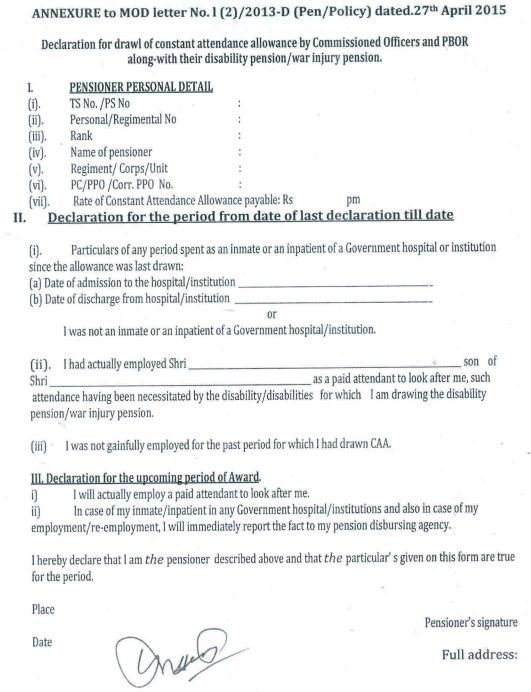
Payment of Constant Attendance Allowance (CAA) on monthly basis with disability pension to Armed Forces personnel

Payment of Constant Attendance Allowance (CAA) on monthly basis with disability pension to Armed Forces personnel – Reg.

“Constant Attendance Allowance shall be paid on monthly basis during the period of award along, with disability or war injury pension as the case may be.”

No.I(2)/2013-D(Pen/Pol)
Government of India
Ministry of Defence
D(Pension/Policy)
New Delhi, Date: 27th April 2015
To
The Chief of Army Staff
The Chief of Naval Staff
The Chief of Air Staff

Subject: Payment of Constant Attendance Allowance (CAA) on monthly basis with disability pension to Armed Forces personnel – Reg.

Sir,

The undersigned is directed to state that as per Regulation 89 of Pension Regulation for the Army Part-l (Edn-2008) and equivalent provisions in Navy and Air Force Pension Regulations, payment of Constant Attendance Allowance is made in arrears twice in a year along with disability pension/ war injury pension on the basis of declaration/certificate submitted by the pensioner to his/ her pension disbursing agency (PDA) in May and November each year subject to fulfillment of other prescribed conditions.

2. Keeping in view of the hardships being faced by the disabled pensioners in claiming Constant Attendance Allowance. Government was reviewing the said provision from quite some time. In partial modification of above provision, the President is now pleased to decide that henceforth Constant Attendance Allowance shall be paid on monthly basis during the period of award along, with disability or war injury pension as the case may be.

3. Concerned Armed Forces Pensioners shall submit a declaration on the format enclosed as Annexure with this order to their pension disbursing agency at the time of initial payment of CAA and thereafter on annual basis at the time of his/her annual identification. During initial declaration pensioner shall state in item III of the Annexure that he/she will employ an attendant for the upcoming one year or up to the date for which CAA has been sanctioned whichever is earlier. During subsequent annual declarations pensioner would also complete item II of the Annexure providing a declaration for the period from the date of last declaration. Payment made against declaration under item III of Annexure shall be treated as provisional and would be final on submission of subsequent declaration under item II.

4. In case a pensioner drawing CAA becomes inpatient in any Government Hospital / Institution or is gainfully employed, he shall immediately report the matter to the FDA. Since, CAA is being paid, on the basis of annual declaration, any overpayment on account of CAA noticed with reference to the declaration quoted above, shall be adjusted from the monthly pension due to the pensioner.

5. All other team and conditions. for grant and payment of Constant Attendance Allowance which are not. affected by this order, shall remain unchanged. Pension Regulations of the three Services shall be amended in due course.

6. This issues with the concurrence of Finance division of this Ministry vide their ID. No. 10(08)/2014/Fin/Pen dated 09/04/2015.

Hindi version will follow.
Yours faithfully
sd/-
(Prem Prakash)
Under Secretary to the Government of India
Constant Attendance Allowance

Source: www.desw.gov.in

Friday, November 21, 2014

Circumstances for Suspension and Timely review of Suspension: Instructions under CCS(CCA) Rules, 1965

Circumstances for Suspension and Timely review of Suspension: Instructions under CCS(CCA) Rules, 1965

 Central Civil Service (Classification, Control and Appeal) Rules, 1965 — Circumstances under a Government Servant may be placed under suspension and timely review of suspension: DoPT Order


F. No. 11012/17/2013-Estt.A-III
Government of India
Ministry of Personnel, Public Grievances & Pensions
Department of Personnel and Training
Establishment Division


North Block, New Delhi — 110001
Dated November 18th 2014


OFFICE MEMORANDUM


Subject: Central Civil Service (Classification, Control and Appeal) Rules, 1965 — Instruction regarding timely review of suspension.

Rule 10 of the Central Civil Services (Classification, Control and Appeal) Rules, 1965, deals with the provisions of suspension. As per the rule, a Government servant may be placed under suspension, in the following circumstances:

(a) where a disciplinary proceeding against him is contemplated or is pending; or
(b) where, in the opinion of the authority aforesaid, he has engaged himself in activities prejudicial to the interest of the security of the State; or
(c) where a case against him in respect of any criminal offence is under investigation, inquiry or trial:

2. A Disciplinary Authority may also consider it appropriate to place a Government servant under suspension in the following circumstances. These are only intended for guidance and should not be taken as mandatory:-
(i) Cases where continuance in office of the Government servant will prejudice the investigation, trial or any inquiry (e.g. apprehended tampering with witnesses or documents);
(ii) where the continuance in office of the Government servant is likely to seriously subvert discipline in the office in which the public servant is working;
(iii) where the continuance in office of the Government servant will be against the wider public interest [other than those covered by (i) and (ii)] such as there is public scandal and it is necessary to place the Government servant under suspension to demonstrate the policy of the Government to deal strictly with officers involved in such scandals, particularly corruption;
(iv) where allegations have been made against the Government servant and preliminary inquiry has revealed that a prima facie case is made out which would justify his prosecution or is being proceeded against in departmental proceedings, and where the proceedings are likely to end in his conviction and/or dismissal, removal or compulsory retirement from service.


3. In the first three circumstances the Disciplinary Authority may exercise his discretion to place a Government servant under suspension even when the case is under investigation and before a prima facie case has been established. Suspension may be desirable in the circumstances indicated below:-
(i) any offence or conduct involving moral turpitude;
(ii) corruption, embezzlement or misappropriation of Government money, possession of disproportionate assets, misuse of official powers for personal gain;
(iii) serious negligence and dereliction of duty resulting in considerable loss to Government
(iv) desertion of duty;
(v) refusal or deliberate failure to carry out written orders of superior officers In respect of the types of misdemeanor specified in sub-clauses (iii) and
(v) discretion has to be exercised with care.
3. Rules 10(6) and 10(7) of the CCS (CCA) Rules, 1965, deal with review of the suspension cases. The provision for review within ninety day is applicable to all types of suspensions. However, in cases of continued detention, the review becomes a mere formality with no consequences as a Government servant in such a situation has to continue to be under deemed suspension. A review of suspension is not necessary in such cases.

4. It has been brought to the notice of this Department that in cases of prolonged suspension period, the courts have pointed out that the suspension cannot be continued for long and that inspite of the instructions of DoP&T, the Disciplinary Authorities are not finalizing the disciplinary proceedings within the stipulated time. Also, in such cases the Government is unnecessarily paying subsistence allowance without extracting any work and if, on the culmination of the disciplinary proceedings, the charged officer is exonerated from the charges, the Government has to unnecessarily pay the full salary and treat the period of suspension as on duty etc.. It is, therefore, desirable that timely review of suspension is conducted in a just and proper manner and that the disciplinary proceedings are finalized expeditiously.

5. All Ministries/ Departments are requested to bring the existing instructions on timely review of suspension and expeditious completion of disciplinary proceedings to the notice all concerned under their control.


(J.A.Vaidyanathan)
Director(Establishment)


Source: www.persmin.nic.in
[http://ccis.nic.in/WriteReadData/CircularPortal/D2/D02est/11012_17_2013-Estt.A-III-18112014.pdf]

Tuesday, May 20, 2014

Chairperson's note dated 19.05.2014 regarding implementation of the Cadre restructuring

Chairperson's note dated 19.05.2014 regarding implementation of the Cadre restructuring

Message from Chairman-II

Greetings to the officers and staff of the IC&CE. This message is in continuation of my earlier message dated 12.5.2014. As I had mentioned the implementation of the CR has to be taken up in right earnest, but it will require patience and perseverance. I have got a number of communications urging that immediate DPCs be held as officers are retiring every month. There is a lot of anxiety as to how the CR is to be implemented. Through this message I would like to apprise to you all of the steps being taken at CBEC level and also reiterate to you those steps which are required to be taken by Cadre Controlling Authorities (CCAs).

You must have already gone through letter F.No. 8/B/106/HRD(M)/2013 dated 28.11.2013 issued by DG(HRD) giving the details of the 6 committees which had been set up for implementation of the CR. The action to be taken now, flows from the work of those committees.

See also CBEC Cadre Restructuring Order with Annexures

The steps to be taken are as follows:

I. Issue of notification defining the jurisdiction of the reorganised zones/Commissionerates/Directorates. Letters have already been issued to the CCs on 13.5.2014 to recheck and resubmit the notifications to be issued. These notifications are expected to be issued from the concerned wings of the CBEC by 23.5.2014. Sh. S.B. Singh, Member (CX) is monitoring this.

II. (a) Simultaneously, the notification regarding allocation of staff in the various grades for the revised formations have to be issued by AD-W section’ of CBEC. Member (P&V) is monitoring the timely issue of the notification on allocation of staff.

(b) On issue of notification for allocation of staff, all CCAs must work out the vacancy position, update rosters and inform the same within one week to Member (P&V) so that the number of fresh recruitments & category can be intimated to SSC. This is also monitored by Member (P&V).

III. Action for issue of notification for the amendments to various statutes based on revised designations has been undertaken by committee no. V.  Some of the amendments are required to be introduced through Finance Bill since amendments to Act are involved. (Member (B) is monitoring the work of this committee). Other notifications are to be issued by Board. Member (B) would also examine the appropriate timelines for each.

IV. For all the new formations which are to come into existence, location codes have to be given. In addition there would be requirement for providing thin clients, infrastructure such as WAN/LAN etc. These matters are under the domain of Dte. of Systems and is being monitored by me.

V. Immediately after the issue of the notification mentioned in para I & II, infrastructure committee would be working out the requirements for additional space for the new formations and submit their infrastructure proposals (including Budget Requirement) after collecting and vetting the same. Member (CK) would be monitoring this.

VI. There are 2 other important activities. One is the conduct of DPCs for promotions to various grades in Group C and B by the CCAs.

(a) There are large number of cadres in group B 84 C. DPCs can be done in those cadres which do not require any change in RRs. Whereas in some other cases, new RP.s may have to be drafted or amendments may be required to the existing RRs. Member (P&V) would be intimating to the CCAs by 28.5.2014, the RRs in respect of those cadres where no change is required and for which DPCs can be held. This is necessary to ensure that DPCs are conducted in a coordinated manner across all the Zones.

(b) CCAs would recall that vide letter No. 8/B/106/HRD(HRM)/2013 dated 13.2.2014 a format had been prescribed to enable monitoring of APARS by the CCAs. It had been desired that all folders be in readiness by 1.4.2014.  However, reports received from the CCAs indicate that still considerable work is required in some of the zones. It is reiterated that unless folders are updated and all action such as finalization of representations, NRC, vigilance certificate, rosters, etc. are ready, the CCA will not be able to conduct the DPCs. Member (L&J) has been nominated to monitor the readiness of the CCAs for holding the DPC in Group B and C cadres. She would also monitor the conduct of DPCs across all the zones. Member (LBJ) shall take up this action immediately on receipt of the list of RRs cleared by the Member (P&V).

VII. In so far as the promotions of 2118 officers of Group B to Group A is concerned, the zone of consideration would involve the verification and updated status of around 10,000 APARS. Letter dated 23.11.2013 of the DG(HRD) indicates that sub committee no.I of the committee no.II has been given the task of ensuring the readiness of the folders. Member (P&V) is reviewing the work of this committee. It will be the responsibility of every CCA to ensure that the APAR folders are complete and correct in all respects. CCAs may therefore contact the sub committee members to ensure that the folders in respect of group B officers belonging to their respective zones are complete and correct in all respects. Only thereafter, verification would be done by AD.II/JS(Admn.) before forwarding to UPSC. Further update on this shall be given after review. It is reiterated that unless the work of APAR verification is completed it would not be possible to move to UPSC for getting the date(s) for holding the DPC. You would all appreciate that DPC for 2118 officers is quite unprecedented, and one matter which will involve a lot of work for UPSC as well. Hence officers, staff & associations are requested to have patience, cooperate & assist the administration to the maximum so that this major activity can be carried out as smoothly & swiftly as possible.

sd/-
(J.M. Shanti Sundharam)
Chairman
19-5-2014
Source: www.cbec.gov.in
[http://www.cbec.gov.in/deptt_offcr/cadre-restruct/chairprsn-note-19may2014.pdf]

Wednesday, April 2, 2014

CBDT released revised allocation of regionwise posts

CBDT released revised allocation of regionwise posts

F.No. HRD/CM/102/28/2013-14
Government of India/Ministry of Finance
Department of Revenue
Central Board of Direct Taxes
Directorate of Income Tax
New Delhi, 31 March, 2014
ORDER

In continuation of separate sanction orders of CBDT vide F.No. HRD/CM/102/3/2009 - 10/11/0167 dated le July 2013 for creation of posts in the IRS and grades other than the IRS, and in supercession of all earlier orders regarding distribution of posts in various CCA Regions, posts in various grades in the Income Tax Department are hereby allocated to various cadre controlling Regions, as per Annexure 1.

2.The detailed scheme of allocation of posts will follow.

3.Sanction is also accorded to revision of the designations cadre controlling Regions under Principal Chief Commissioners of Income Tax as under the link:

http://irsofficersonline.gov.in/Documents/OfficalCommunique/1331201474208.PDF

Thursday, August 29, 2013

Changes in the scheme of selection process for recruitment to the promotion quota of various cadres of All India Services

Changes in the scheme of selection process for recruitment to the promotion quota of various cadres of All India Services

 It has been approved in principle, to consider a few changes in the scheme of selection process for recruitment to the promotion quota of various cadres of All India Services.  As per the existing regulations, the assessment of the suitability of a candidate is made on the basis of his service records.  As per the revised scheme, it is proposed to assess the candidate on the basis of four components i.e. ‘Written Examination’, ‘Length of Service’, ‘Assessment of Performance Appraisal Reports’ and ‘Interviews’.

The above decision was taken after consulting the State Governments and the concerned Cadre Controlling Authorities (CCAs i.e., the Ministry of Home Affairs and the Ministry of Environment and Forest).  Further, to implement the scheme, necessary amendments in the concerned rules/regulations are necessary.  The State Governments & the CCAs concerned have been consulted on this aspect also.  The Central Government has received certain objections from different quarters, such as that the new scheme will be detrimental to the interests of senior state services officers, the officers belonging to the categories of Scheduled Castes and Scheduled Tribes; it would also undermine the element of experience viz-a-viz academic knowledge and would be against the larger public interest as the officers would prefer studying in place of doing public service, etc.   The inputs received in this regard from the State Governments and other quarters will be kept in view in firming up the regulations.

 This was stated by Shri V. Narayanasamy, Minister of State in the Ministry of Personnel, Public Grievances and Pension and Minister of State in the Prime Minister’s Office in written reply to a question by Dr. Chandan Mitra today.

****

KSD/SAMIR/sk

Annexure A
SUMMARY OF THE AFFIDAVIT BY THE GOVERNMENT

The salient features of the affidavit are as under:


a. Non Interference in Investigation
Non-interference in investigation of CBI in PC Act offence cases is already provided in the DSPE Act.

b. Appointment of Director, CBI
Appointment of  Director CBI by the President on the recommendation of a Committee consisting of Prime Minister as Chairperson, Leader of Opposition in the House of People as Member and the Chief Justice of India or a Judge of the Supreme Court nominated by him as Member.

c. Removal of Director, CBI
Removal of Director CBI, only by order of the President on grounds of proved misbehavior and incapacity after the Central Vigilance Commission on a reference made to it by the President has reported that the Director is guilty based on an inquiry conducted in accordance with the AIS Rules in this regard.

d. Director, CBI as member of Selection Committee
Induction of Director CBI as full-fledged member in the Selection Committee for recommending selection of officers of CBI of the level of SP and above.

e. Superintendence on Non-PC Act offences
Superintendence of the Delhi Special Police Establishment for all cases (other than Prevention of Corruption Act offences whose superintendence is with Central Vigilance Commission) has been in the Central Government, with a rider that while exercising the powers of superintendence, the Central Government shall not exercise powers in such a manner so as to require the Delhi Special Police Establishment to investigate or dispose of any case in a particular manner.

f. Timeline for prosecution of officers under Section 6(A) of DSPE Act
On the required approval of the Central Government before conducting inquiry or investigation against officers of JS level or above under Section 6(A) of DSPE Act, it has been provided that the Central Government shall take a final decision within a period of 3 months and an order declining such request would contain reasons in support thereof.

g. Appointment of Director (Prosecution)
Director of Prosecution is to be selected based on the recommendation of the Selection Committee, headed by the Central Vigilance Commissioner with Secretary DoPT, Secretary MHA, and Secretary Department of Legal Affairs as members and Director CBI as member convener. The categories of persons who shall be eligible for appointment, apart from cadre officers of the Ministry of Law & Justice, would include a person who has been in practice as an advocate for not less than 15 years and has been designated as a senior advocate. Powers and functions of the Director of Prosecution have been delineated.

h. Institutional accountability of CBI
Establishment of an Accountability Commission has been proposed to ensure institutional accountability of CBI.  The Commission will consist of three whole time Members, to be appointed by the President, from amongst the  retired judges of the Supreme Court or the High Court with the senior most judge as the Chairperson of the Commission and the CVC as an ex-officio Member. The salary and allowances and the other terms and conditions would be as may be prescribed by the Government. The jurisdiction, functions and powers of the Commission have been detailed. The Commission would entertain and inquire into allegations of misbehavior, incapacity, impropriety or irregularity on the part of officers and staff of DSPE. However the complainant has to approach the Director in the first instance.

i. Financial Autonomy:
                  Apart from functional autonomy to CBI, the financial powers of the Director shall be equivalent to the powers exercisable by the Director General of Central Reserve Police Force.

j. In accordance with Cabinet`s approval the Central Government shall introduced a Bill containing the necessary amendments in Parliament and the same shall be moved in accordance with Parliamentary procedure.

Source : PIB

Now Trending

34% DA Order for Central Govt Employees wef 01.01.2022 - Latest CG Employees DA Order Jan 2022

 DA Order for Central Government Employees from Jan 2022 - Finmin Order 2022 Latest CG Employees DA Order Jan 2022 Dearness Allowance payabl...

Disclaimer:

All efforts have been made to ensure accuracy of the content on this blog, the same should not be construed as a statement of law or used for any legal purposes. Our blog "Central Government Staff news" accepts no responsibility in relation to the accuracy, completeness, usefulness or otherwise, of the contents. Users are advised to verify/check any information with the relevant department(s) and/or other source(s), and to obtain any appropriate professional advice before acting on the information provided in the blog.

Links to other websites that have been included on this blog are provided for public convenience only.

The blog "Central Government Staff news" is not responsible for the contents or reliability of linked websites and does not necessarily endorse the view expressed within them. We cannot guarantee the availability of such linked pages at all times.

Any suggestions write to us
centralgovernmentnews@gmail.com