Sunday, December 13, 2015

Indefinite Strike by Central Government Employees – Charter of demands

Indefinite Strike by Central Government Employees – Charter of demands

Confederation of Central Government Employees JCM (NC) Staff Side has represented to Cabinet Secretary that the 7th CPC proposed 14% increase in Basic Pay is meagre compared to any other CPCs and wants to convene a meeting to discuss the charter of demands given below during Feb 2016 otherwise JCM (NC) Staff Side may have to go for indefinite Strike from 1st March 2016.

JCM (NC) Staff Side letter to Cabinet Secretary on the meagre increase of 14% of the 7th CPC recommendation – Calls for negotiation and if fails Indefinite Strike from March 2016

Confederation of Central Government Employees has represented that 7th CPC has recommended very less increase in pay compared to other CPCs in the past.  Confederation Looks for further negotiation during February 2016 and if it fails it has planned for indefinite Strike from March 2016.

NJCA
National Joint Council of Action
4, State Entry Road, New Delhi – 110055
No.NJC/2015/7th CPC

December 10, 2015

    To
    Shri. Pradip Kumar Sinha
    Cabinet Secretary
    Government of India
    Rashtrapati Bhawan Annexe
    New Delhi-110001.

    Sir,

    Subject:- 7th CPC recommendations and Charter of Demands – Reg.

We send herewith our suggestions and demands on the recommendation made by the 7th CPC. As indicated when the undersigned met you on 20th November 2015 the central government employees are extremely agitated over the totally retrograde recommendations of the Commission.

The meagre increase of 14% recommended by the 7th CPC is the lowest ever any pay Commission has made. It was the similar recommendation, we would request you to recall, made by the 2nd CPC that triggered a confrontation of an unprecedented nature, leading to a strike action which lasted for five days in the year 1960. In the background of the fact that the 5th and 6th CPC recommendations had resulted in the wage rise of 31% and 54% respectively, the anger, anguish and frustration of the employees are the natural outcome. Unless the minimum wage is re-determined with all consequential benefits, the discontent will not be capable of being addressed effectively.

It is, therefore, necessary that a meeting of the members of the Standing Committee of JCM NC is convened under your chairmanship immediately to discuss the issues we have incorporated in the enclosed charter. Settlement through bilateral negotiation has become the urgent need and requirement.

I have been directed by the meeting of the NJCA held on 8th December 2015 to convey to you the disappointment and resentment of the employees over the recommendations of the 7th CPC. We expect a bilateral negotiated settlement of the issues without delay from the Government. We request you that a mutually agreeable settlement on the issues are brought about latest by the first week of February 2016. I have been asked by the meeting to inform you that the entire Central Govt Employees under the auspices of National JCA will be constrained to go indefinite strike in the first week of March 2016 if the desired settlement through bilateral discussions is not brought about by the first week of February 2016. To facilitate an early resolution of the issues, we expect the government to set up a Committee of Group of Ministers to negotiate with the NJCA immediately.

We earnestly hope that the Government will effectively intervene and bring about a satisfactory settlement much before the first week of February 2016 and avoid an otherwise inevitable confrontation.

Thanking you,
Yours faithfully,
(Shiva Gopal Mishra)

Convener

Click to view the NCJ Staff Side letter No.NJC/2015/7th CPC dated 10.12.2015

Filling up vacancies in Central Government – BPMS

Filling up vacancies in Central Government – BPMS

BPMS – Bharatiya pratiraksha mazdoor Sangh requested Shri Dr. Jitendra Singh, Minister of State, Government of India, to fill up vacancies in the Government machinery to serve the public better. BPMS projects around 7 lakhs vacancies in Central Government installations.

BPMS requests for Filling up the vacant posts in Central Government Installations by regularising the Contract Employees.

Bharatiya Pratiraksha Mazdoor Sangh has made a request to the Minister of State Shri Jitendra Singh, for filling up of the vacant posts in the Central Government installations.

BHARATIYA PRATIRAKSHA MAZDOOR SANGH

REF: GENC / MOS / Recruitment 03
Dated: 10.12.2015
To,
Dr. Jitendra Singh,
Minister of State, Government of India,
Ministry of Personnel, PG & Pension,
New Delhi – 110001.

Subject: Filling up the vacant posts in Central Government Installations.

Hon’ble Sir,

With due regards, it is submitted that Government Employees National Confederation (GENC), affiliated to Bharatiya Mazdoor Sangh has been adopting the resolutions for filling up the vacant posts in Central Government Offices /  Establishments and has been always reflecting its concern on the functioning of Government Mechanism due to deficiency in the work force.

You are already aware of the Group-Wise & Status-Wise estimated number of Central Govt. Civilian Regular employees in major Ministries/Departments (excluding UTs) are as under in various Ministries which are mentioned below:-
(As on 01.01.2012)
Ministry
A
Number of Sanctioned Posts
Total
A
B(G)
Number in Position   
Total


B(G) 
B(NG) 
C(NG)


B(NG)  
 C(NG)

Railways
8748
7652
0
1560388
1576788
9228
8072
0
1288400
1305700
Home
18953
2390
42776
864815
928934
14817
1763
32921
780755
830276
AffairsDefence
13773
12213
14518
443233
483737
13185
11847
11174
332388
368594
(Civilians) Posts
610
1155
5639
203703
211107
610
1155
5639
203703
211107
Revenue
8255
24144
31355
74569
138323
5881
20885
23353
48668
98787
Others
50530
39286
50166
205672
345654
44239
33002
40390
152435
270066
Total
100869
86840
144454
3352380
3684543
87960
76724
113477
2806369
3084530

 (As on 01.01.2014)        (in lakh)
Ministry
Railways
Number of Sanctioned Posts
15.51
Number in Position
13.16
MHA
10.56
9.8
Defence
5.85
3.98
Civilians
Posts
 
2.50
 
1.90
Revenue
1.76
0.96
Total
40.49
33.02

From above it may be deduced that more than 7 lakh sanctioned posts are lying vacant for a long period which is not only adversely affecting the efficiency of good governance but give ample opportunity for exploitation of contract worker employed in the Government sector. Bharatiya Mazdoor Sangh has been demanding for abolition of contract work system and regularization of the contract workers.

Now, our  Hon’ble Prime Minister, Shri  Narendra  Modi  has also  assured  the unemployed youth to give them proper employment.

Hence,  it  is  requested  to  your  good  self  to  intervene  into the  matter  and  issue necessary directives to all the Ministries of Govt of India to fill up the vacant posts without further delay.
Thanking you.
Sincerely yours
SADHU SINGH
Organizing Secretary

Competent Medical Officer for issuing certificate of disability for family pension

Competent Medical Officer for issuing certificate of disability for family pension

Government of India, Ministry of Personnel, P.G. & Pensions OM describes “medical authority” competent to issue disability certificate as per M/o Health & Family Welfare Notification No.S.13020/1/2010, dated 18.6.2010

Government of India Notification on Competent Medical Officer/Board for issuing certificate of disability for the purpose of family pension under rule 54 of CCS (Pension) Rules, 1972

Ministry of Personnel, P.G. & Pensions has described that “medical authority” means any hospital or institution specified for the purposes of this Act by notification by the Central Government or appropriate State Government/UT.

No.1/18/01-P&PW(E)(Vol.II)
Government of India
Ministry of Personnel, P.G. & Pensions
Department of Pension & Pensioners’ Welfare

3rd Floor, Lok Nayak Bhavan,
Khan Market, New Delhi
the 5th November, 2015

OFFICE MEMORANDUM

Sub: Competent Medical Officer/Board for issuing certificate of disability for the purpose of family pension under rule 54 of CCS (Pension) Rules, 1972 – reg.
Reference is invited to this department’s Office Memorandum of even number dated 30th September, 2014 on the above subject.

2. It had been conveyed that for grant of family pension under the CCS (Pension) Rules, 1972, the authority competent to issue disability certificate would be as specified in the guidelines issued by the M/o Health & Family Welfare Notification No.S.13020/1/2010, dated 18.6.2010, in pursuance of the Persons with Disabilities (Equal Opportunities, Protection of Right and Full Participation) Rules, 1996. It had also been conveyed that for the past cases, the disability certificate issued either in pursuance of the guidelines, dated 18.06.2010 or in pursuance of rule 54 (6) of the CCS (Pension) Rules, 1972 shall be acceptable.

3. As per Section 2(p) of the Persons with Disabilities (Equal Opportunities, Protection of Rights and Full Participation) Act, “medical authority” means any hospital or institution specified for the purposes of this Act by notification by the appropriate Government. In pursuance of this, State Governments/UT administrations are required to notify the medical authorities to issue disability certificate.

4. In addition to the authorities indicated in para 2 above, for grant of family pension under the CCS (Pension) Rules, 1972, including past cases, the authority competent to issue disability certificate would be any hospital or institution specified as a Medical Authority for the purposes of the Persons with Disabilities (Equal Opportunities, Protection of Rights and Full Participation) Act by notification by the Central Government or a State Government or a Union Territory Administration.

(D.K. Solanki)
Under Secretary to the Government of India
Phone: 24644632
Download Govt of India OM No.1/18/01-P&PW(E)(Vol.II) dated 05.11.2015

7th Pay Commission Report on Leave Encashment of EL

7th Pay Commission Report on Leave Encashment of EL

Enhancement of ceiling of Earned Leave for purposes of Leave Encashment

The Commission has received representations seeking raising the ceiling limit of 300 days to 450 days for purposes of Leave encashment.

7th Pay Commission Report on Leave Encashment of EL


Analysis and Recommendations : The Commission notes that based on the recommendations of the VI CPC, serving employees are entitled for encashment of Earned Leave up to 60 days while in service. This is not to be deducted from the maximum number of Earned Leave of 300 days encashable at the time of retirement. The VI CPC, therefore, has further liberalised the regime of leave encashment.

The recommendations in relation to pay of both the civilian and defence forces personnel will also lead to a significant increase in the pay drawn and therefore in the total amount of leave encashment available for an employee.

Therefore raising the present ceiling of 300 days is not recommended by the Commission.

Authority: 7th CPC Report

Saturday, December 12, 2015

Central Pensioners : 37% are in the 60-70 age group

Central Pensioners : 37% are in the 60-70 age group

Age Analysis of Pensioners as on 01.01.2014 : Payment of additional pension/family pension with advancing age came into force based on recommendations of the VI CPC. This Commission, with a view to ascertain the strength in various age groups, called for information on age profile of pensioners and family pensioners. The data with regard to pensioners in terms of various age groups, as reported to the Commission, for the five categories of pensioners’ viz., Central Civil, Railways, Post, Defence (Civil) and Defence (Services) is as under:

Age Analysis of Pensioners as on 01.01.2014


# Others includes those below 60 years of age and those above 100 years.

@ Others under Central Civil additionally includes cases whose revision had not been effected, certain categories of pensioners like Judges of Supreme Court and High Courts, Ex-MPs, freedom fighters.
^ Railways have included those less than 60 years of age in the 60-70 age group.

From the table above it can be observed that of the total 51.96 lakh pensioners, 37 percent are in the 60-70 age group, about 26 percent each are in the 70-80 and ‘Others’ age group. The balance 11 percent are in the 80 plus category and thus entitled to enhanced pension based on advancing age.

The stacked bar graph brings out for each category of pensioners the break up in percentage terms of each age group viz., 60-70 years, 70-80 years, 80-90 years, 90-100 years and Others.


Railways have included those less than 60 years of age in the 60-70 age group
The graph above brings out the following:
i. Railways, in comparison to other categories have largest percentage of pensioners above the age of 80 years. While in all other categories this percentage is in the range of 7-9 percent, in the Railways it is 21 percent.
ii. Defence Services have a large percentage of personnel retiring at an early age, as is confirmed by the data. 57 percent of defence service pensioners fall in the ‘Others’ age group. Central Civil which also includes CAPFs has 25 percent in ‘Others’ age group.
Authority: 7th CPC Report

Enhanced Family Pension : No Change is being recommended by 7th CPC

Enhanced Family Pension : No Change is being recommended by 7th CPC

Increasing the existing time period of seven years for enhanced family pension

The Commission has received representations seeking enhancement in the period of enhanced family pension from the existing seven years or 67 years, whichever is less, to ten years in case of death of retirees.
Analysis and Recommendations : The current rates of enhanced family pension are :
i. In the case of death in service: Payable to the family of a government servant for a period of ten years from the date of death of a government servant, without any upper age limit.
ii. In the case of death after retirement: Payable for a period of seven years or up to the date on which he would have attained 67 years had he survived, whichever is less.
The Commission notes that the revision with regard to period of eligibility for the enhanced family pension of ten years was made based on recommendations of the VI CPC Report. No further change is being recommended by this Commission.

7th Pay Commission Report on Death Gratuity

7th Pay Commission Report on Death Gratuity

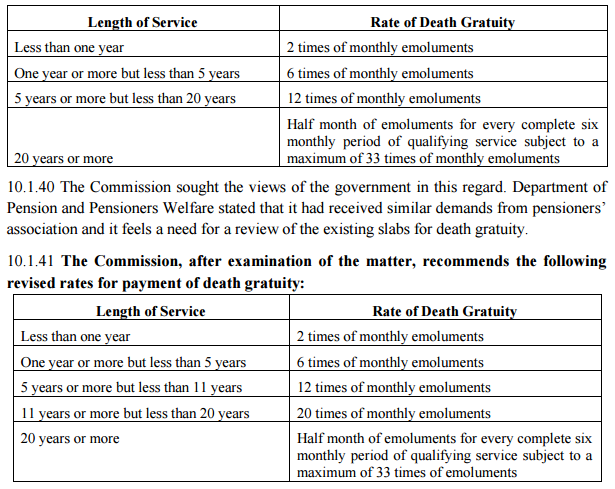
The Commission has received representations pointing to a need for rationalization of current slabs for death gratuity, especially for the slab of 5 to 20 years of qualifying service in which family pensioners are stated to be placed at a disadvantageous position.

Analysis and Recommendations : As per Rule 50 of Pension Rules, the death gratuity admissible will be as follows, subject to the maximum limit prescribed for the gratuity:


7th CPC Death Gratuity


Authority: 7th CPC Report

Strength of Central Government Pensioners as on 01.01.2014

trength of Central Government Pensioners as on 01.01.2014

Strength of Pensioners as on 01.01.2014 : Pensioners can be broadly categorised into Civil and Defence. Within civil pensioners there exist three broad categories: Central Civil, Railways and Post.

As on 01.01.2014, as per data reported to the Commission, the total number of pensioners were 51.96 lakh. The category wise break up is shown in the pie chart below


Central Government Pensioners

Pensioners and Family Pensioners

The break-up of the total 51.96 lakh pensioners as on 01.01.2014 between pensioners and family pensioners, category wise, is as under:
Pensioners and Family Pensioners

The table above brings out the following:

i. Of the total 51.96 lakh pensioners as on 01.01.2014, 11.83 lakh viz., 23 percent were family pensioners.
ii. Civilian pensioners consisting of Central Government Civil, Railways and Posts, as on 01.01.2014 number 27.81 lakh while defence pensioners (including defence civilians were 24.15 lakh. Defence pensioners (including defence family pensioners and defence civilians) constitute 47 percent of all pensioners.

7th Pay Commission: Private sector employees want similar hikes

7th Pay Commission: Private sector employees want similar hikes

New Delhi: Following the 7th Pay Commission report, there is a significant discontent among private sector employees, and employers are dealing with lowered motivation and performance levels, says a survey.

According to a TimesJobs.Com survey, over 70 per cent private sector employees regret working in the private sector after central government employees bag 23.55 per cent salary hike.

“The discontent caused in the private sector by this performance-indiscriminate hike to central government employees is palpable. And India Inc employers are having to face the brunt of this dissatisfaction with lowered motivation and performance levels,” TimesJobs.Com COO Vivek Madhukar said.

A large majority of respondents (68 per cent) felt that this hike was “unfair”. Another 47 per cent respondents believe the raise has no linkage to employee performance while 30 per cent feel the massive hike will eventually widen the public and private sector income disparity.

While the disappointment with private sector pay scales was high across experience levels, entry-level employees were the most disappointed.

About 80 per cent junior/entry-level employees said they regretted having taken up jobs in the private sector, reveals the survey. Nearly 75 per cent middle and senior-level employees also shared similar sentiments.
“All (100 per cent) the professionals surveyed said private sector companies should increase minimum wages like the central government,” the survey noted.

However, most private sector employees agreed that their jobs offered them more room for career growth. Close to 80 per cent employees think private sector jobs score better over government jobs given the opportunities for growth and job change.

The survey covered over 700 professionals working in the private sector from across the country, who earn their increments based on their individual performance and contributions to the business. It had representation from employees from across sectors and experience levels.

PTI

Friday, December 11, 2015

Submitted a memorandum for correcting the negative and unwanted recommendations of 7th CPC - BPEF

Submitted a memorandum for correcting the negative and unwanted recommendations of 7th CPC -BPEF

BHARATIYA POSTAL EMPLOYEES FEDERATION
BPEF & GENC ( Affiliated to BMS)
MEMORANDUM
GENC/7th C.P.C./Examination/ Recommendation /2015
Dated: 10-12-2015
To
Shri Jitender Singh Ji
Hon’ble Minister of MOS
Ministry of Personnel Public Grievances & Pension
Govt. of India
New Delhi – 110 001

Sub: Suggestion over various negative recommendations of 7th C.P.C. to Govt of India for correction of the same to the advantage of Employees and for the sake of constitutional provisions. –regarding..

Respected Sir,

The Government Employees National Confederation studied the report containing the recommendations of Seventh Central Pay Commission and observed that although there are some positive recommendation in it but also there are several instances came to notice the sprit and promises made by Chairman Shri A.K. Mathur as mentioned in para 1.29 that Govt. services are not merely only contract but is a status and employees expect fair treatment from the Govt. are not reflected in the recommendations properly. Some recommendations are negative to extent that they went against the constitutional rights of the employees. Few of them are :

(1) It tried to rationalize the Pay structure by devising “Index of Rationalization “but ended with several unwanted discrepancies.
(2) It is the fact that the Allowances were allowed by Departments as per their operational & administrative needs, but 7th C.P.C. on its own initiative has declared them “outlived their utility “and recommended for their discontinuance.
(3) Vide para 1.17 it expresses its views that status in society due to becoming a Govt. employee cannot be monetized. The commission has erred in considering the fact that the status requires money to maintain it. It wrongly computed consumption units of a normative family as per present policies towards women, Children and senior parents and, therefore, could not arrive at correct minimum salary demanded.
(4) It says that the concept of Grade Pay and pay Band has been done away and all grade pay at all levels has been subsumed into the pay matrix but has also done away with the promotional benefit of difference of Grade pay provided earlier on promotion and restricted itself to recommend only 3% increment on promotion.
(5) Vide para 9.1.1 it remarked that with increased salary packages these advances have lost their relevance and recommended that all 12 interest free advances like Medical, LTC, Cycle etc. should be abolished without considering its validly to the employees, its family and the Govt. policies towards extension of these advances.
(6) By recommending increase in bench mark to “very good” for grant of MACPS benefits and recommending stoppage of further increment for not attaining it depicts criminal action over the employees for his no fault .
G.E.N.C. suggestions
  1. Deficiency in PAY MATRIX
Although the intentions and promises made in Para 5.1.1 of 7th CP.C. are “simplification and rationalization” ,the 7th C.P.C. has wrongly taken up the entry pay for each grade pay devised by 6th CPC as the basis of rationalization and a “ index of renationalization” have been formed which is , for PB-I it is 2.57, for PB-2 it is s 2.62 , for PB-3 it is 2.67. It is amazing that at one hand 7th CPC says that the entry pay designed by 6th C.P.C. was disproportionate and on other hand chooses same for future rationalization in the form of recommended pay matrix.

Therefore, the G.E.N.C makes question that how a disproportionate entry pay, after going through process of rationalization through Index of rationalization .
  1. Will produce equidistant levels as promised ?
  2.  Will produce a judicious and caring horizontal matrix of entry pay of each level containing the exact compensation to Qualification, skill set required as well as increasing roles and responsibilities at each step of level?
  3. Will produce Proportionate increase in quantum of pay as promised in para 5.1.19?
  4. Will produce Levels, as status determiner as mentioned in para 5.1.18?
  5. Will Satisfy holistic approach of 7th pay commission towards salaries allowances and other perquisites of compensation structure at each level as promised in para 1.18.
In view of all above questions, the G.E.N.C. is proposing following modification while devising New pay matrix

(a) The Index of rationalization may be 15% enhancement in each 18 levels starting from G.P. 1800 and moving up to PB-3 onward instead of proposed disproportionate Index of rationalization of 7th C.P.C.

(b) After devising Pay matrix as above, the Post existing is G.P. 1900 may be merged with G.P. 2000 and similarly G.P. of 2400 may be merged with G.P. of 2800 as a provision of rationalization of Grade Pay in General. This method has been recommended by 7th C.P.C. to general commercial cadre existing in Ministry of Railways.

By 7th CPC
By G.E.N.C
G.P. Group of posts Quantum of Entry .Pay. Proposed by 7th CPC Percentage increase in pay with respect of previous  level Quantum of Entry .Pay. Proposed  by GENC Percentage increase  in pay with respect of   previous level
1800   C       18000
18000     –
1900   C       19900 10.5% 21000    15%-
2000   C       21700   9% 24150   15%
2400   C       25500 17% 27772   15%
2800   C       29200 12% 31937   15%
4200   B       35400 21% 36727   15%
4600   B       44900 26% 42236   15%
4800   B       47600 6% 48671 15%
5400 PB-II   B       53100 11.55% 55911 15%
5400 PB-III   A 56100 5.6% 64366 15%

For others level the same method can be adopted , if deemed fit. The GENC has taken up this rationalization up to cadre in which direct recruitment takes place.

2.MINIMUM PAY :
The minimum pay computed by 7th CPC vide Table Annexed to Chapter 4.2 needs careful modification as below.
  1. The rates mentioned as par 4.2.8 are taken as per product prices. Here, it is to say that any consumer has to buy the products at retail prizes which are always ahead of these product prizes because of middle man profit , sales tax , VAT etc. which when combined are at least ahead by 12% of product prize.
Therefore, adding 12% of 18000 i.e. 2160 to 18000 makes minimum wage of three consumption unit Rs. 20160. On this basis, the share of one consumption unit comes out to be Rs. 6720
  1. Several initiatives from side of Govt. has come forward these years with respect to women, Children & senior parents which are necessary to be included in the consumption unit as given by Doctor aykroyd . They are
(a) Senior Citizen and parents maintenance Act 2010 which provides liability of Mother and Father over employed Sons/Daughters.

(b) Gender bias reflected in ackroyed formula in respect of women employees as well as house wife, mother is not acceptable as per Govt. policy. The provisions of full unit for these dependents are to be included in consumption unit.

(c) Full consumption unit to Children below age 14 has to be made compulsory as the present day Govt. is health sensitive, therefore, we have to consider that the quantity and prizes of commodities used by children is much higher than commodities used by adults.

(d) Dating back to First CPC the lowest entering Govt. employee was mere 5th pass but as per the recommendations of 6th CPC, accepted by Govt., the lowest employee being inducted into Govt. service is 10th pass. Therefore mental labour of this skilled employee has also to be considered and monetized.
By computing all factors mentioned in 1 and 2 above following computation from minimum wage comes out
(i) 20160 minimum wage arrived at 1 above divided by 3 makes Rs. 6720 as full unit consumption.
(ii) Employee, wife, two Children below 14, Mother, & Father makes 6 consumption unit of newly recruited MTS in the Govt. sector.
(iii) Therefore, as per (i) & (II), Rs. 6720 X6 equals to Rs. 40320
(iv) 25% of 6720 i.e. 1680 being mental labour for 10th pass MTS, has to be added to Rs. 40320 above .
(v) Therefore , Rs. 40320 + Rs.1680 equal to Rs. 42000 as minimum wage.
The Govt. may also consider and arrive at the minimum wage on the basis of NET NATIONALPER CAPITA INCOME (neutralized inflation ) data of CSO ( Central statistical organization ) which is Rs. 6175 per consumption unit.

However, keeping in view the paying capacity of employees and economic situation of newly developing country of India, the GENC is proposing Rs. 24000 as minimum wage to a newly recruited employee.

3. FITMENT BENEFIT : Fitment benefit provided by the 7th C.P.C. is 2.57 which is 14.29 % more than 2.25. equivalent to the fitment benefit provided by 2nd CPC .

The GENC, therefore, demands that it should not be less than 51% of 2.25 as provided by 6th CPC. Which comes out to be 3.42.

4. INCREMENT AT THE TIME OF PROMOTION :
The GENC intends to remind you that the employees are getting only 3% replacement benefit in new pay Matrix on promotion. Previously the employees were getting 3% benefit along with difference of grade pay on promotion.
Therefore, we suggest that:-
(i)On each promotion, one extra increment in that promotional level may be provided. OR
(ii)The pay in new pay matrix may be fixed by providing one extra increment in the concerned level.
5. ANNUAL INCREMENT RATE : The Annual increment Rate provided by previous C.P.C. were calculated when pay scale system was prevalent and age for full pension was 33 years. In worst cases an employees with 3% increment Rate can reach to maximum from minimum in 33 years.

The 6th CPC has also endorsed the concept of 3% annual increment in pay band system but has suggested full pension in 20 years . This recommendation was later on accepted by Govt. and revision in pension rules were made accordingly.

Now it was turn of 7th CPC to take into account above facts and, therefore, would have devised annual increment of 5% considering that the employee in new pay matrix will reach in 20 Years for full pension benefit . Unfortunately this has not been done.

Therefore, in order to have coordination between previous and present criterion for providing increment on the basis of pension computation, the 5% annual increment rate may be considered to devises new pay Matrix.

6. Date of Annual Increment:- With present formula that each employee completing 6 months in a year will get increment, on 1st July. The concept of 1st July of year is not adequate for those entering in the service in any month between January and June & for those retiring any of the month of the year. Therefore, the GENC proposes that both type of above employees may be provided one increment irrespective of date of entry or date of retirement. Similarly, two dates i.e. 1st January or 1st July can be made for assessing and providing annual increment.

7.With holding of Annual increment to Non performer after 20 years – increase in MACPS benchmark and introducing efficiency Bar. Vide para 5.1.46 “there is a vide spread perception that increment as well as upward movement in the hierarchy happens as a matter of course. Also, grant of MACP is taken for granted. “

These lines are totally against the promises of Shri A.K Mathur Chairman 7th CPC quoting apex court judgement in para 1.29 “ it should always born in mind that legitimate aspirations of an employee are not gullitoned and a situation is not created where hopes ends in despair. Hope for everyone is gloriously precious and that a model employer should not convert it to be deceitful and treacherous by playing a game of chess with their seniority also vide para 1.30 it quotes that the employee should not be thought as criminal and unnecessary suspicion should not be made about him.

On availability of such sprit and promises, the bench mark “ Very good” should not be taken in a way that “average” and “good “remark are criminal activities and without any disciplinary proceeding their annual increment can be withheld. Similarly these remarks cannot declare employee a non performer. The GENC, therefore, request that the para 5.1.45 pertaining to MACPS & para 5.1.46 pertaining to efficiency Bar may not be considered for implementations. .

8.MACPS : (1) The 7th CPC has compiled the key demands received by it and quoted regarding MACPS demand in 5.1.12 (e) that the MACPS providing benefits in grade pay hierarchy, was giving in adequate benefit after long gap of 10, 20 & 30 Years and demanded that, it should be provided in promotional hierarchy instead of grade pay hierarchy. Similarly, the demand for increase in the frequency of administering MACP has also came for consideration. .

In view of all above, the 7th C.P.C. restricted itself to recommend that the frequency of MACP will remain 10, 20 & 30 years but in process to provide adequate MACPS benefits , it recommended , that it will be provided in immediate next level in the hierarchy.

The GENC is trying to analyze the words immediate next level in the hierarchy and concludes that it should simply mean the immediate next level in the hierarchy existing in the department.

After going through entire recommendation it has been observed that the word hierarchy was used for hierarchy existing in the department or a cadre. In case the meaning of immediate next level in the hierarchy is level hierarchy then It can be said that 7th CPC has not done there any modification in the MACPS scheme and it only tried by deceitful and treacherous method to take away the benefit as promised.

Therefore, the GENC strongly demand that the word immediate next level in the hierarchy may be made clearer so that it may mean immediate next level in the cadre / promotional hierarchy.

(2) Similarly, recommendation of stepping up has been made by 7th CPC in its para 11.40.82 in respect of Railway Accounts for MACPS anomalies.

Therefore the GENC strongly demand that the stepping up of pay of senior for MACPS anomalies with Junior to all seniors drawing lesser pay than junior in entire Central Govt. Employees may be made. It is to remind that MACPS scheme is common to all and is not restricted to any cadre or Department.

9.House Rent Allowance: The factor of 0.8 has been introduced illogically and without any justification. This factor should be removed & H.R.A. should be to restored on the basis of Metro and Non metro classification of cities only with percentage 40 & 30 respectively .

10.CGEIS Benefit : Many banks especially corporation Bank of India is providing Insurance cover on natural death over salary account to the tune of 10 to 20 Lacks . Therefore, it is not advisable to increase the Insurance Benefit heavily and also its premium.

If saving fund is the basis of this increase in CGEIS premium then all New entrant may be allowed for G.P.F. contributions.

11. Child Care leave: This leave for all two years may be granted with full salary. Its benefit should also be extended to Male employees.

12.Medical Advances : As the terms of Children Education Allowance and Traveling Allowance were made easier , the terms of Medical Advance may also be made easier and advances up to 1 lacs amount should be allowed to be sanctioned by the Head of the office instead present 10 thousand ceiling.

13. Leave Travel Concession:- should be allowed exactly on same terms as it is presently. It is to remined that the facilities was devised to boost up the tourism Industry and also to get relief to the employees and its family from getting tired due to routine work.

14. Bonus: Bonus in all forms may be continued as it is considered as deferred wage.

15. Income Tax issues: Present limit of income tax may be enhanced to 2.57 times . All allowances of Central Govt. employees may be kept out from preview of Income tax. The Pension amount should be exempted from tax .Death cum retirement gratuity should be exempted form income tax.

16. Fitment benefits of to decide quantum of minimum pension: should be equal to minimum wage and fitment benefit of 2.57 may be increased to 3.

17. Allowances: All Allowances were devised as per requirement of existing Govt. policies and conditions of service in the Department. Therefore, any decision taken abruptly is certainly going to produce unrest. The GENC quotes certain allowances that are certainly to be restored and instead its rate should also be enhanced and rationalized.

Assisting Cashier Allowance , Caretaking Allowance , Family planning Allowance , FMC, Funeral Allowance, Ghat Allowance , Handicapped Allowance, Head quarter Allowance, Kit Maintenance Allowance., ,Over times Allowance, Rent free Accommodation, Risk Allowance , Training stipend , Treasurer Allowance Washing allowance , Cash Handling Allowance ., Cycle Allowance etc.

18.Compassionate Appointment: Ceiling of 5% over DR vacancies imposed over Central Govt. employees at the time of compassionate appointment may be removed and it may be made 100%

19. Gramin Dak Sewak: GENC demands that Negative recommendation of 7th C.P.C. to treat GDS a non Govt. employees to the extent that their salary may be separated from salary other regular employees being drawn from consolidated fund of India may be expunge out from recommendation of 7th C.P.C. as Department of Posts has already constituted a GDS committee to look into to all service condition and employment matters in entirety.

20. New Pension Scheme: It is to emphasis that Article 366 (17) defines Pension. On its basis AIR 1983 SC 130 held that Pension is not an exgratia payment but it is payment of past services rendered. Similarly, Supreme Court reiterated that pension is not a bounty of state. It is earned by the employees for services rendered to fall back upon after retirement. It is attached to the office it cannot be arbitrarily denied.
In a judgement in U.O.I. & others (1990) 4 SSC 207) – It was never held that both the pension retiree and PF release form a homogeneous class and that any further classification among them would be voilative of Article -14.

The 7th CPC held that under the pension scheme, the Govt. obligation begins on his retirement and then continuous till the death of employees. In Para 10.1.64 the 7th CPC quotes there is clear evidence that Govt. has progressively moved towards liberalized regime for past pensioners. The 6th CPC has provided additional pension and 7th CPC has provided one Rank one pension.

Unfortunately no promise has been made by the 7th CPC. But vide para 10.3.3 it quotes that the commission notes that the NPS is the culmination of a series of social securities and pension related reforms initiatives in India . At present OASIS has concluded that instead of defined benefit scheme for pension , the defined contribution scheme should be introduced. In NPS 40% of accumulated wealth is invested for pension purpose and 60% is paid at the time of retirement. NPS is not covered in GPF. On the death of employee 80% wealth is utilized for purchase of annuity and 20% is paid to legal heir.

7th C.P.C. Vide para 10.3. clearly speaks that uncertainty over the NPS scheme should be removed. Therefore the BPEF suggest that
1.The quantum of pension should be made equivalent to old pension scheme and this decision may be notified along with 7th C.P.C. recommendations.
2.The amount of gratuity for NPS should be made equal to old pension.
3.Family pension & other benefit to the NPS employees should be declared along with 7th CPC recommendations.
With regards and hopes for positive correction
Yours sincerely
Sd/-
( Sadhu Singh )
Source: bpefsg.blogspot.in
7CPC, 7th CPC News, 7th CPC Report, Allowance, BMS, BPEF, FITMENT BENEFIT, HRA, Increment, MACPS, Minimum Pay, Pay matrix, Pay Structure, recommendations of 7th CPC
========================
7th Pay Commission: Private sector employees want similar hikes

New Delhi: Following the 7th Pay Commission report, there is a significant discontent among private sector employees, and employers are dealing with lowered motivation and performance levels, says a survey.
According to a TimesJobs.Com survey, over 70 per cent private sector employees regret working in the private sector after central government employees bag 23.55 per cent salary hike.

“The discontent caused in the private sector by this performance-indiscriminate hike to central government employees is palpable. And India Inc employers are having to face the brunt of this dissatisfaction with lowered motivation and performance levels,” TimesJobs.Com COO Vivek Madhukar said.

A large majority of respondents (68 per cent) felt that this hike was “unfair”. Another 47 per cent respondents believe the raise has no linkage to employee performance while 30 per cent feel the massive hike will eventually widen the public and private sector income disparity.

While the disappointment with private sector pay scales was high across experience levels, entry-level employees were the most disappointed.

About 80 per cent junior/entry-level employees said they regretted having taken up jobs in the private sector, reveals the survey. Nearly 75 per cent middle and senior-level employees also shared similar sentiments.
“All (100 per cent) the professionals surveyed said private sector companies should increase minimum wages like the central government,” the survey noted.

However, most private sector employees agreed that their jobs offered them more room for career growth. Close to 80 per cent employees think private sector jobs score better over government jobs given the opportunities for growth and job change.

The survey covered over 700 professionals working in the private sector from across the country, who earn their increments based on their individual performance and contributions to the business. It had representation from employees from across sectors and experience levels.

PTI

Now Trending

34% DA Order for Central Govt Employees wef 01.01.2022 - Latest CG Employees DA Order Jan 2022

 DA Order for Central Government Employees from Jan 2022 - Finmin Order 2022 Latest CG Employees DA Order Jan 2022 Dearness Allowance payabl...

Disclaimer:

All efforts have been made to ensure accuracy of the content on this blog, the same should not be construed as a statement of law or used for any legal purposes. Our blog "Central Government Staff news" accepts no responsibility in relation to the accuracy, completeness, usefulness or otherwise, of the contents. Users are advised to verify/check any information with the relevant department(s) and/or other source(s), and to obtain any appropriate professional advice before acting on the information provided in the blog.

Links to other websites that have been included on this blog are provided for public convenience only.

The blog "Central Government Staff news" is not responsible for the contents or reliability of linked websites and does not necessarily endorse the view expressed within them. We cannot guarantee the availability of such linked pages at all times.

Any suggestions write to us
centralgovernmentnews@gmail.com