Showing posts with label Union Budget. Show all posts

Friday, February 2, 2018

Defence - Budget 2018-19 - Allocate 12.10 percent of the total Central Government Expenditure

Defence - Budget 2018-19 - Allocate 12.10 percent of the total Central Government Expenditure

Union Budget for the financial year 2018-19, presented by the Finance Minister Shri Arun Jaitley in the Parliament today, envisaged a total outlay of Rs. 24,42,213 crore. Out of this, Rs 2,95,511.41 crore has been earmarked for Defence. This accounts for 12.10 percent of the total Central Government expenditure for the year 2018-19.

The allocation of Rs. 2,95,511.41 crore represents a growth of 7.81 percent over Budget Estimates (Rs. 2,74,114.12 crore) and 5.91 percent over Revised Estimates (Rs. 2,79,003.85 crore), respectively for the financial year 2017-18.

Out of Rs. 2,95,511.41 crore allocated for the financial year 2018-19, Rs. 1,95,947.55 crore has been allocated for Revenue (Net) expenditure and Rs. 99,563.86 crore for Capital expenditure for the Defence Services and the Organizations/ Departments under Ministry of Defence. The amount of Rs. 99,563.86 crore, allocated for Capital expenditure, includes modernization related expenditure. The Capital allocation for Ministry of Defence under BE 2018-19 is 33.1 percent of the total Central Government Expenditure on Capital Account, which is Rs 3,00,441 crore.

For Defence Pension, which is over and above the outlay mentioned above, an amount of Rs. 1,08,853.30 crore has been provided in BE 2018-19. This is 26.60 percent above the BE 2017-18 of Rs. 85,740 crore and 14.26 percent over RE 2017-18 of Rs. 95,000 crore.

The approval for the construction of Sela pass has given further impetus to the Defence preparedness.

Source: PIB

Thursday, February 1, 2018

HIGHLIGHTS OF BUDGET 2018-2019

HIGHLIGHTS OF BUDGET 2018-2019

PRESS INFORMATION BUREAU
GOVERNMENT OF INDIA

HIGHLIGHTS OF BUDGET 2018-19

New Delhi, 01th February, 2018
  • Finance Minister Shri Arun Jaitley presents general Budget 2018-19 in Parliament.
  • Budget guided by mission to strengthen agriculture, rural development, health, education, employment, MSME and infrastructure sectors
  • Government says, a series of structural reforms will propel India among the fastest
    growing economies of the world. Country firmly on course to achieve over 8 % growth as manufacturing, services and exports back on good growth path.
  • MSP for all unannounced kharif crops will be one and half times of their production cost
    like majority of rabi crops: Institutional Farm Credit raised to 11 lakh crore in 2018-19 from 8.5 lakh crore in 2014-15.
  • 22,000 rural haats to be developed and upgraded into Gramin Agricultural Markets to protect the interests of 86% small and marginal farmers.
  • "Operation Greens" launched to address price fluctuations in potato, tomato and onion for benefit of farmers and consumers.
  • Two New Funds of Rs10,000 crore announced for Fisheries and Animal Husbandary
    sectors; Re-structured National Bamboo Mission gets Rs.1290 crore.
  • Loans to Women Self Help Groups will increase to Rs.75,000 crore in 2019 from 42,500 crore last year.
  • Higher targets for Ujjwala, Saubhagya and Swachh Mission to cater to lower and middle class in providing free LPG connections, electricity and toilets.
  • Outlay on health, education and social protection will be 1.38 lakh crore. Tribal students to get Ekalavya Residential School in each tribal block by 2022. Welfare fund for SCs gets a boost.
  • World‟s largest Health Protection Scheme covering over 10 crore poor and vulnerable families launched with a family limit upto 5 lakh rupees for secondary and tertiary treatment.
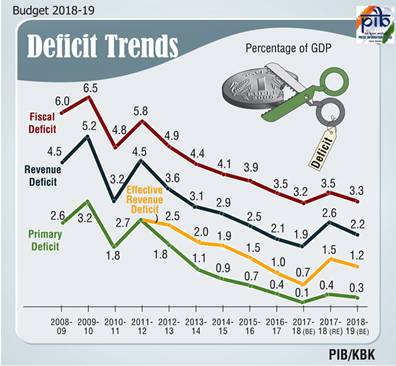
  • Fiscal Deficit pegged at 3.5 %, projected at 3.3 % for 2018-19.. Rs. 5.97 lakh crore allocation for infrastructure
    budget-2018-19-snapshot

    budget-2018-19-deficit-trends

  • Ten prominent sites to be developed as Iconic tourist destinations
  • NITI Aayog to initiate a national programme on Artificial Intelligence(AI)
  • Centres of excellence to be set up on robotics, AI, Internet of things etc
  • Disinvestment crossed target of Rs 72,500 crore to reach Rs 1,00,000 crore.
  • Comprehensive Gold Policy on the anvil to develop yellow metal as an asset class
  • 100 percent deduction proposed to companies registered as Farmer Producer Companies
    with an annual turnover upto Rs. 100 crore on profit derived from such activities, for five years from 2018-19.
  • Deduction of 30 percent on emoluments paid to new employees Under Section 80-JJAA
    to be relaxed to 150 days for footwear and leather industry, to create more employment.
  • No adjustment in respect of transactions in immovable property where Circle Rate value does not exceed 5 percent of consideration.
  • Proposal to extend reduced rate of 25 percent currently available for companies with turnover of less than 50 crore (in Financial Year 2015-16), to companies reporting turnover up to Rs. 250 crore in Financial Year 2016-17, to benefit micro, small and medium enterprises.
  • Standard Deduction of Rs. 40,000 in place of present exemption for transport allowance and reimbursement of miscellaneous medical expenses. 2.5 crore salaried employees and pensioners to benefit.
  • Relief to Senior Citizens proposed:
    • Exemption of interest income on deposits with banks and post offices to be increased from Rs. 10,000 to Rs. 50,000.
    • TDS not required to be deducted under section 194A. Benefit also available for interest from all fixed deposit schemes and recurring deposit schemes.
    • Hike in deduction limit for health insurance premium and/ or medical expenditure from Rs. 30,000 to Rs. 50,000 under section 80D.
    • Increase in deduction limit for medical expenditure for certain critical illness from Rs. 60,000 (in case of senior citizens) and from Rs. 80,000 (in case of very senior citizens) to Rs. 1 lakh for all senior citizens, under section 80DDB.
    • Proposed to extend Pradhan Mantri Vaya Vandana Yojana up to March, 2020. Current investment limit proposed to be increased to Rs. 15 lakh from the existing limit of Rs. 7.5 lakh per senior citizen.
      budget-2018-19-trends-in-tax-receipts

  • More concessions for International Financial Services Centre (IFSC), to promote trade in stock exchanges located in IFSC.
  • To control cash economy, payments exceeding Rs. 10,000 in cash made by trusts and institutions to be disallowed and would be subject to tax.
  • Tax on Long Term Capital Gains exceeding Rs. 1 lakh at the rate of 10 percent, without allowing any indexation benefit. However, all gains up to 31st January, 2018 will be grandfathered.
  • Proposal to introduce tax on distributed income by equity oriented mutual funds at the rate of 10 percent.
  • Proposal to increase cess on personal income tax and corporation tax to 4 percent from present 3 percent.
  • Proposal to roll out E-assessment across the country to almost eliminate person to person contact leading to greater efficiency and transparency in direct tax collection.
  • Proposed changes in customs duty to promote creation of more jobs in the country and also to incentivise domestic value addition and Make in India in sectors such as food processing, electronics, auto components, footwear and furniture.
Source: PIB

Monday, February 13, 2017

New Income Tax Rates And Deductions Applicable From April 1, 2017

New Income Tax Rates And Deductions Applicable From April 1, 2017

With some tinkering in the income tax rates for 2017-18, Finance Minister Arun Jaitley reduced the tax rate for income between Rs. 2.5 lakh and Rs. 5 lakh to 5 per cent in the Union Budget, while adding a surcharge of 10 per cent on tax for income between Rs. 50 lakh and Rs. 1 crore.

Although the basic income tax exemption limit remains the same at Rs. 2.5 lakh, there are many exemptions available in the Income Tax Act, which can substantially reduce your tax liability.

One needs to plan from the beginning of the next financial year to take maximum benefit of the income tax deductions available.

Here are the new income tax slabs for taxpayers:

General categorySenior citizensSuper senior citizens
(Up to 60 years of age)(60-80 years)(Above 80 years)
IncomeTaxIncomeTaxIncomeTax
Up to Rs. 2.5 lakhNilUp to Rs. 3 lakhNilUp to Rs. 5 lakhNil
Rs. 2,50,001-Rs. 5 lakh5%Rs. 3,00,001-Rs. 5 lakh5%Rs. 5,00,001-Rs. 10 lakh20%
Rs. 500,001-Rs. 10 lakh20%Rs. 5,00,001-Rs. 10 lakh20%Above Rs. 10 lakh30%
Above Rs. 10 lakh30%Above Rs. 10 lakh30%
# Surcharge of 10% for income between Rs. 50 lakh and Rs. 1 crore
# Surcharge of 15% for income above Rs. 1 crore
# Rebate of up to Rs. 2,500 for taxable salary up to Rs. 3.5 lakh
# Education and higher education cess of 3%
Here are the some of the deductions available for FY2017-18: 

House Rent Allowance under Section 10 (13A) of the Income Tax Act

House Rent Allowance, commonly known as HRA, makes up a major chunk of a salaried individual’s total pay. HRA is partly exempted from tax. If you are staying in your own house or not paying any rent, your HRA will be completely taxable. However, those who stay with their parents can also claim HRA benefits by paying rent to their parents.

The amount which is allowed for exemption under HRA is calculated as minimum of:

1) Rent paid annually minus 10 per cent of basic salary plus dearness allowance
2) Actual HRA received
3) 40 per cent of basic and dearness allowance (50 per cent in case of metro cities)

Deductions under Section 80C
Section 80C of the Income Tax Act provides various provisions under which an individual can get deduction benefits up to Rs. 1.5 lakh. Employees’ Provident Fund (EPF), Public Provident Fund (PPF), Sukanya Samriddhi Account, National Savings Certificate and tax-saving fixed deposits are some of the investment options that offer benefits under Section 80C. The premium paid for life insurance plans, National Pension Scheme (NPS) and tax-saving mutual funds (ELSS) also qualify for deduction under Section 80C.
Further, one can claim tuition fees paid for up to two children, principal repayment on home loan, stamp duty and registration cost on the house bought as deduction under Section 80C.

Deductions under Section 80CCD(1B)
Introduced in Budget 2015-16, Section 80CCD (1B) provides deduction up to Rs. 50,000 for investment in NPS Tier 1 account. This deduction is over and above the deduction available in Section 80C. An individual in 30 per cent tax bracket can save up to Rs. 15,450 of tax by investing Rs. 50,000 in NPS.

Deduction of interest on housing loan (Section 24B)
Buying a house is among several other things an individual wants to do during his or her lifetime. The income tax rules also incentivise the same. Under Section 24B of the Income Tax Act, interest paid up to Rs. 2 lakh on housing loan and up to Rs. 30,000 on home improvement loan is allowable as deduction from your taxable income.

The government has however cut down tax benefits borrowers enjoyed on properties let out on rent. As per current tax laws, for properties rented out, a borrower could deduct the entire interest paid on home loan after adjusting for the rental income. On the other hand, borrowers of self-occupied properties get Rs. 2 lakh deduction on interest repayment on home loan.

However, according to the proposed change in Budget 2017, on rented properties, the borrower can only claim deduction of up to Rs. 2 lakh per year after adjusting for the rental income. And the amount above Rs. 2 lakh can be carried forward for eight assessment years.

Since the interest component of home loan repaid in initial years is higher, experts say that the borrower may not be able to fully adjust the interest paid as deduction even in subsequent years.

Deduction under Section 80EE
Under Section 80EE, an additional deduction of Rs. 50,000 is available over and above the limit of Section 24B on interest paid on home loans if the person is buying a house for the first time (the person must not own any other residential property on the date of sanction of loan). However, to avail the benefit of this section the value of the property must be below Rs. 50 lakh and the loan amount should not exceed Rs. 35 lakh. Further, the property must be bought after April 1, 2016.

Deduction under Section 80D

Premium paid for medical/health insurance for self, spouse, children and parents qualify for deduction under this Section. On can claim deduction of Rs. 25,000, if he is below 60 years of age, and Rs. 30,000 if he is above 60 years of age, towards medical insurance premium paid for self, spouse and children. Further, additional deduction of Rs. 25,000 is available if one has bought medical insurance for his parents. This deduction can go up to Rs. 30,000 if parents are above the age of 60 years.

Deduction under Section 80DD
If a tax payer has dependent parents, spouse, children or siblings who are differently-abled, then he can claim deductions up to Rs. 75,000 for expenses on their maintenance and medical treatment under this section. This deduction can increase to Rs. 1.25 lakh in case of severe disability.

Deduction under Section 80DDB
Under this section, one can claim deduction of Rs. 40,000 for treatment of certain diseases for self and dependents. The deduction can go up to Rs. 60,000 if the tax payer is above 60 years of age and if he is above 80 years of age, then the deduction amount is up to Rs. 80,000.

Deduction under Section 80E
According to the provisions of Section 80E, a taxpayer can claim deduction for interest paid on education loan for him, spouse or children. There is no upper limit on the amount of deduction. However, the loan must have been taken from a financial institutional or approved charitable institution and for full-time higher education.

Source: NDTV

Wednesday, January 18, 2017

GST: Service tax likely to be hiked to 18 percent this budget

GST: Service tax likely to be hiked to 18 percent this budget

New Delhi: Most services are likely to attract a tax of 18 percent under the Goods and Services Tax (GST) as Union Finance Minister Arun Jaitley presents the Union Budget on February 1.

It will be interesting to witness whether the Centre raises the service tax rate from the existing 15 percent by at least one percentage point to 16 percent as a precursor to the rollout of GST.
However, the Centre and states have agreed to rollout GST from July 1, 2017, after which most services will turn costlier.

Also, a higher service tax, even for three months, will help the Centre partially offset the revenue loss after the GST kicks in, sources indicated.

Under GST, the service tax collections will be divided equally between the Centre and the states. A service tax closer to the GST rate will also help consumers avoid a greater price shock after the new system is rolled out.

Jaitley-headed GST Council has agreed on a four-slab structure -5, 12, 18 and 28 percent-along with a cess on luxury and 'sin' goods such as tobacco.

Within these, two standard rates of 12 percent and 18 percent could extend to a majority of the taxable goods.

ANI

Thursday, September 22, 2016

Cabinet approves merging of Rail budget with Union Budget

Cabinet approves merging of Rail budget with Union Budget

New Delhi: In a major overhaul, the Cabinet today approved advancing presentation of the annual Budget by a month, scrapped over nine decade old tradition of having a separate Railway Budget and removed classifications for expenditure to make the exercise simpler.

With a view to get all the legislative approvals for the annual spending and tax proposals before the beginning of the new financial year on April 1, the Cabinet headed by Prime Minister Narendra Modi approved advancing date for presentation of the General Budget by a month instead of present practice of unveiling it at the end of February.

The Cabinet also approved merging Railway Budget with the general Budget and doing away with distinction of plan and non plan expenditure, officials said.

To facilitate this, the Budget Session of parliament will be called sometime before January 25, a month ahead of the current practice.

Accordingly, the beginning of budget preparation will be advanced to early October and GDP estimates made available on January 7 instead of February 7 now.

Till now Budget was presented on the last day of February and it is not until mid-May that the Parliament approves it in two parts. And with the monsoon arriving in June, most of the schemes and spendings by states do not take off until October, leaving just half a year for their implementation.

Early presentation of Budget would mean that the entire exercise is over by March 31, and expenditure as well as tax proposals come into effect right from the beginning of new fiscal, thereby ensuring better implementation.

Also, the 92 year old practice of presenting a separate budget for Railways has been scrapped and proposals pertaining to it would now form part of the General Budget.

This would lead to presentation of a single Appropriation Bill, including the estimates of Ministry of Railways, thereby saving precious time of Parliament by not having to hold separate consideration and passing of two Appropriation Bills.

The Cabinet also approved removal of distinction between Plan and Non Plan expenditure as the present classification resulted in excessive focus on former with almost equivalent neglect to items such as maintenance which are classified as non Plan.

The Cabinet felt it is the total expenditure, irrespective of Plan or Non-Plan, that generates value for the public. Plan expenditure was for the first time presented separately in the budget for 1959 to 1960.

PTI

Thursday, July 17, 2014

Income Tax Exemption Limit Raised by Rs.50,000 – Does it meet the Central Government employees’ expectations?

Income Tax Exemption Limit Raised by Rs.50,000 – Does it meet the Central Government employees’ expectations?

Finance Minister Arun Jaitley announced that the Income Tax exemption limit for individual taxpayers, below the age of 60 years has been raised from Rs. 2 lakhs to Rs. 2.5 lakhs.

The General Budget 2014-15 presented by the Union Finance Minister Shri Arun Jaitley on 10th this month, most Central Government employees were hoping that the Income Tax exemption limit for salaried pupil would be raised to atleast Rs 3 lakhs this time. But the Finance Minister delivered a shock and disappointment to everyone with an increase of a mere Rs. 50,000.

Prior to the election, based on the speeches and statements issued by the now Finance Minister, there were talks that the non-taxable income limits would be raised to Rs. 5 lakhs.

Central Government employees, who were constantly disappointed in the past few years, were not ready to believe it. But they reluctantly hoped that the amount would be raised by Rs. 1 lakh.

The fact that it was increased by only Rs. 50,000 had disappointed many. It could have been much worse had there not been any increase at all or if it was a consolatory hike of Rs. 10,000.

The Minister explained that he couldn’t offer anything more for the time being due to acute cash crunch for the newly elected Government. But he assured everybody that it is just the beginning, and that there will be plenty of positive changes in the future. Since this is the first budget presented by the new Government and since he has already granted exemption of Rs. 50,000, his promise is very believable.

It is worth mentioning that tax exemption under Section 80C is going to be increased from Rs. 1 lakh to Rs. 1.5 lakhs. It is a painful fact that tax exemptions for savings had not been increased for a number of years. There were rumours that the Government is planning to hike the exemption by Rs. 1 lakh, but the Finance Minister has offered much-needed consolation by increasing it by Rs. 50,000.

Although the change is not a huge one for thousands of Government employees who have been waiting for tax relief for a number of years, they are bound to feel mildly reassured.

The table given below shows the non taxable salary slab for the past eight years.

YEARMINIMUM INCOME CEILING
2009-101,60,000
2010-111,60,000
2011-121,80,000
2012-132,00,000
2013-142,00,000
2014-152,50,000

Source : CGEN.in
[http://centralgovernmentemployeesnews.in/2014/07/income-tax-exemption-limit-raised-by-rs-50000-does-it-meet-the-central-government-employees-expectations/]

Thursday, February 28, 2013

Relief for Taxpayers in the Bracket of Rs.2 Lakh to 5 Lakh Tax Credit of Rs.2000 to Every Person with Total Income upto 5 Lakh


Relief for Taxpayers in the Bracket of Rs.2 Lakh to 5 Lakh Tax Credit of Rs.2000 to Every Person with Total Income upto 5 Lakh

The Finance Bill 2013-14 proposes a relief of Rs.2000 to every person who has a total income upto Rs.5 lakh in a financial year. Presenting the Union Budget in the Lok Sabha today, the Finance Minister Shri P.Chidambaram said that 1.80 crore taxpayers are expected to benefit to the value of Rs.3600 crore on account of this proposal of tax credit of Rs.2000. He further said that the current slabs were introduced only last year. Hence, there is no case to revise either the slabs or the rates. However, he proposed to give some relief to the taxpayers in the first bracket of Rs.2 lakh to Rs.5 lakh.

Now Trending

34% DA Order for Central Govt Employees wef 01.01.2022 - Latest CG Employees DA Order Jan 2022

 DA Order for Central Government Employees from Jan 2022 - Finmin Order 2022 Latest CG Employees DA Order Jan 2022 Dearness Allowance payabl...

Disclaimer:

All efforts have been made to ensure accuracy of the content on this blog, the same should not be construed as a statement of law or used for any legal purposes. Our blog "Central Government Staff news" accepts no responsibility in relation to the accuracy, completeness, usefulness or otherwise, of the contents. Users are advised to verify/check any information with the relevant department(s) and/or other source(s), and to obtain any appropriate professional advice before acting on the information provided in the blog.

Links to other websites that have been included on this blog are provided for public convenience only.

The blog "Central Government Staff news" is not responsible for the contents or reliability of linked websites and does not necessarily endorse the view expressed within them. We cannot guarantee the availability of such linked pages at all times.

Any suggestions write to us
centralgovernmentnews@gmail.com