Showing posts with label 7th CPC HRA. Show all posts

Sunday, September 12, 2021

House Rent Allowance 2021 - Y Class Classification of Cities for HRA - Orders issued August 2021

 Re-classification of Mathura-Vrindavan as ‘Y’ class city for House Rent Allowance to CPSE Employees

7th CPC HRA 2021 to CPSE Employees

HRA


F.No.2(46)/2012-DPE(WC) -GL-VII/2021
Government of India
Ministry of Finance
Department of Public Enterprises

Public Enterprises Bhawan
Block 14, CGO Complex,
Lodhi Road, New Delhi-110003
Dated: 25th August, 2021

Office Memorandum

Subject: Re-classification of Mathura-Vrindavan Municipal Corporation as ‘Y’ class city for the purpose of grant of House Rent Allowance (HRA) to Central Public Sector Enterprises (CPSE) -reg.

The undersigned is directed to refer to DPE’s OM of even number dated 07.01.2013 and 07.09.2015 regarding classification of cities/town for the purpose of grant of House Rent Allowance (HRA) to CPSE employees following 2007 IDA pay scales.

2. Department of Expenditure (DOE) vide OM NO 2/4/2018-E.II(B} dated 25.02.2020 has conveyed that Mathura-Vrindavan Municipal Corporation shail stand classified as ‘Y’ class city/town for the purpose of grant of House Rent Allowance to the central Government employees posted there.

3. It has been decided that the reclassification of Mathura-Vrindavan Municipal Corporation as contained in the DoE OM 2/4/2018-E.II(B) dated 25.02.2020 would also be applicable to the employees of CPSEs following 2017/2007 IDA pay scales and following CDA pay scales in line with VI & VII Central Pay Commissions’ recommendations with effect from 01.03.2020.

4, Further, it has also been decided that the orders on classification/re-classification of cities/towns categoriesd as ‘X’, ‘Y’ and ‘Z’ issued by the Department of Expenditure for the employees of Central Government would mutatis-mutandis be also applicable to the employees of CPSEs following 2017/2007 IDA pay scales and following CDA pay scales in line with VI & VII Central Pay Commissions’ recommendations.

5. All Administrative Ministries/Departments of the Government of India are requested to bring the foregoings to the notice of the CPSE under their administrative control for necessary action at their end.

(Samsul Haque)
Under Secretary


Encl: As Above

Thursday, February 27, 2020

Classification of Cities for HRA as per 7th CPC - X Y Z Classification of Cities for HRA 2020

Classification of Cities for HRA as per 7th CPC - X Y Z Classification of Cities for HRA 2020

7th CPC HRA 2020


No. 2/4/2018-E.II(B)
Government of India
Ministry of Finance
Department of Expenditure

Dated, the 25 February, 2020
North Block, New Delhi

OFFICE MEMORANDUM

Subject:- Re-classification of Mathura-Vrindavan Municipal Corporation as 'Y' class city for the purpose of grant of House Rent Allowance (HRA) - regarding.

The undersigned is directed to invite. attention to this Ministry’s O.M. No.2/5/2014-E.II(B) dated 21.07.2015 regarding re-classification /upgradation of cities on the basis of the population figures of 2011 census for the purpose of House Rent Allowance to the Central Government employees and to say that consequent upon combining of Municipal Council of Mathura and Municipal Council of Vrindavan and constitution of Mathura - Vrindavan Municipal Corporation vide Notification No.1799/9-7-17-8(Seema Vistar)/ 2016 dated 12.05.2017 of the Government of Uttar Pradesh, resulted in increase In population and hence, Mathura- Vrindavan Municipal Corporation qualifies for classification as ‘Y’ class city/ town for the purpose of grant of House Rent Allowance to the Central Government employees.

2. It has been decided that Mathura-Vrindavan Municipal Corporation shall stand classified as ‘Y’ class city/town for the purpose of grant of House Rent Allowance to the Central Government employees posted there,

3. These orders shall be effective from 1st March, 2020.

7TH PAY COMMISSION House Rent Allowance (HRA)

4. The orders will apply to all civilian employees of the Central Government. The orders will also be applicable to the civilian employees paid from the Defence Services Estimates. In respect of Armed Forces personnel and Railway employees, separate orders will be issued by the Ministry of Defence and the Ministry of Railways, respectively.

5. In so far as the persons serving in the Indian Audit and Accounts Department are concerned, these orders are issued after consultation with the Comptroller & Auditor General of India, as mandated under Article 148(5) of the Constitution.

(Nirmala Dev)
Deputy Secretary to the Government of India

Classification of Cities in Uttar Pradesh

Already listed cities classified as Y
  • Moradabad (M.Corpn.)
  • Meerut (UA)
  • Ghaziabad* (UA)
  • Aligarh (UA)
  • Agra (UA)
  • Bareilly (UA)
  • Lucknow (UA)
  • Kanpur (UA)
  • Allahabad (UA)
  • Gorakhpur (UA)
  • Varanasi (UA)
  • Saharanpur (M.Corpn.)
  • Nodia* (CT)
  • Firozabad (NPP)
  • Jhansi (UA)

Wednesday, July 17, 2019

7th CPC HRA : Grant of House Rent Allowance to Central Government employees on basis of Census-2011

7th CPC HRA

Grant of House Rent Allowance to Central Government employees on basis of Census-2011

2/5/2017-E.II(B)
Government of India
Ministry of Finance
Department of Expenditure

North Block, New Delhi
Dated the 15th July, 2019

OFFICE MEMORANDUM

Subject:- Re-classification / Upgradation of Cities / Towns on the basis of Census-2011 for the purpose of grant of House Rent Allowance (HRA) to Central Government employees -reg.

Reference is invited to this Department’s OM No. 215/2014-E,II(B) dated 21.07.2015 relating to re-classification of cities/towns on the basis of Census-2011 for the purpose of grant of House Rent Allowance (HRA) to the Central Government employees. Orders with regard to grant of HRA on implementation of the recommendations of 7th Central Pay Commission (CPC) were subsequently issued vide OM No. 2/5/2017-E_II(B) dated 07.07.2017.

2. This Department is in receipt of references from a few Ministries/ Departments, seeking clarification with regard to continuation of special dispensation allowed in the past to cities/towns for grant of HRA at higher rates. In this context, it is clarified that any special dispensation allowed in the past to cities/towns for grant of HRA at higher rates, not specifically mentioned in aforesaid OMs No. 2/5/2014-E.11(B) dated 21.07.2015 and No. 2/5/2017-E.II(B) dated 07.072017 shall continue to apply, if the same has not been superseded/dispensed with or the existing classification of such city has not been revised to a higher classification on account of the population criteria, vide aforesaid OMs dated 21.07.2015 and 07.07.2017.

3. In so far as the persons serving in the Indian Audit and Accounts Department are concerned, these orders issue in consultation with the Comptroller & Auditor General of India.

(Nirmala Dev)
Deputy Secretary to the Government of India

Source: DoE

Thursday, April 4, 2019

Admissibility of House Rent Allowance (HRA) in the event of non-acceptance or surrender of railway residential accommodation

Admissibility of House Rent Allowance (HRA) in the event of non-acceptance or surrender of railway residential accommodation

GOVERNMENT OF INDIA
MINISTRY OF RAILWAYS
RAILWAY BOARD
No.E(P&A)II/2012/F.E.2/4
The General Manager,
All Indian Railways/PUs, NF(Con), CORE
The DG/RDSO/Lucknow, DG/NAIR/Vadodara
CA0s,DMW/Patia1a, WPO/Patna, COFMOW/NDLS, RWP/Bela, CAO/IROAF
Dated: 02.04.2019

Sub: Admissibility of House Rent Allowance (HRA) in the event of non-acceptance or surrender of railway residential accommodation.

Ref:
(1) Department of Expenditures, MoFs 0M No.2/5/2017-E.IIB dated 05.03.2019
(2) Rai1way Board’s letter No.E(P&A)II-87/HRA-15, dated 16.5.1988
(3) Rai1way Board’s No.E(P&A)II-95/HRA-3, dated 14.02.1996
(4) Rai1way Board’s letter No.E(P&A)II-99/HRA-2, dated 12.07.1999 & 16.03.2000
(5) Rai1way Board’s letter No.E(P&A)II-2002/HRA-4, dated 16.10.2002 & 09.05.2003
(6) Rai1way Board’s No.E(P&A)II-2010/HRA-2, dated 08.12.2010
(7) Rai1way Board’s letter No.E(P&A)II-2017/HRA-3, dated 15.01.2018

With reference to Department of Expenditure, Ministry of Finance’s Office Memorandum at (I) & other Railway Board’s references above, Board (MS, FC & CRB) have approved the following:
For other than those Railway employees (officers and staff) for whom accommodation is specially earmarked and whose occupation of railway quarter is essential for easy accessibility during emergencies, efficient discharge of their duties, et., the condition of Applying for Government Accommodation and furnishing of ‘No Accommodation Certificate’ by Employees to become eligible for HRA may be dispensed with and Department of Expenditure. MoF’s letter under reference may be made applicable Mutatis Mutandis is for such categories of Railway employees.
Railway accommodation so vacated may be allotted to other employees of the same pool or other pool or Essential category employees by changing the pool, if required, by the Zonal Railway. The Quarter-allotment Authority shall promptly take necessary action in this regard.

Other extant instructions/guidelines issued from Board on the subject shall remain unchanged as modified from time to time.

Department of Expenditure, MoF’s letter under ref. (1) is enclosed for ready reference.

This issues with the concurrence of Associate Finance of Transformation Cell Of Railway Board.
Kindly acknowledge the receipt and ensure compliance.
sd/-
(Umesh Balonda)
Executive Director/S&T)
Transformation Cell

Thursday, August 16, 2018

Grant of additional House Rent Allowance (HRA) to the civilian employees of the Central Government - Finmin Order

Grant of Additional House Rent Allowance to CG Employees - Finmin Order 14.8.2018
Grant of additional HRA to the civilian employees of the Central Government serving in the States of North Eastern Region, Andaman & Nicobar Islands, Lakshadweep Islands and Ladakh

No.28/1/2017-E.II(B)
Government of India
Ministry of Finance
Department of Expenditure
New Delhi, dated the 14th August,2018
OFFICE MEMORANDUM

Subject: Grant of additional HRA to the civilian employees of the Central Government serving in the States of North Eastern Region, Andaman & Nicobar Islands, Lakshadweep Islands and Ladakh.

Consequent upon revision of rates of House Rent Allowance (HRA)/additional HRA w.e.f. 01.07.2017 vide this Department’s O.M. No.2/5/2017-E.ll(B) dated 07/07/2017 and O.M. of even number dated 19.07.2017 respectively, it has been decided to grant additional HRA at old duty station w.e.f. 01.07.2017 to all those Central Government civilian employees who have been transferred to North Eastern Region, Andaman & Nicobar Islands, Lakshadweep Islands and Ladakh, prior to 01.07.2017 or after 01.07.2017 and continue to remain posted there after 01.07.2017, as under:-
(i) ln case of civilian employees of Central Government transferred to and posted from a date prior to 01.07.2017 who leave their families behind at the old duty station, the HRA of the old duty station will be calculated on the revised pay drawn on 01.07.2017 with the percentage rates of HRA effective on 01.07.2017 as per 0.M. No. 2/5/2017.E.ll(B) dated 07/07/2017.

(ii) In case of civilian employees of Central Government transferred to and posted from a date on or after 01.07.2017 who leave their families behind at the old duty station, the HRA of the old duty station will be calculated on the revised pay drawn on the date of transfer with the percentage rates of HRA effective on the date of transfer.

2. This is issued with the approval of Secretary (Expenditure)
sd/-
(Nirmala Dev)
Deputy Secretary to the Government of India
Source: https://www.doe.gov.in

Tuesday, October 24, 2017

House Rent Allowance (HRA) : Report of the Committee on Allowances

House Rent Allowance (HRA) : Report of the Committee on Allowances

House Rent Allowance (HRA) (Para 8.7.3-16)
 
Existing Provisions: HRA is paid @30, 20 and 10 percent for X class (50 Lakh & above), Y class (5 to 50 lakh) and Z class (below 5 lakh) cities respectively.

At present, in the case of those drawing either NPA or MSP or both, HRA is being paid as a percentage of BP+NPA or BP+MSP or BP+NPA+MSP respectively.

Recommendations of 7th CPC: It has been retained and rationalized. After applying a multiplication factor of 0.8, the rates have been revised downwards to 24 percent, 16 percent and 8 percent of the Basic Pay for X, Y and Z class cities, respectively.

The rate of HRA will be revised to 27 percent, 18 percent and 9 percent when DA crosses 50 percent, and further revised to 30 percent, 20 percent and 10 percent when DA crosses 100 percent. Add-ons like NPA, MSP, etc. should not be included while working out HRA.

Demands:
 
I. National Council (Staff Side), JCM: HRA may be retained @30%, 20% and 10% for X, Y and Z cities respectively as the Commission has taken unreliable statistics to determine HRA, which has been reduced by a multiplication factor of 0.8 to 24%, 16% and 8% for X, Y and Z cities respectively.

II. CAG, Civil Aviation, M/o Health & FW, M/o HRD - D/o of Higher Education, MEA, Coal, DAE, DRDO, Dep. Of Space, CVC: Retain the allowance at the existing rates.

III. M/o of Law & Justice- D/o Justice: Cities having population of more than 1 crore may be granted HRA @ 30%.

Analysis and Recommendations of the Committee: The Committee has the following observations on the recommendations of the 7th CPC on HRA:
 
(I) HRA rates have been revised downwards by applying the multiplication factor of 0.8 applied by the 7th CPC on all percentage- based allowances. This was done to neutralise the significant increase in the Basic Pay. All fixed allowances have only been given an inflation indexed increase by the 7th CPC. While the 7th CPC has not explicitly stated how the multiplication factor of 0.8 has been arrived at anywhere in the Report, it may be seen that factoring in the expected Dearness Allowance of 125% on 01.01. 2016 would have yielded a multiplication factor of 0.875 which may have been rounded off to 0.8.

(II) On the 7th CPC recommendation that the rate of HRA will be revised to 27%, 18% and 9% when DA crosses 50 percent and further revised to 30%, 20% & 10% when DA crosses 100%, the Committee is of the view that given the inflation rates since January 2016 and the RBI policy on inflation, the DA rates might not go beyond 50% in the next 10 years.

(III) While the rents for residential accommodation have not gone up significantly in the recent past and might also have fallen in some areas, the HRA at the rates recommended by the 7th CPC at the lower levels might not continue to be adequate as per the prevailing market rent.

In view of these observations, the Committee has deliberated upon the following three options which separately, or in combination, can be suggested by way of modifications to the 7th CPC recommendations:

Option (i): Having regard to submissions made before it stating that towards the later part of the ten year period, HRA compensation falls considerably short of requirement, the 7th CPC has recommended that the rate of HRA will be revised to 27 percent, 18 percent and 9 percent when DA crosses 50 percent, and further revised to 30 percent, 20 percent and 10 percent when DA crosses 100 percent. However, considering the present inflation rate, the rate of increase of the Dearness Allowance and future inflation projections, it appears unlikely that DA rates will reach 100 % in the ten year period. Taking this into consideration, the Committee considered that the timing of the upward revisions in HRA rates proposed by the 7th CPC may be advanced as under:

report-on-allowances-hra


This would have no immediate financial implication and the 1st revision, as per the current trend of increase in DA, is expected to occur in July, 2018. Accordingly, additional annual financial implication in July, 2018 will be approximately Rs.1850 crore. The additional financial implication in the second, third and fourth revision will also be
approximately Rs.1850 crore per annum.

Option (ii): Instead of advancing the full restoration of HRA rates, the Committee considered splitting the revisions proposed by 7th CPC as under:

7th-CPC-report-on-allowances-hra


The financial implication would be similar as in Option (i) except that the timing of the revision would undergo a change.

Option (iii): It has been pointed out that at the recommended rates, HRA at the minimum level might not be sufficient. The minimum HRA calculated at the entry level of Level 1for X, Y and Z category cities at the rates recommended by the 7th CPC will be Rs.4320, Rs.2880 and Rs.1440 respectively. The Committee considered recommending that the HRA at the rates recommended by the 7th CPC may be subject to a floor which may be fixed at Rs.5400, Rs.3600 and Rs.1800 per month, calculated at 30%, 20% and 10% of the minimum pay for X, Y and Z category cities respectively. This will benefit employees in Levels 1, 2 and 3.

The additional financial implication is estimated to be Rs. 385.00 crore and around 7.70 lakh employees shall be benefited. After a detailed consideration of the above options, the Committee recommended that either only option (iii) or option (iii) in combination with option 
(ii) be accepted. A final decision in this regard may be taken by E-CoS.

Authority: www.doe.gov.in
Click to view the Report

Wednesday, June 14, 2017

7th Pay Commission: Latest Developments On Allowances, HRA

7th Pay Commission: Latest Developments On Allowances, HRA
7TH CPC
The government had last year accepted the recommendation of Justice AK Mathur-headed Seventh Pay Commission in respect of the hike in basic pay and pension.


The Union Cabinet today did take up proposals related to 7th pay commission allowances, including HRA, as it was not part of the meeting’s agenda, sources told NDTV. Finance Minister Arun Jaitley is on an official visit to South Korea. Nearly 50 lakh central government employees could get revised allowances under 7th pay commission award, including HRA or house rent allowance, from July, Financial Express in a report said last week. The report, citing sources, said that the Cabinet may decide on 7th pay commission allowances this month.
The Ashok Lavasa committee, which examined the 7th pay commission's recommendations on allowances, submitted its report to the finance minister on April 27. An Empowered Committee of Secretaries was set up screen the report and firm up proposals for the Cabinet.
The Lavasa committee suggested some modifications in some allowances that are applicable universally to all employees as well as certain other allowances which apply to specific employee categories, the finance ministry had said in a statement. Economists say that disbursement of 7th pay commission allowances is expected to give a further boost to consumer spending and thus the broader economy.

The Reserve Bank has however flagged upside risks to inflation from disbursement of revised 7th pay commission allowances. "At the current juncture, global political and financial risks materialising into imported inflation and the disbursement of allowances under the 7th central pay commission's award are upside risks. The date of implementation of the latter is still not announced and as such, it is not factored into the baseline projections," the RBI said in its latest monetary policy statement last week.
The government had last year accepted the recommendation of Justice AK Mathur-headed Seventh Pay Commission in respect of the hike in basic pay and pension. The 7th Pay Commission's recommendations relating to allowances were referred to the Ashok Lavasa committee.

The 7th pay commission had recommended that house rent allowance be paid at the rate of 24 per cent, 16 per cent and 8 per cent of the new basic pay, depending on the type of city. The 7th pay commission had also recommended that the rate of HRA be revised to 27 per cent, 18 per cent and 9 per cent when DA or dearness allowance crosses 50 per cent, and further revised to 30 per cent, 20 per cent and 10 per cent when it crosses 100 per cent. With regard to allowances, employee unions have demanded HRA at the rate of 30 per cent, 20 per cent and 10 per cent.

The 7th pay commission had recommended that of a total of 196 allowances, 52 be abolished altogether and 36 be abolished as separate identities by subsuming them in another allowance.

The Cabinet had earlier approved modification in recommendations of the 7th pay commission relating to the method of revision of pension of pre-2016 pensioners and family pensioners based on recommendations of a high-level panel. The decision will benefit over 55 lakh pre-2016 civil and defence pensioners and family pensioners.

Friday, May 12, 2017

7th CPC HRA : Justification for Retaining the Existing Rates of 10%, 20% and 30%

7th CPC HRA - Justification for Retaining the Existing Rates of 10%, 20% and 30%

"How justified is the stand of 7th CPC to apply a factor 0.8 to suppress the quantum of allowances is beyond comprehension."

HOUSE RENT ALLOWANCE

Housing accommodation is provided to a small segment of the Civil Servants. While the percentage of satisfaction is very high at the senior level Officers, Employees at the lower levels are to depend upon the market for a dwelling place. Of late recruitment at Gr B and C levels in Central Govt Offices is on the basis of an all India Examination and the regional recruitment which was in prevalence a decade back has been dispensed with. Once, recruited, he/she is perforce to be posted outside his/her home state making it necessary to search for a dwelling unit at the place of his/her posting and compete with those workers in the private sector whose salary levels in certain cases are phenomenally high. Housing in the country, despite introduction of various projects, tax concessions etc, continues to be a seller's paradise. A simple scrutiny of the rate of increase in the cost of construction and the rates quoted by the property dealers, real estate agents and tenant facilitators will reveal the extent of escalation in rent over the last a decade.

In Para 8.7.14 the 7th CPC has made a bald statement that with the increase in Basic pay most of the employees will be able to afford rented houses as per their entitlement. The Chart given under Para 8.7.14 indicates the rent increases over a period between 2006-14. The rent is shown to have gone up by 118% by 2014. The Commission has sourced the house rent index figures from AICPI (IW). We have no hesitation to state that the Commission's observation based upon the most unreliable data must be discarded. Even according to the said data, which only indicates the figures upto 2014, the registered increase was 118%. The progression between 2009 to 2014 from 136 to 168 gives an average increase of 22 points. This reads as much similar to the progression of the AICPI (IW) prepared by the Indian Labour Bureau Shimla, whose commodity prices have been adopted by the 7 CPC for minimum Wage computation.

How divorced those rates are from the reality in the market has been explained with facts and figures in our letter dated 10.12.2015 to the Chairman, Empowered Committee of Secretaries. Even if one bases the computation on such unreliable data, the hypothetical progression of the housing index by end of 2015 shall be 279-290 which warrant an increase by 136%.

Relating the index figures indicated in chart under Para 8.7.14 to the DA percentage as on 1.1.2016.(125%), the ratio obtaining both in H1 and H2 i.e. 123 to 260 (2014) and 126 to 268 (2014) are 2.11 and 2.13 respectively. If the same is calibrated to 125% as on 1.1.2016, the ratio shall be 2.64 and 2.66. This will necessitate raising the HRA to 33.13% in Metro Cities, 22% in Y Class Cities and 11.12% in Z class towns.

The hypothetical progression on average basis will also make it necessary to compensate housing expenses at 29.7% in Metro Cities and 19.74% in Y class Cities and 9.87% in Z class towns.

The Commission is on record to state that the house rent factor in AICPI (IW) is on an average 15.27. The 6th CPC has indicated the factor at 8.67 and has been on record to state that the factor is not uniform at all places. The rates between Metro cities and small towns vary violently. This apart the Commission has applied a factor of 0.8 to all allowances, which are not cost indexed on the specious plea that wages per- se has been increased. While the Basic wages registered a paltry rise of 14% over a period of ten years (1.4% per annum) how justified is the stand of 7th CPC to apply a factor 0.8 to suppress the quantum of allowances is beyond comprehension. The Commission has proceeded with the assumption that the grant of 30,20 and 10% of the determined basic pay was a full and perfect reimbursement of expenses incurred by the Government employees on housing, which is undoubtedly erroneous as could be evidenced from the observation of the 6th CPC itself. Even if all these untenable contentions of 7 CPC and the unreliable statistics are taken into account, still it is clear that in order to maintain the present compensation level, the commission ought to have maintained the status quo in respect of rates of HRA and should not have reduced it by the application of 0.8 factor. We, therefore, request for the reasons adduced above, that the HRA may be retained at the levels determined by 6th CPC i.e. 30, 20, and 10 per cent of Basic pay for X,Y, Z class of cities and towns respectively.

Source: http://nfaeehq.blogspot.in/

Monday, April 17, 2017

Delay in 7th CPC Allowances: Is any compensation on the way

Delay in 7th CPC Allowances: Is any compensation on the way: 

7th-Pay-Commisssion-latest-news

Committee on Allowances has concluded his exercise as the last meeting was held on 6th April, 2017 and the confirmation of the submission of report to Govt. has not yet available from authentic sources. Cabinet Secretary has already assured to JCM that he will put-up the report to the Cabinet for early approval. There is an indication that govt is considering for compensation to Central Government Employees for inordinate delay of implementation of the allowances as per recommendation of Seventh Central Pay Commission.

Source has decoded that the Government is planning to make the announcement for a Compensation on Allowances in lieu of delay in allowances recommended by the 7th Pay Commission. There are so many questions here and also have been analyzed to judge you on this matter.

When the allowances at the new rates will be implemented?
According to the earlier posts of  the Cabinet to adjudge on 7th CPC revised allowances before April 23 and the other hand the RBI is not in the mood to outlaw the govt to implement the revised allowances. Read the full article RBI is not against the HRA hike as per 7th CPC HRA; Analysis.

What is the crucial date of effect of allowances at the rate recommended by 7th Pay Commission and the committee of allowances?
Answer of this question is factual under two sides, first the demand of employees and the second the way of implementation of 7th CPC. The employees and their union are pressing hard on the implementation of revised allowances from the date of implementation of 7th CPC i.e. 01.01.2016. Whether the demand of employees union is illegitimate? Not fully, in view of the timing of constitution of the 7th CPC. The unions are blaming to the committee and the government for the delay.

The delay in implementation of 7th CPC was not from the employees side.
The constitution of the 7th CPC was notified vide the resolution dated 28th of February 2014 under the Chairmanship of Justice Shri Ashok Kumar Mathur, Shri Vivek Rae as full time member and Smt. Meena Aggarwal as Secretary, with the condition to give the report in 18 months. As per initial notification the report was to be submitted in the month of August 2015, but the commission got the extra 3 months for submission of report and finally the commission handed over the report to govt on Nov, 2015 after 3 months. Although, two to four months were enough to complete the other formality for implementation by implementation cell of finance ministry, but govt handed over the all exercise to a empowered committee. Lastly the govt has approved some recommendation of the 7th CPC for implementation to Central Government Employees on 25th July, 2016 after 8 months of receiving of report and the employees was entitled to get the arrears of revised basic pay from 01.01.2016 and new salary from the month of August, 2016.

What will be the effective date of revised allowance from 01.01.2016 or 01.08.2016 or the month after the approval of report of allowances committee?
As the employees union are demanding the effective date of allowances from 01.01.2016, is seems hard to be accepted by the govt. We knows the allowance in 6th CPC and previous CPCs were also not implemented retrospectively as the revised basic pay means the allowances were given from the date of approval/implementation of revised pay as per respective CPC.

Hence it is easily interpreted that the revised allowances will not be given from the date of revision of Basic Pay in 7th CPC i.e. 01.01.2016. Now the question arise here, what about the date of approval/implementation of 7th CPC to Central Government Employee by the Govt. Perhaps, the date can be 01st August, 2016. The all the facts says that the employees are eligible to get the revised/enhanced allowances from the date of approval of the 7th CPC as the withheld decision in the formulation of a committee by fully from the Govt. side. As the employee unions were objected on many issues like minimum pay, advances, allowances etc. but govt delayed only the allowances.

Whether govt will revised the allowances with retrospective effect?
To find the answer of the above question, the pay and allowances as per the 7th CPC norms should be analyzed as a summary. Here the lowest pay scale is taken to understand the difference between 6th CPC & 7th CPC Pay:-

The lowest Pay Scale was in the 6th CPC = PB 1 (5200-20200) & Grade Pay 1800
The employee in this scale was getting the following prior the 7th CPC on 01.01.2016 -

Basic Pay: Rs. 5200 + Grade Pay 1800 = Rs. 7000
(The pay for newly appointee was differ)
DA on 01.01.2016 = Rs. 8330
For X Group City
HRA - 2100
Tpt All - 600 + 714 = Rs. 1314
Total Gross Salary = 17430
The employee in this scale was eligible in the 7th CPC with effect from 01.01.2016 -
Basic Pay = Rs. 18000
HRA = Rs. 4320 and Tpt = 1350

Now
Difference in Basic Pay is Rs. 2670
Difference in Allowance (HRA only) is Rs. Rs.2220

As per above illustration the difference of revised basic pay and revised allowance (HRA) is nearly 85%. Means govt has saved 85% corpus of expenditure in enhancement of pay and allowances of Central Government Employee by delaying the approval of allowances. By this central government employees was loosing this amount since August, 2016. Hence it is also instituted that Govt employees are eligible for a compensation in situation of not getting the revised allowance from the date of implementation of 7th CPC i.e. August, 2016.

Union demand of revised allowance from 01.01.2016 may be persuaded by the compensation
As per sources indicated that the Committee to check the 7th CPC recommendation on allowances has given the importance the union demand to give the enhanced allowances from the date of 01.01.2016. A positive note given by the committee as per suggestion to the govt. to compensate the employees for the delay in decision regarding allowances. The sources has also indicated that the compensation will be given as monthly rate from Jan, 2016 or August, 2016 upto the date of approval/decision given by govt on revised allowances.

Conclusion: It is the matter of future that what, how much and when the revised allowances will be given to the Govt. employees? But it is fact that employees are eligible for the revised allowances from the August, 2016 and either the allowances must be given retrospectively or as compensation. Which type of days will coming to the Central Government Employees after a loss of revised allowances for 9 months and how the govt makes it as "Achhe Din" to their Govt employees or govt is following their logo "Sabka Saath Sabka Vikaas".

Via: Paramnews.com

Monday, April 10, 2017

7th CPC recommended an increase in house rent allowance (HRA) of 8-24 per cent of basic pay

Seventh Central Pay Commission Allowances

The 7th CPC recommended an increase in house rent allowance (HRA) of 8-24 per cent of basic pay.

The higher HRA would have a direct and immediate impact on headline CPI through an increase in housing inflation.

Assuming a rate of increase in the HRA as proposed by the 7th CPC is implemented from early 2017-18 onwards and the State Governments implement a similar order of increase with a lag of one quarter,CPI inflation could be 100-150 bps higher than the baseline for 2017-18.

The HRA impact on inflation is expected to persist for 6-8 quarters, with the peak effect occurring around 3-4 quarters from implementation. In addition, indirect effects could occur from elevated inflation expectations.

Download RBI Document

Friday, April 7, 2017

Is RBI's Monetary Policy is concerned with 7th CPC House Rent Allowances hike?

Is RBI's Monetary Policy is concerned with 7th CPC House Rent Allowances hike?

Central Government Employees are eagerly waiting for hike in allowances as per 7th Pay Commission. The 7th Pay Commission recommended the rates at which HRA is to be paid to 24 per cent, 16 per cent and 8 per cent respectively for Class X, Y and Z cities and towns respectively of new Basic pay (pay in the pay band plus grade pay multiplying by the fitment factor of 2.57). The existing rates of HRA for these cities and towns were 30 per cent, 20 per cent and 10 per cent of Basic pay (pay in the pay band plus grade pay) respectively.

Yesterday RBI has issued its First Bi-monthly Monetary Policy Statement for 2017-18. Paramnews has analyzed this report in view of early approval of allowances committee. This report has stated that the Seventh Pay Commission recommendations will not upset fiscal maths as additional expenditures will be offset by either surplus revenues or expenditure cuts. Accordingly, a view has been expressed, this time too RBI seems neutral on prohibiting to hike the allowances specially House Rent Allowances.
HERE ARE TWO QUESTIONS TO BE POINTED OUT
  • Can we Say RBI plays the vital role in implementing 7th CPC House Rent Allowances?
  • Whether Govt. had taken RBI’s report to delay the hike in HRA as per 7th CPC Recommendation?
To Find the above we should have a recap on RBI Monetary Policy Report From April 2016 to First Bi-monthly Monetary Policy Statement for 2017-18.

As per RBI Projected Monetary Policy Report April 2016:-

The implementation of the CPC's recommendations could impact inflation and growth through:
a) the direct impact of the proposed increase in the house rent allowance (HRA);
b) indirect effects operating through consumption to aggregate demand; and
c) inflation expectations channel
According to RBI The higher HRA would have a direct and immediate impact on headline CPI through an increase in housing inflation. As RBI assumed a rate of increase in the HRA as proposed by the 7th CPC is implemented from early 2017-18 onwards and the State Governments implement a similar order of increase with a lag of one quarter, CPI inflation could be 100-150 bps higher than the baseline for 2017-18. We can better understand in the below given chart by RBI.

paycommission-RBI


The implementation of the 7th Central Pay Commission (CPC) awards can have a significant bearing on the inflation trajectory through both direct and indirect channels shown by RBI in below given chart.
6thCPC-CPI

6cpc-state-govt

RBI also assumed that the impact of the pay awards is likely to be seen over a period of two years. Compared to the 6th CPC awards, increase in the housing index would be more quick and continuous and indirect effects are likely to be smaller. Moreover, outgo of arrears under 7th CPC awards would be substantially lower but HRA rates would automatically increase when the dearness allowance of the employees crosses threshold levels3.

In the broad sense, as we see the above points projected by the RBI, we can easily say that due to the reason that the Govt has stopped giving 7th CPC House Rent Allowances and constituted the Committee on Allowances under Finance Secretary Ashok Lavasa in June last year after the government implemented the recommendation of the 7th Pay Commission.

The special committee on allowances recommended by the 7th Pay Commission is expected to recommend more than double House Rent Allowance (HRA). The committee on allowances recommended by the 7th Pay Commission is likely to propose a increases ranging between 106 per cent and 122 per cent in HRA for all categories of employees. The government was also expected to start giving HRA by October 2016, including all allowances, once again a report from the RBI ?

RBI governor Urjit Patel announced in the last bimonthly monetary policy on December 7, it seems that higher allowances, if at all, will not come before March 2017 i.e. the next financial year. As the RBI Governor said that disbursement of salaries and arrears under 7th Pay Commission award has not been disruptive to inflation outcomes, he added that the extension of two months given to the Ministry of Finance to receive the notification on higher allowances under the Pay Commission's award, could push it's fuller effect into the next financial year, rather than this financial year.

As many as 14 meeting have been held between the Committee on Allowances and the central government employees' unions so far on higher allowances under the 7th Pay Commission, but no consensus could be reached.

Various Media Reports are claiming that the report will be approved by cabinet after the ongoing Budget session of Parliament is over on April 12.

The finance secretary-led panel, which is giving final touches to the reworked allowances based on the 7th pay panel's recommendations, will hold its final meeting shortly, according to various sources.

The panel met for over three hours on Wednesday to deliberate on the subject. "Decisions are broadly taken on allowances pending a final review. But these will be announced only after current Budget session ends on April 12 to avoid any controversy," another source said.

But the questions remain here:-
  • What "Decisions" will be broadly taken on House Rent Allowances?
  • When "These" will be announced ?
  • Whether the Govt. is waiting for "RBI" nod for good time? If yes, then when does the good time appear ? or
  • Is it pending due to "MCD Election" ? After 05 may 2017.
  • Is Govt waiting for Budget session of Parliament is over ? After April 12 2017.
  • Is Govt waiting for RBI Second Bi-monthly Monetary Policy Statement for 2017-18 ? After June 07, 2017.

Monday, October 24, 2016

7th CPC HRA : Allowance Committee Meeting Proposal for House Rent Allowance

7th CPC HRA : Allowance Committee Meeting Proposal for House Rent Allowance

7th-CPC-HRA

Sources said that the Allowance Committee Meeting has finalized a proposal on HRA. It will be finalized in the Meeting held on 25th October 2016. It is said that the proposed Meeting under the Chairmanship of DOPT Secretary (P) with the Secretary Staff Side, NC (JCM) is to firm up the view on various allowances pertaining to Department of Personnel & Training.

This Meeting is conducted as per the decision of Allowance Committee Meeting held on 1-9-2016. The meeting to finalize the allowances pertaining to DOPT has been scheduled to be held on 25th October 2016.
The Reliable Sources said that the Official Side are in the view of increasing HRA by 1 Stage to reach 30% , 20% and 10% .

The pay Commission recommended HRA at the rates initially from 24%, 16%, and 8 % and whenever DA reaches 50% it will be increased to 27%, 18% and 9% and Finally after DA reaches 100% the HRA will be revised to 30% , 20% and 10% for X,Y and Z cities respectively.

The NCJCM has demanded in its Memorandum submitted to the 7th Pay Commission that 60%, 40% and 20% HRA to be recommended for X,Y and Z cities.

The Pay Commission totally ignored this demand and recommended reduction of rates from Sixth CPC. Since it is Co related with DA , it will be increased after two stages to 30%, 20% and 10% after DA reaches 50% and 100%.

The sources said that now it is proposed to start the HRA rates initially from 27%, 18% and 9% and after DA reaches 50% the House Rent Allowance will be revised to 30%, 20% and 10% for X,Y and Z cities respectively.

Friday, August 19, 2016

Not Revising HRA as per 7th CPC Recommendation is a big disappointment…!


Not Revising HRA as per 7th CPC Recommendation is a big disappointment…!

7th Pay Commission submitted its Recommendation in November 2016. House Rent Allowance is one of the very important recommendation expected by CG Employees among the most expected recommendations.

A Govt servant is spending one third of his salary for paying House Rent. Considering these expenses of CG Employees those who are living in big cities, Sixth CPC has recommended 10, 20 and 30% of the Basic pay as HRA. Accordingly, HRA has been paid for the past Eight Years and the Federation Demanded to increase this rates in 7th Pay Commission.

But the Commission in its recommendation reduced these rates to 8,16 and 24%. Though it has been justified with various reasons by 7th CPC, it disappointed the CG employees. Since CG Employees felt that only these reduced rates will be paid for next ten years, their demand to restore the old rates started gaining big support. As a result of this, all the Staff associations and Federations pressurized the Government to increase the rate of HRA and it was included in charter of 7th CPC demands.

Already the Government had wasted six months in the name of Empowered Committee to examine the 7th CPC Recommendations. Until now the report of this committee is not published.

The Cabinet gave its approval for the implementation of 7th CPC recommendations on 29th June 2016. It has been stated in that report that, a committee headed by Secretary, Finance will be Constituted to examine the Allowances and committee is given four-month time to submit its report. Till then the HRA will be paid as per Sixth CPC rates.

Meanwhile, Group of Ministers invited NJCA for a meeting to with draw the Indefinite Strike proposed to commence from 11th July, In that meeting, Increasing the percentage of HRA also discussed. The Government agreed to form a committee to examine the Allowances. It has been described as Government indirectly agreed to increase the HRA.

Implementation of 7th CPC recommendation was ensured by Gazette Notification issued on 25th July 2016. But there was no Change in the recommendation of HRA.

Till now the Central Government employees are wondering that why the Committee has been given four Months’ Time to examine the HRA. As well as the decision to continue the HRA in Sixth CPC is considered as big disappointment.

HRA plays a Major Role in pay hike. So the CG Staff feel that HRA would have been paid in Revised rates from this month onwards. Thereafter paying arrears for the Increased amount in HRA will become inevitable. Because there is no assurance that Revised rates of HRA will be given retrospective effect.

Friday, July 15, 2016

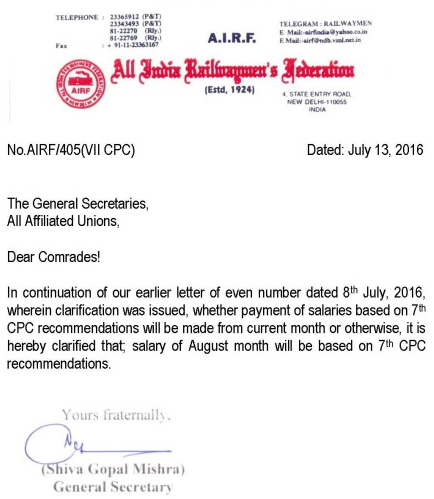
AIRF: Salary of August month will be based on 7th CPC recommendations

AIRF: Salary of August month will be based on 7th CPC recommendations

7th Pay Commission – Clarification regarding salaries to be paid

A.I.R.F.
All India Railwaymen’s Federation
No.AIRF/405(VII CPC)
Dated: July 13, 2016
The General Secretaries,
All Affiliated Unions,
Dear Comrades!

In continuation of our earlier letter of even number dated 8th July, 2016, wherein clarification was issued, whether payment of salaries based on 7th CPC recommendations will be made from current month or otherwise, it is hereby clarified that; salary of August month will be based on 7th CPC recommendations.

airf-letter-7thCPC

Saturday, July 2, 2016

House Rent Allowance (HRA) Calculations after implementation of 7th CPC

House Rent Allowance (HRA) Calculations after implementation of 7th CPC

The Union Cabinet finally cleared the 7th Central Pay Commission for implementation on the 29th of July 2016. The Report which recommended a hike in salaries and pension for employees and pensioners, will be implemented from 1st January 2016. After taking into account dearness allowance at the prevailing rate, the salary, pension to all central government employees and pensioners will increase by at least 14.29 % as on January 2016, and could go up to 23 % in upper categories.
 The union cabinet approved the recommendations of the 7th CPC on pay and pension but proposals for allowances was deferred and announced a committee under the finance secretary. The committee will analyse the allowances to be implemented or scraped. So the allowances like HRA, TA etc. will continue at existing rates for now.
 Regarding the HRA at present, it is 30 % for class X cities, 20% for Y cities, and 10% for Z class cities. However, in the 7th CPC report it was recommended that the HRA should paid at the rate of 24%, 16% and 8% of the new basic pay for X, Y and Z category of cities respectively. The commission had recommended a rise in HRA when the DA crosses 50% to 27%, 18% and 9% and further increase to 30%, 20% and 10% when the DA crosses 100%.
 Now the allowances including HRA will be kept under the newly formed committee, there will be a huge confusion when calculating allowances including the HRA. On what basis will the HRA be calculated if the new recommendations are implemented?
 For example,
6th CPC Pay in the pay band Grade Pay Basic Pay HRA @30% 7th CPC Basic pay HRA @ 24%
Rs.13690 Rs.4200 Rs.17890 Rs.5367 Rs.46200 Rs.11088
Rs.10000 Rs.2000 Rs.12000 Rs.3600 Rs.30840 Rs.7464

Let us wait and see for the government orders regarding the calculations!!!!

Thursday, June 30, 2016

Percentage of HRA in 7th pay commission after cabinet approval

Percentage of HRA in 7th pay commission after cabinet approval

The Pay commission has recommended HRA should be rationalized by using the factor 0.8 which is used for rationalising the percentage based allowances. The 7th CPC recommended 24 percent, 16 percent and 8 percent of the Basic Pay for Class X, Y and Z cities respectively. The Commission also recommended that the rate of HRA will be revised to 27 percent, 18 percent and 9 percent when DA crosses 50 percent, and further revised to 30 percent, 20 percent and 10 percent when DA crosses 100 percent.

The cabinet committee reviewed the recommendations on Allowances and they are not able to give a decision over the Allowances. Hence the Union Cabinet decided to constitute a Committee headed by Finance Secretary for further examination of the recommendations of 7th CPC on Allowances. And it is said that the Committee will complete its work in a time bound manner and submit its reports within a period of 4 months.

In the press release issued by government said the following

” The Commission examined a total of 196 existing Allowances and, by way of rationalization, recommended abolition of 51 Allowances and subsuming of 37 Allowances. Given the significant changes in the existing provisions for Allowances which may have wide ranging implications, the Cabinet decided to constitute a Committee headed by Finance Secretary for further examination of the recommendations of 7th CPC on Allowances. The Committee will complete its work in a time bound manner and submit its reports within a period of 4 months. Till a final decision, all existing Allowances will continue to be paid at the existing rates.”

Since the House Rent Allowance also listed among one of these 196 Allowances, the status HRA is not clear now. The existing rates of HRA is 30%, 20% and 10% for class X, Y and Z respectively. Whether these existing rates of HRA will be paid based on revised pay or pre revised pay..? It needs to be clarified when implementation of 7th pay commission is in process.


Tuesday, May 31, 2016

Latest Development on 7th CPC recommendations

Latest Development on 7th CPC recommendations

NJCA
National Joint Council of Action
4, State Entry Road New Delhi-110055
Ph: 011-23365912, 23343493, Fax: 23363167
No.NJCA/2016
Dated May 27, 2016
All Constituent Organisations,
National Council(JCM)

Dear Comrades,
As there had been no response from the Government to our communication dated 2nd May, 2016, we decided to seek an appointment with the Cabinet Secretary. Accordingly a delegation consisting of the following members of the NJCA met Cabinet Secretary, Shrl P.K. Sinha on 26. May 2016.

Com. Shiva Gopal Misra Com.
Guman Singh
Corn. K.K.N. Rutty

From the discussions, it appears that, the Empowered Committee has made up their mind to recommend to the Government a slight increase in the Minimum Wage. No indication was however given as to the consequential revision of the Fitment Formula and Pay Matrix. There had also not been any hint about the need to restore the percentage of the HRA, which the 7th CPC has recommended for reduction. On Advances and Allowances, abolished, the Government might be advised to setup a committee to go into the matter and make suggestions. In the matter of the New Contributory Pension Scheme also, the Government might refer the demand to a committee.

On the question of pension benefit to the retired personnel, who are covered by the defined benefit pension scheme, the Cabinet secretary indicated that, both the Department of Pension and Defence Ministry were of the firm view that the first option recommended by the 7th CPC to bring about the parity with the past pensioners being infeasible and impracticable (due to the non-availability of the requisite records) might not be accepted and acted upon.

Surprised over this development, the delegation requested for an official formal meeting of the Standing Committee so that the considered views of the Staff Side could be presented. The delegation informed to the Cabinet Secretary that, non-acceptance of the recommendation of the 7th CPC in the case of pensioners will be extremely disappointing for them and will give rise to avoidable discontent. The Cabinet Secretary suggested to the Staff Side to reach out to the Department of Pension and Ministry of Defence in’ the matter. So far he is concerned; he is an open minded on this subject, provided it is workable.

The National JCA will meet on 3rd June 2016 at New Delhi to consider these developments and take appropriate decision.

Monday, February 22, 2016

Grant of House Rent Allowance to Railway Employees Posted to New Zones/New Divisions: Railway Board orders

Railway Board decision on House Rent Allowance – Orders Issued

GOVERNMENT OF INDIA
MINISTRY OF RAILWAYS
(RAILWAY BOARD)
No.E(P&A)II-98/HRA-6
RBE No: 20/2016
New Delhi, dated 17/02/2016
The General Manager/CAO’s
All Indian Railways & Production units.

Sub : Grant of House Rent Allowance to Railway employees posted to new Zones/new Divisions – Regarding.

Attention is invited to the instructions contained in Board’s letters of even number dated 9.3.2004, 9.8.2005, 9.8.2006, 12.12.2007, 24.10.2008, 10.12.2009 , 01.07.2013 and 24.07.2014 on the above subject.

2. The matter has been considered by the Board subsequent to issue of letter No. E(G)2009 QR 1-2 dated 20.10.2014 and it has been decided that railway employees posted to ECR and NWR may be allowed house rent allowance upto 31.12.2015 on the same terms and conditions laid down in the letter of even number dated 09.03.2004 ibid and as amended/clarified from time to time.

3. This issues with the concurrence of the Finance Directorate of the Ministry of Railways.
sd/-
(Salim Md. Ahmed)
Director/E(P&A)-II
Railway Board.
Source: NFIR

Friday, December 18, 2015

Analysis and Recommendations of 7th Pay Commission on House Rent Allowance

Allowances related to Housing  : House Rent Allowance (HRA) : Presently, HRA is payable at the following rates:
House Rent Allowance (HRA)

There are a large number of demands for paying HRA as a percentage of (Basic Pay + DA), instead of as a percentage of Basic Pay alone, as at present. Representations have also been received regarding enhancement of percentage rates and having only two classifications of Metros and Non-metros (instead of the present classification of X, Y and Z cities).

PBORs of uniformed forces have vehemently argued for doing away with the concept of Authorized Married Establishment and the requirement of a minimum age of 25 years for grant of Compensation in Lieu of Quarters (CILQ).

Analysis and Recommendations: Compensation towards the housing needs of Central Government employees is covered in three ways:

1. As a component of Basic Pay when it is initially fixed (based upon the Aykroyd formula)
2. As a constituent of Dearness Allowance [the AICPI(IW), on which the DA is currently based includes a weight of 15.27% towards housing], and
3. In the form of House Rent Allowance

In view of the fact that the DA calculation methodology that is being followed does include a certain weightage for housing, the demand to pay HRA as a percentage of Basic Pay + DA is not justified.

To arrive at the appropriate rates of HRA, the Commission used a two-fold approach: (i) It compared the rise in housing compensation with the cost of housing in major X, Y and Z category cities over the period 2006 to 2013, and (ii) It compared, de novo, the HRA after the rise in Basic Pay proposed with representative house rents in major X, Y and Z category cities.

For (i) above, the table of comparison (for a hypothetical employee whose Basic Pay was Rs.1000 in 2006) is given below:

7cpc compensation for housing

As is clear from the above table, compensation for housing in 2013 was 1.79 times that in 2006 for Class X cities, 2.07 times for Class Y cities and 2.92 times for Class Z cities.
During the same period, the weighted (by population of cities) average rise31 in housing index for Class X cities was 1.69 times, for thirty most populated Class Y cities it was 2.10 times, and for twenty-five most populated Class Z cities it was also 2.10 times.

Thus, it can be safely concluded that the rise in housing compensation has largely kept pace with the rise in rental values in all categories of cities.

However, if a zero-based comparison of HRA with house rents is carried out the Commission observed that today there are websites that give a good idea of the prevalent house rents in various cities. From the information available on the websites, it was observed that with the increase in Basic Pay proposed (and consequent rise in HRA with the rationalized percentages), most of the employees will be able to afford a rented house as per their entitlement.

The Commission also took note of the link between increase in HRA and increase in house rent. There was a sharp rise in the index from the first half of 2009, immediately following VI CPC recommendations. The All India House Rent Index32 chart given below demonstrates this:


Considering all these factors, and in line with our general policy of rationalizing the percentage based allowances by a factor of 0.8, the Commission recommends that HRA should be rationalized to 24 percent, 16 percent and 8 percent of the Basic Pay for Class X, Y and Z cities respectively.

However, the Commission also recognizes that with the current formulation, once the new pay levels are implemented, the compensation towards HRA will remain unchanged until such time as the pay and allowances are next revised. Going by the historical trend this event is likely to be a decade away. Some representations have been received stating that towards the later part of the ten year period the HRA compensation falls considerably short of the requirement. Having regard to this, the Commission also recommends that the rate of HRA will be revised to 27 percent, 18 percent and 9 percent when DA crosses 50 percent, and further revised to 30 percent, 20 percent and 10 percent when DA crosses 100 percent.

Currently, in the case of those drawing either NPA or MSP or both, HRA is being paid as a percentage of Basic Pay+NPA or Basic Pay+MSP or Basic Pay+NPA+MSP respectively. HRA is a compensation for expenses in connection with the rent of the residential accommodation to be hired/leased by the employee and is graded based on the level of the employee, and therefore should be calculated as a percentage of Basic Pay only. Add-ons like NPA, MSP, etc. should not be included while working out HRA.

Monday, November 23, 2015

7th CPC recommendations to reduce House Rent Allowance

7th CPC recommendations to reduce House Rent Allowance

The 7th Central Pay Commission has been recommended to reduce the percentage of House Rent Allowance for all categories of Central Government employees rationalized to 24 percent, 16 percent and 8 percent of the Basic Pay for Class X, Y and Z cities respectively.

The Commission also recommends that the rate of HRA will be revised to 27 percent, 18 percent and 9 percent when DA crosses 50 percent, and further revised to 30 percent, 20 percent and 10 percent when DA crosses 100 percent.


7th CPC HRA: HRA is the most important factor of allowance issuing to existing Central Government employees, it is given for compensate to live in rented house. The HRA rules are allowed for getting allowance even if he/she living in own house.

A major changes had been made in 6th CPC on HRA rules. The percentages were prescribed on basic pay according to the cities in India. The cities are classified as X, Y and Z and the rates of percentage respect of the cities are 30%, 20% and 10% on basic pay (Grade pay including).

Central Government employees are expecting changes in the rate of percentage according to cities.

NC JCM STAFF SIDE SUGGESTION ON HOUSE RENT ALLOWANCE

National Council JCM Staff Side given suggestion on House Rent Allowance for Central Government employees as under…

House Rent allowance. 


The present scheme of HRA is based on the recommendation of the 6th CPC, which is as follows:


We reproduce hereunder the recommendation made by the third Central Pay Commission in the matter of grant of house rent allowance. (Para 29 Part I. Vol. IV.Chapter 56), which would be the best if implemented even today. While we find it difficult to accept the kind of parity suggested above, we are aware of the acute problem caused by the lack of adequate government housing and by the inadequate government housing and by the inadequacy of the existing rates of house rent allowance and recommend as follows:-

Government should take houses on long lease and make residential accommodation available to its employees on payment of 10% of their pay.

(ii) Government should lay down appropriate house rent allowance rates in different cities and towns based not on population criteria, but on an actual assessment of the prevailing levels of rent in different cities and towns. Alternatively, certain notional rents for different types of accommodation meant for officers and personnel of specified pay groups should be laid down for particular cities after studying the actual conditions in that city. The difference between the actual rent paid and 10% of pay should be reimbursed subject to a maximum of the difference between the notional rent and 10% of the pay. The existing norms in regard to entitlement of accommodation, size of rooms etc. could, if necessary, be reduced depending on the housing situation and the norms usually adopted by different income groups in renting accommodation in the various cities. Such notional rents should, to start with, be applied to all stations falling under the description of classified cities for purposes of House Rent Allowance, Additions could also be made to the list later on by including other cities deserving similar treatment.

 (iii) Till the Government is able to make arrangements recommended in the preceding sub-paragraphs, the rates of HRA should be as follows:-
The above said recommendations is still to be acted upon by the Government and the transitory provisions suggested by them i.e. payment of allowances at a pre-determined rate on the basis of classification made of the cities depending upon the population continue to be employed. The non-implementation of the above recommendation of the third CPC , has without exception, gone to depress the wage of all sections of Central Government employees as they are perforce to spend more than what they receive as HRA for obtaining and retaining the accommodation.
The rates prescribed by the 6th CPC, though an improvement over its predecessor Commission, it has not improved the situation. The real estate value throughout the country has skyrocketed and owning an accommodation within the city/Municipal limit has become impossible for Government employees. There is not a single town/village where the real estate boom has remained unaffected. The phenomenal increase in the value of land has naturally impacted the rent, one is to pay on leasing house/flat. The house rent allowance does not bear even a small percentage of the rent. The 7th CPC may recommend to the Government to act upon the suggestion made by the 3rd CPC without any further delay. Pending action on the part of the Government, the Commission may suggest the following rates of House Rent allowance;


Now Trending

34% DA Order for Central Govt Employees wef 01.01.2022 - Latest CG Employees DA Order Jan 2022

 DA Order for Central Government Employees from Jan 2022 - Finmin Order 2022 Latest CG Employees DA Order Jan 2022 Dearness Allowance payabl...

Disclaimer:

All efforts have been made to ensure accuracy of the content on this blog, the same should not be construed as a statement of law or used for any legal purposes. Our blog "Central Government Staff news" accepts no responsibility in relation to the accuracy, completeness, usefulness or otherwise, of the contents. Users are advised to verify/check any information with the relevant department(s) and/or other source(s), and to obtain any appropriate professional advice before acting on the information provided in the blog.

Links to other websites that have been included on this blog are provided for public convenience only.

The blog "Central Government Staff news" is not responsible for the contents or reliability of linked websites and does not necessarily endorse the view expressed within them. We cannot guarantee the availability of such linked pages at all times.

Any suggestions write to us
centralgovernmentnews@gmail.com