Showing posts with label AIRF Latest News. Show all posts

Friday, April 12, 2019

Inclusion of important categories of staff within the ambit of Risk And Hardship Matrix of 7th CPC for payment of Risk And Hardship Allowance

Inclusion of important categories of staff within the ambit of Risk And Hardship Matrix of 7th CPC for payment of Risk And Hardship Allowance

A.I.R.F.
All India Railwaymen’s Federation
4, State Entry Road, New Delhi - 110055

No.AIRF/Sub-Committee 294
Dated: April 11, 2019
The Convener,
Committee on Risk & Hardship Allowance and
EDPC-II, Railway Board,
DFCC Building, Pragati Maidan Metro Station,
New Delhi

Dear Sir,
Sub: Inclusion of important categories of staff within the ambit of Risk And Hardship Matrix of 7th CPC for payment of Risk And Hardship Allowance

Technical Staff(Helpers, Technicians, JEs and SSEs) of all Engineering Disciplines(Civil, Electrical, Mechanical and S&T Deptts.), staff engaged in train operation, sanitation and many staff of Medical Department are prone to Risk and Hardship. Their level of Risk and Hardship may vary according to their job contents, working conditions, weather conditions, work pressure and surrounding environments at the respective places.

While drawing structure of Risk and Hardship Matrix, it is clarified that, the Matrix only aims to compensate for Risk and Hardship involved in job/work environment and it does not determine status in any way.

1. Categories of Civil Engg. Deptt. (Helpers to SSEs)

(i) P. Way - JEs/SSEs, Technicians(Blacksmith, Welder, Carpenter), Helpers of Blacksmith and Welder.
Track Maintainers of Constn. Org. and USFD Staff.
(ii) Track Machine - Staff working on Openline and Workshops(JEs, SSEs, Technicians and Helpers)
(iii) Bridge Deptt., Openline and Workshops - JEs, SSEs, Technicians(Sarang, Riveter, Welder, Blacksmith, Grinder, Fitter, Machinist, Turner, Driller and Helpers).
(iv) Technicians and SSEs(Works) and also staff attending drainage cleaning.
(v) Gateman

2. Categories of Electrical Deptt.

(i) TRD Staff (Helpers, Technicians, JEs and SSEs)
(ii) TRS Staff (Helpers, Technicians, JEs and SSEs) of Openline and Workshops
(iii) Power Staff (Helpers, Technicians, JEs and SSEs) of Openline
(iv) Air-conditioning and Train Lighting Staff (Cell and Battery Fitter and Helpers)
(v) Tower Wagon Driver
(vi) General Services Staff, including Power Houses and Sub-Station Operator.
(vii) EOT Crane Driver, Slingers, Gunners

3. 7th CPC Risk And Hardship Allowance - AIRF Letter Dt.11.4.2019

(i) JEs/SSEs, Technicians and Helpers of C&W Maintenance Depots and Workshops.
(ii) JEs/SSEs, Technicians and Helpers of Locomotive Sheds and Workshops.
(iii) Lab. Sudt., C&MAs
(iv) Technicians (Fitters, BH Painters, Machinists, Welders, Millwright)
(v) Auto/ Forklifter/ Drivers, Crane Drivers, Gunners, Slingers

S&T Deptt.

(i) JEs/ SSEs (Signal), ESMs, MSMs and Helpers
(ii) JEs/ SSEs (Telecom.), TCMs, WTMs and Helpers

5. Operating Deptt.

(i) SMs, YMs, TNCs, Pointsman, Shuntman, Shunting Jamadar, Shunting Master, Traffic Asstt.

6. Medical Deptt.

Radiographers, Safaiwala, Malaria Staff

7. Technical Staff (JEs/ SSEs, Technicians, Helpers) of Production Units of all Engg. Disciplines

All categories, having job contents, related to Annexure of RBE No.44/2013 dated 02.05.2013.
Yours faithfully,
sd/-
(Shiva Gopal Mishra)
General Secretary
Source: AIRF

Friday, July 15, 2016

AIRF: Salary of August month will be based on 7th CPC recommendations

AIRF: Salary of August month will be based on 7th CPC recommendations

7th Pay Commission – Clarification regarding salaries to be paid

A.I.R.F.
All India Railwaymen’s Federation
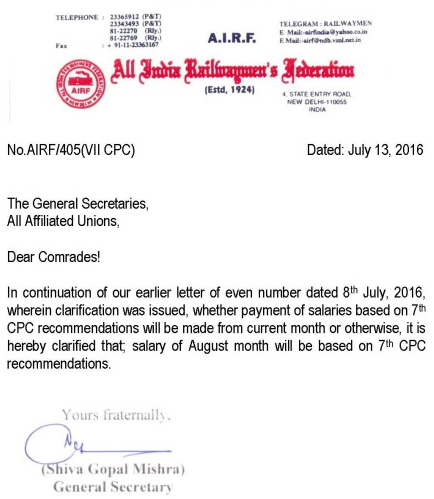
No.AIRF/405(VII CPC)
Dated: July 13, 2016
The General Secretaries,
All Affiliated Unions,
Dear Comrades!

In continuation of our earlier letter of even number dated 8th July, 2016, wherein clarification was issued, whether payment of salaries based on 7th CPC recommendations will be made from current month or otherwise, it is hereby clarified that; salary of August month will be based on 7th CPC recommendations.

airf-letter-7thCPC

Thursday, June 30, 2016

No improvement in Minimum Wage and Multiplying Factor – AIRF

No improvement in Minimum Wage and Multiplying Factor – AIRF

We should go ahead with our preparations for “Indefinite Strike – Com. Shiva Gopal Mishra
It is quite unfortunate that, our demand for improvement in the report of the VII CPC has not been considered by the government.

Therefore, it would be quite appropriate that, we should go ahead with our preparations for “Indefinite Strike”, slated to be commended from 06:00 hrs. on 11th July, 2016…. Complete letter is uploaded below:-

A.I.R.F
All India Railwaymen Federations
4,STATE ENTRY ROAD, NEW DELHI-110055
No.AIRF/160
Dated: June 29, 2016
The General Secretaries,
All Affiliated Unions,

Dear Comrades!
Sub: Cabinet approval on the VII CPC report

As all of you are aware that the Union Cabinet has accepted the report of the VII CPC today.

It has been noticed that there is no improvement in Minimum Wage and Multiplying Factor as well, which was our hard pressed demand. Instead, wages, as recommended by the VII CPC have been accepted as it is, which is highly disappointing.

Only two committees have been formed, one to take care of the allowances and another for National Pension Scheme, which will submit their reports within four months time.

It is quite unfortunate that, our demand for improvement in the report of the VII CPC has not been considered by the government.

Therefore, it would be quite appropriate that, we should go ahead with our preparations for “Indefinite Strike”, slated to be commended from 06:00 hrs. on 11th July, 2016.

You are also advised to intensify the mass mobilization.
With fraternal greetings!
Yours faithfully
(Shiv Gopal Mishra)
General Secretary
Source: AIRF

Thursday, June 16, 2016

Empowered Committee meeting scheduled on 11.6.2016 has been cancelled – AIRF

Empowered Committee meeting scheduled on 11.6.2016 has been cancelled – AIRF

Internal meeting of group of secretaries scheduled on 11.06.2016 on 7th Pay commission didn’t take place

Internal meeting of group of secretaries which was scheduled to be held on 11.06.2016 has been cancelled. Meeting didn’t take place at all. Shri P.K. Sinha Cabinet Secretary is heading the committee of Group of Secretaries.

On the clarion call of the National Joint Council of Action (NJCA), against the retrograde recommendations of the VII CPC, 11-point Charter of demands of the Central Government employees as also non-settlement of long pending genuine demands of the Railwaymen, AIRF and its affiliates organized huge demonstrations at all Zonal Headquarters of Indian Railways on 9 June 2016. On this occasion the employees of Indian Railway participated in mass demonstrations with full enthusiasm with holding banners in hand and shouting slogans for early redressal of their long pending genuine demands.

On the one hand AIRF and its affiliates are fighting for the cause of Railway employees and on the other hand rumour mongers are spreading false news through social media. Rumour mongers are coming out daily with different kind of news and pay scales about 7th Pay Commission. They have even declared that government would take a final call on 7th Pay Commission during internal meeting of group of secretaries on 11th of June, 2016.

We will update on the issue soon. Please don’t believe rumour mongers on What’sAPP, Facebook and other social media sources.

We request all comrades to not to believe such rumour mongers. These fellows have no benefits but to lighten the feelings of agitated working class. AIRF urge comrades to be prepared for Indefinite strike which is scheduled on 11, July 2016 at 06:00 AM.

Source: AIRF

Thursday, February 19, 2015

AIRF writes to PM in respect of his support in defending Right to Strike for workers

AIRF writes to PM in respect of his support in defending justify to Strike for workers

Com. Shiva Gopal Mishra writes to Prime Minister of India in respect of his support in defending justify to Strike for workers.
A.I.R.F.
All India Railwaymen’s Federation
4, State Entry Road,
New Delhi – 110055, India
No.AIRF/128
Dated: February 18, 2015
Shri Narendra Modi Ji,
Hon’ble Prime Minister,
(Government of India),
South Block,
New Delhi

Respected Sir,

I write today to alert you to the serious situation faced by the International Labour Organization.

The Employers’ Group in the Committee on the Application of Standards precipitated a crisis by challenging the independence of the long-established and authoritative Committee of the Experts on Application of Conventions and Recommendations(CEACR), a group of highly qualified persons, vetted and appointed through the tripartite Governing Body of the ILO.

Since June 2012 there have been a number of discussions in the ILO Governing Body, “Informal Discussions” with the experts and tripartite consultations. The Swiss Government facilitated, to no avail, an attempt to reach a consensus on a way forward.

To date, the employers have not fundamentally altered their position. The employers simply refuse to defer to the observations of the experts, while at the same time refusing to avail themselves of the judicial means available under the ILO constitution to challenge those observations which creates great instability for the entire ILO supervisory system. While not binding as only the International Court of Justice can issue a legally binding interpretation of a Convention under the ILO Constitution, the work of the supervisory system, particularly the ILO Committee of Experts, is recognized as having persuasive validity and should stand in the absence of higher authority.

Instead, they continue to insist that the experts’ reports state clearly that they have not been approved by the
Tripartite Constituents. This is part of their effort to put the political bodies, rather than independent experts, in charge of interpreting the conventions. The employers do not find that the existing, detailed statement of the experts’mandate already found in the reports is sufficiently clear and thus want a “Clarification”, “Statement of Truth”, or “Disclaimer”, which defines to the Employers’ Group satisfaction the mandate of the Committee of Experts and the legal status of their opinions.

The effective cornerstone of the ILO for many decades, its Supervisory System, is under threat.

Prime Minister Sir, the ILO was founded by governments with the foresight to provide a unique and tripartite forum where labour matters and concerns could be discussed in a mature and respectful context and balances between diverging interests sought.

Without it, workers are left without this important recourse to justice and fairness.

I urge you to make your support for the ILO and its Supervisory System known to the social partners of your country.
Yours sincerely,
(Shiva Gopal Mishra)
General Secretary

Monday, October 27, 2014

Suggestions for review of Staff Benevolent Fund

Suggestions for review of Staff Benevolent Fund – Regarding

No.2/1/2014-Welfare
Government of India
Ministry of Personnel Public Grievances and Pensions
(Depart of Personnel & Training)
Lok Nayak Bhavan, Khan Market
New Delhi, dated October 20, 2014
To
Joint Secretary (Admn.),
All Ministries/Departments,
Government of India,
New Delhi.
21 OCT 2014
Subject:-Suggestions for review of Staff Benevolent Fund – Regarding

Sir/Madam,

The undersigned is directed to say that the Central Government being the largest single employer in the country, bears the major responsibility of looking after the welfare of a large number of employees spread all over the country. This Ministry recognizing that welfare of employees is one of prime tasks of personnel management, provides and aids a large network of staff welfare programmes underlining the fact that improvement in the working and living conditions of the employees and their families, leads to efficiency and high morale amongst them. A compendium of instructions giving a brief account of such welfare programmes was brought out by this Ministry in 2001. A need is felt to update/revise the compendium.

The Staff Benevolent Fund is one of such staff welfare programmes. A copy of the extract taken out from the compendium related to this programme is sent herewith with the request that suggestions of your Ministry/Department, if any, for revision/modification of the provisions of the Staff Benevolent Fund may please be furnished for consideration of this Department by 31.10.2014.

yours faithfully
(N. Sriraman)
Director( Welfare)
Source: AIRF
Tags: #AIRF, #Staff Benevolent Fund, #AIRF Latest News, #Central Government Employees, #DOPT, 

Saturday, September 27, 2014

Bonus for Railway employees delayed due to hospitalization of Finance Minister

Bonus for Railway employees delayed due to hospitalization of Finance Minister

Com. Shiva Gopal Mishra/GS AIRF has met Minister for Railways today in respect of PLB.

A.I.R.F.
All India Railwaymen’s Federation
Shiva Gopal Mishra
General Secretary
No.AlRF/387
Dated: September 25, 2014
The General Secretaries,
All Affiliated Unions,
Dear Comrades,

Sub: Productivity Linked Bonus

Today I met Shri Sadananda Gowda, Hon’ble Minister for Railways at 13:30 hrs. and apprised him about the restlessness prevailing among the Railwaymen on the issue of PLB. He told me that he has already discussed the issue with Hon’ble Finance Minister and written him a D.O. letter on the subject, but it is unfortunate that he has been hospitalized. Even though he will try that PLB issue is resolved by today evening.

In spite of all these efforts, we are getting frantic calls from our affiliated unions, and the situation seems to be very tense throughout the Indian Railways.

As has been advised earlier, our people should be in all preparedness to meet any eventuality in future.
With fraternal greetings!
Comradely yours,
(Shiva Gopal Mishra)
Source: AIRF

Thursday, September 25, 2014

AIRF will not tolerate delay in Bonus for Railwaymen

AIRF will not tolerate delay in PLB. Com Shiva Gopal Mishra General Secretary has asked Railwaymen to be prepared for showdown in case PLB is delayed.

Productivity Linked Bonus to Railwaymen for the year 2013-14

All India Railwaymen’s Federation
(Estd. 1924)
No.AIRF/387
Dated: September 24, 2014
The General Secretaries, All Affiliated Unions,

Dear Comrades,

Sub: Productivity Linked Bonus to Railwaymen for the year 2013-14

As you are aware, during our earlier meeting with Hon’ble Minister for Railways on 15th September, 2014, in connection with Productivity-Linked Bonus(PLB) to Railwaymen, Hon’ble MR had assured us that, there would not be any reduction in the PLB and the same would be paid before “Durga Pooja”.

Since Hon’ble Prime Minister of India is going to leave for the US, there is every likelihood of delay in the payment of PLB, which is not tolerable to us.

Though, we are still pursing the matter with the Railway Board, Hon’ble MR and MoSR, but in case PLB is not paid to Railwaymen before “Durga Pooja”, we should be in all preparedness for show-down.
Comradely yours,
sd/-
(Shiva Gopal Mishra)
Source: AIRF

Wednesday, September 10, 2014

Memorandum submitted to 7th Central Pay Commission : Corrigendum on the Proposed Pay Scales

Corrigendum – Revision of Pay Scales of Running Staff and Nursing Cadre from proposed pay scales in Memorandum submitted to 7th Central Pay Commission.

All India Railwaymen’s Federation
4, State Entry Road,
New Delhi – 110055
INDIA
No.AIRF/405(VII CPC)
Dated: September 8, 2014
Hon’ble Chairman,
Seventh Central Pay Commission,
New Delhi

Respected Sir,
Sub: Corrigendum on the Proposed Pay Scales

This refers to detailed memorandum submitted by the All India Railwaymen’s Federation to Seventh Central Pay Commission on 30th July, 2014. Consequent upon certain internal deliberations, the proposed pay scales, as contained in our original memorandum submitted to VII CPC, need to be revised as appended below:-

S.No. Categories Existing
Pay Scales
Minimum of the
open-ended
proposed scale
1. Guard(Goods) PB-I GP Rs.2800 Rs.56000
2. Asstt. Station Master, Pharmacist PB-I GP Rs.2800 Rs.74000
3. Loco Pilot(Shunting) PB-I GP Rs.2400 &
GP Rs.4200
Rs.56000
4. Loco Pilot(Goods), Loco Pilot(Passenger), Motorman,
Loco Pilot(Mail/Express) Guard (Passenger), Guard(Mail/
Express), Shunting Master, Chief TNC and any other posts
in PB-II(GP Rs.4200)
PB-II GP Rs.4200 Rs.74000
5. Staff Nurse PB-II GP Rs.4600 Rs.74000
6. Nursing Sister PB-II GP Rs.4800 Rs.78000
7. Chief Matron PB-III GP Rs.5400 Rs.88000
8. Railway Stenographers may be provided with same pay scales
and remunerations as those of CSS/RBSS, as the Ministry of
Railways has not yet granted parity to them.
- As already
proposed in the
memorandum

The VII CPC are earnestly requested to kindly consider the above proposal of the AIRF favourbaly.
With kind regards!
Yours faithfully,
sd/-
(Shiva Gopal Mishra)
General Secretary

Copy to: Member Secretary, Seventh Central Pay Commission, New Delhi – for kind information and taking necessary action

Source: AIRF

Friday, August 22, 2014

Payment of Productivity Linked Bonus to the Railwaymen for the year 2013-14

Payment of Productivity Linked Bonus to the Railwaymen for the year 2013-14

AIRF General Secretary writes a letter to Railway Minister regarding the Productivity Linked Bonus for Railway employees…


All India Railwaymen’s Federation
4, State Entry Road, New Delhi-110055
No.AIRF/387(252)
Dated: August 21, 2014

Hon’ble Minister for Railways,
Ministry of Railways,
Rail Bhawan,
New Delhi

Respected Sir,

Sub: Payment of Productivity Linked Bonus to the Railwaymen for the year 2013-14

Pooja Festivals are approaching very fast, but unfortunately uptill now, Railway Ministry has not given any proposal to us for the Productivity Linked Bonus(PLB) to the Railwaymen for the year 2013-14.

In this connection, it is worth mentioning that, last year, there have been lot of agitations due to Railway Ministry’s move for arbitrary reduction in the number of days of PLB.

As you are aware that, with less number of staff, Railwaymen are running high number of trains. Passenger and Traffic units have increased.

We hope, this time PLB should be more than the last year. We, therefore, hope, that the sentiments of the Railwaymen should be kept while deciding PLB and payment of the PLB should be arrange at an earliest.

With kind regards!

Yours faithfully,
sd/-
(Shiva Gopal Mishra)
General Secretary

Source: AIRF

#AIRF Latest News, #Bonus, #PLBonus, #Productivity Linked Bonus, #Railway Employees, #Railway  Bonus,  #Railway bonus news, #Central Government Employees News

Wednesday, July 16, 2014

AIRF secretary writes a letter to Railway Minister in protest against the Railway Budget

Com. Shiva Gopal Mishra GS/AIRF has written letter to Railway Minister in protest against the Railway Budget.
A.I.R.F
All India Railwaymen’s Federation
4, State Entry Road,
New Delhi.-110055
D.O.No. AIRF/60
Dated: July 14, 2014
Resp. Shri Sadananda Gowda Ji,

Sub: Rail Budget 2014-15

We are very much pained and constrained on the Rail Budget 2014-15, presented by you in the floor of the Lok Sabha.

I had given you a memorandum consisting of suggestions related to Rail Budget, but unfortunately none of them could get place in this Rail Budget, and by and large there is nothing motivational and inspiring for the Railwaymen in the said Rail Budget. This has happened after a long time.

Moreover, direction of the said Rail Budget is towards privatization, and the announcement of Foreign Direct Investment(FDI) in the Railways has created lot of resentment among the Railwaymen. All India Railwaymen’s Federation(AIRF) in its General Council Meeting, held at Chennai on 3-4 July, 2014, unanimously adopted a resolution to oppose all kinds of privatization in the Railways.

AIRF is a recognized federation and having a wider support among 13 lakh Railway employees. We always expect from the Railway Board that before making any announcement, which may change the face/ownership of the Railways, the matter must be discussed transparently with the Federation. But in the matter of FDI and PPP, no discussion has been made with the recognized federations.

If any decision detrimental to the interest of Railway Industry, Railwaymen in particular and the Rail users in general, takes place, we will have no other alternative, but to organize sustained struggle to save the Indian Railways.

In this Rail Budget, something also has been said about the Restructuring of the Railways. Earlier also there had been similar talks of Railway Restructuring through Rakesh Mohan and Prakash Tandan Committees and also under various modes.

We know that, the Planning Commission in the past also tried to privatize the Indian Railways but they could not do so because of pressure from the Railway workers as well as rail users.

I know that, as “Opposition”, at that time, the BJP had also opposed the idea of Privatization and FDI. There should not be any change in that stand on coming into power.

Since lot of demoralization and de-motivation are going down the line among the Railway employees, who are very sensitive and working round-the-clock to keep operative country’s lifeline. It would be appreciated, if a dialogue is organized with the recognized federations, representing 13 lakh Railway employees, at an earliest to clarify various issues, taking the Railways to a different direction.

I do hope, you will take this communication in a very justify perspective because the AIRF throughout the years, after 1974, has tried to maintain industrial peace and still stands for the same, but such announcements may create a breach of industrial peace.

Therefore, an early dialogue is requested.
With kind regards!
Yours Sincerely,
sd/-
(Shiva Gopal Mishra)
General Secretary
Source : AIRF

Wednesday, July 9, 2014

AIRF is greatly disappointed with Rail Budget 2014-15

 AIRF is greatly disappointed with Rail Budget 2014-15

ALL INDIA RAILWAYMEN'S FEDERATION
4,State Entry Raod, New Delhi - 1100055

RAIL BUDGET DISAPPOINTS THE RAILWAYMEN

New Delhi: 8th July. 2014 — Shri Shiva Gopal Mishra, General Secretary, All India Railwaymen’s Federation (AIRF), has described Rail Budget 2014-15 as “Disappointing”.

This budget has not given any relief to 13 lakh Railway employees, working 24 hrs., 365 days in all weathers, facing arduous conditions, even sacrificing their lives.

The said budget has also given lot of indications of privatization, bringing in FDI and PPP in the Railways, which would be detrimental for the Interest of all the stakeholders, including the rail users.

In this budget, announcement has also been made about the introduction of new trains, but without developing infrastructure and adding manpower, which would endanger Railway Safety.

The budget talks less about the Common Rail User, but much about the Affluent Class, who can afford AC Class travelling.

Shri Mishra has made it amply clear that would not tolerate any  form of privatization in the Railways.

sd/-
(R.K.Mishra)
For General Secretary / AIRF
Source: AIRF

Monday, June 30, 2014

AIRF highlighted genuine demands of Railway Employees for Railway Budget 2014-15

AIRF highlighted genuine demands of Railway Employees for Railway Budget 2014-15

Railway Budget 2014-15 – Suggestions of AIRF
All India Railwaymen’s Federation
4, State Entry Road,
New Delhi – 110055
No.AIRF/60
Dated: June 28, 2014
Hon’ble Minister for Railways,
Ministry of Railways,
(Government of India),
New Delhi

Respected Sir,
Sub: Rail Budget 2014-15 – AIRF’s suggestions

All India Railwaymen’s Federation(AIRF), the largest federation of the Ministry of Railways, would like to place following general and genuine demands of the Railwaymen and their dependents for inclusion in the forthcoming Rail Budget 2014-15.

1. The former Hon’ble Minister for Railways had made a number of announcements in regard to various Welfare Schemes while presenting successive Rail Budgets, that include opening of Medical Colleges, Nursing Colleges, Central Schools, Technical Institutions etc. was made. In addition. In addition, “Own Your House Scheme” and provision of Mobile Medical Van for treatment of Railway Staff and their families posted on roadside station, was also announced by them for the Railwaymen. It is unfortunate that the above schemes have yet not been seen the light of the day due to one reason or the other and no proper budget allocation is made for implementation of the same.

Ref.: (i) Para 32 of Hon’be MR’s Rail Budget Speech for the year 2009-10 in respect of setting up of Nursing College and Medical Colleges.
Ref.: (ii) Para 50 of Hon’be MR’s Rail Budget Speech for the year 2010-11 – Setting up of hospitals and educational institutions on surplus railway land.
Ref.: (iii) Para 61 of Hon’be MR’s Rail Budget Speech for the year 2011-12 in respect of setting up of Polytechnics
With a view to secure trust and believe of more than 13 lakh Railwaymen in the Railway Ministry, it would be quite appropriate that necessary budgetary provision is ensured in the forthcoming Rail Budget for the year 2014-15, so that there is some visible progress in this regard.

2. Extension of LARSGESS
The “Liberalized Active Retirement Scheme for Guaranteed Employment of Safety Staff” (LARSGESS) was introduced in the year 2010, modifying the “Safety Related Voluntary Retirement Scheme” in vogue, that came into effect in the year 2005.
This LARSGESS Scheme has been working quite successfully and satisfactorily in maintaining safety standards on the Indian Railways and has equally been found economically viable also, as such the scope of this scheme needs to be extended to cover all Safety Categories Staff working in GP up Rs.4600.

3. Improvement in the condition of Railway Colonies, roads and Running/Rest Rooms
A large number of Railway quarters are over-aged and their maintenance/repair is not practicable due to abnormally high cost. Due to paucity of sufficient funds, neither proper maintenance/repair of the Railway quarters is being managed nor new quarters built in replacement of the old-aged ones. The roads and drainage system in the Railway Colonies is also in very depleted condition. Similar is the condition of most of the Drivers/Guard’s Running Rooms, TTEs Rest Rooms, Subordinate Rest Houses and Rest Rooms for other Railways staff, as a result of which, these staff are not able to take proper rest therein.
Adequate funds needs to be allocated for improvement in the condition of Railway Colonies, Running Rooms, Rest Houses, Rest Rooms etc. as also for provision of separate Ladies Running Rooms/Rest Rooms, Toilets and Change Room for Women Railway Employees.

4. Improvement in medical facilities
Railway Health Services are getting deteriorated day-by-day due to non-availability of adequate number of Railway doctors, paramedical staff and infrastructure. Even life saving medicines are at times not being provided to Railway beneficiaries on account of paucity of resources. Proper allocation of funds for overall improvement in Railway Health Services is, therefore, required to be made so as to engage Specialist Doctors, paramedical staff and availability of proper quality of medicines, particularly life saving medicines from reputed firms. Sufficient number of specialized private or semi-government hospitals are also required to be recognized for treatment of Railway beneficiaries at all important stations.

The already announced “Smart Card” facility for getting cashless treatment in recognized hospitals has not yet been implemented despite lapse of sufficient time, as such this facility be introduced immediately for all existing and retired Railway employees so that they are able to get hassle-free treatment in emergency.
In the wake of present Central Government’s scheme to open Medical Colleges in all the district hospitals, all the Divisional Hospitals in the Railways should also be considered for opening of Associated Medical Colleges, wherein facilities available in this hospitals, like doctors, paramedical staff and other medical facilities can be made use of, because the Divisional Hospitals mostly cover more than one district.
There should be no age bar for getting treatment from the Railway Hospitals/Referral Hospitals for the wards of the Railwaymen, and the same should continue till marriage of the daughter or employment of the son without any age limit.

5. Filling up of Safety Category Posts
It is seen that despite several assurances by the Ministry of Railways, around 1.5 lakh Safety Category Posts always remain unfilled, which is a potential danger to the safety of rail operation. Some new mechanism, therefore, needs to be developed to fill up at least vacancies in the Safety Categories in a time bound manner, wherein priority needs to be given to the wards of the Railwaymen. This procedure was in vogue in the early 1990s

6. Extension of facilities of Privilege/Complimentary Passes
It may be recalled that, one of the former Hon’ble Ministers for Railways had announced to extend the benefit of Privilege/Complimentary Pass to both the parents of the Railwaymen and the officers, but the same is yet to be implemented. In case of Defence employees and other enterprises, both the parents are entitled to avail the facility of free travel, but not in the Railways, which is the largest transport system in our country. This needs to be implemented forthwith.

The facility of Post Retirement Complimentary Passes is being denied to all those Railway employees who could not complete 20 years of Qualifying Service due to their late entry in the Railways, either appointed on compassionate ground or absorption of Coolies, employment of Ex. Servicemen in Railways. Since all these appointments are made under special circumstances, the condition of minimum Qualifying Service of 20 years needs to be relaxed for such employees.

The age limit for entitlement of Passes also needs to be enhanced for dependent son in the present social scenario until they get employment, without any age bar.

7. Revision of New Pension Scheme
During the course of negotiations held with the Railway Board on 07.02.2014 on the 36-point Charter of Demands of the AIRF for Railway Strike, it was unanimously agreed that New Pension Scheme will be replaced with “Old/Guaranteed Pension Scheme” for those employed on or after 01.01.2004 on Indian Railways on the pattern of Defence personnel. The former Hon’ble MR had, therefore, taken up this issue with the Ministry of Finance also. Suitable measures be announced to meet the agreement arrived at between the Staff Side and the Railway Board.

8. Absorption of Quasi-Administrative Staff in the Railways
The Quasi-Administrative Staff employed on the Indian Railways be regularized and Railway Board may be instructed to restore the scheme for Quasi-Administrative Offices as being allowed in case of Railway Officers for engaging TADK/Bungalow Peon.

9. Provision of proper infrastructure and manpower while introducing new trains
New trains are being introduced as a regular measure without providing proper infrastructure and adequate manpower, resulting in increasing workload has become a safety hazard, owing to shortage of staff and improper infrastructure. Therefore, no new trains be introduced until proper infrastructure and adequate manpower is made available for running the same.
With kind regards!

sd/-
(Shiva Gopal Mishra)
General Secretary
Source : AIRF

Revision of remuneration rates in para-medical categories in Group ‘C’ on contract basis – Railway Board Order

Revision of remuneration rates in para-medical categories in Group ‘C’ on contract basis – Railway Board Order
GOVERNMENT OF INDIA
MINISTRY OF RAILWAYS
(RAILWAY BOARD)
RBE No. 66/2014
E(NG)II/2005/RC-4/SC/2
New Delhi, dated 25.6.2014
The General Manager (P)
All Zonal Railways/Pus
RE/Allahahad & Metro Railway, Kolkata.

Sub: Revision of remuneration rates in para-medical categories in Group ‘C’ on contract basis

Ref: E(NG)II/2004/RC4/SC/2 dated 01.02.2010
The issue of revision of monthly remuneration rates for filling up posts in para-medical categories in Group ‘C’ on contract basis, have been engaging the attention of the Board. It has now been decided by the Ministry of Railways that the following monthly remuneration (consolidated) will be effective from 1.7.2014.
(i) For the post in Grade Rs. 2550-3200/5200-20200 + GP(l800) = Rs. 10670 per month.
(ii) For the post in Grade Rs. 3050-4590/520040200 + GP(1900) = Rs. 10320 per month.
(iii) For the post in Grade Rs.3250-4900/5200-20200 + GP (2000) = Rs. 10970 per month.
(iv) For the post in Grade. Rs. 4000-6000/5200-20200 + GF’(2400) = Rs. 11590 per month.
(v) For the post in Grade Rs.4500-7000/5200-20200 + GP(2800) = Rs. 12190 per month.
(vi) For the post in Grade Rs. 5000-8000/9300-34800 + GP(4200) = Rs. 20570 per month.
(vii) For the post in Grade Rs. 7450-1500/9300-34300+ GP(4600) = Rs. 21190 per month.
2. Other terms and conditions as stipulated vide Board‘s letter dated 19.07. 2005 would continue to be the same.
3. This issues with the concurrence of Finance Directorate of the Ministry of Railways

sd/-
(HARSHA DASS)
Director Estt. (N)II
Railway Board.
Source: AIRF
[http://www.airfindia.com/Orders%202014/Revision-of-remuneration_RBE-66_2014.pdf]

Thursday, May 29, 2014

AIRF – Preliminary submission to the 7th Pay Commission

AIRF – Preliminary submission to the 7th Pay Commission

Preliminary submission to the VII CPC 
 
ALL INDIA RAILWAYMEN’S FEDERATION
(Estd, 1924)
4,State Entry Road,
New Delhi – 110055
INDIA 
No.AIRF/405(VII CPC)
Dated: May 28, 2014
Justice Shri Ashok Kumar Mathur,
Chairman,
Seventh Central Pay Commission,
New Delhi
 
Dear Sir
 
Sub: Preliminary submission to the VII CPC 
 
I, on behalf of 13 lakh Railwaymen, welcome you and the Members of the VII CPC, would like to submit the following as a preliminary step towards our approach and expectations from the VII CPC.
All India Railwaymen’s Federation(AIRF) was established in the year 1924, and the leadership of this federation was heralded by the eminent personalities like Shri V.V. Giri, who was one of the founder members of the AIRF and was the General Secretary of the AIRF for long 10 years from 1927-37. Lok Nayak Jayaprakash Narayan was the President of this federation from 1947-57. Last President of the AIRF was Shri Umraomal Purohit, from 1980 to till his death in February 2014. He was also Secretary, Staff Side, National Council(JCM) since 1977.
 
All India Railwaymen’s Federation(AIRF) participated in the Independent struggle. It also saved Railway Industry from economic depression of 1930 and faced other challenging tasks at different times.
Railwaymen are the second line of defence, and during 1962 Chinese aggression, 1965 Pakistan War and 1999 Kargil War etc., Railwaymen stood firm in the duty post and carried out army and the necessary equipments to war front.
 
During natural calamities, like floods, earthquake etc., the Railwaymen transport necessary helps to the victims, and in far-flung areas in the country for conducting smooth elections. The Railwaymen run thousands of Special Trains, and during the 16th Lok Sabha elections, Indian Railways run 5,000 Special Trains in addition to split coaches for ferrying security personnel and election materials.
 
The Railways is a common man’s transport, cheaper than other modes of transport as also eco-friendly. The Indian Railways is the symbol of national integrity.
 
 
EXTENSION AND IMPROVEMENT IN RAILWAY SERVICES 
The Railways generate resources, internally also to a substantial quantity. The Railways is having 16 Railway Zones, 06 Production Units and Metro Rail, Kolkata(a new Railway Zone).
 
INDIAN RAILWAYS 
Comparative Statement of improvement in productivity of the Railwaymen is as under:-
 

2005-6 2012-13 Variation
Net Ton Kilometer (Million) 441762 641849 + 45.29
Passenger Kilometer (Million) 615634 1098103 + 78.37
Staff Strength (In Thousands) 1412.4 1287.3 (-) 8.86%


Traffic Unit for 1000 employees*, which is an indicator of improvement is as follows:-

2000-2001 2011-12
535 1408
 
*Traffic Unit represents Passenger Kilometer and NTKM
Indian Railways working is of belt system. It is not an individual’s performance, but collective efforts of all sections of the Railwaymen, which represents improvement in the performance.
 
 
SAFETY
Safety gets paramount importance in the working of the Indian Railways. Unfortunately, new trains are being
introduced as per the demands, but without increasing line capacity, rolling stock and manpower. Rather manpower is decreasing violating the provision of the Hours of Employment. A committee in respect of Working Hours etc. of the Railwaymen was appointed by the Ministry of Railways, which had submitted its report to the Railway Board in August 2013, but unfortunately, no decision has yet been taken on the report of the said committee despite repeated representations. National average for training is 2% of the total expenditure, but the Railways spent only 0.50%.
 
Railwaymen are the Industrial Workers and govern under the Industrial Disputes Act and Hours of Employment & Regulations, framed under the Railway Act and Factory Act.
 
There are more than 7,000 railway stations, of them over 6,000 are road side stations. Large-number of stations are in the forest and terrorist infested areas. Staff working at the roadside stations are bereft of housing, potable water, sanitation, medical aid, and children education is a far cry.
 
Railwaymen work round the clock, and they have to remain vigilant all the 24 hours in 365 days. A committee was appointed on the Safety of the Railways under the chairmanship of Dr. Anil Kakodkar. Para 2.3 of the said report is cited below:-
 

Killed Injured
Railwaymen 1,600 8,700
Passenger/Public 1,019 2,118
(Unmanned Level Crossing) 723 690
 
WAGES, DEARNESS ALLOWANCE AND OTHER ALLOWANCES 
 
The wages of the Railwaymen are low in comparison to the workers of the PSUs. This has been constantly agitating the minds of the Railwaymen.
 
1st to 7th CPC appointed only after the series of agitations, submission of Charter of Demands or after the Strike Notice.
 
AIRF had to launch country-wide strike against anti-labour report of the 2nd CPC in the year 1960 and against the report of the 3rd CPC(20-day long 1974 strike).
 
LIVING WAGE was propagated by the 1st CPC as back as 1946-47. It has been embodied in the Article 43 of the Constitution of our country, wherein directive principles have been enshrined. Unfortunately, the same is yet to be achieved after 66 years of the Independence and 62 years of adoption of the Constitution.
The 4th CPC in para 7.32 of its report at page 85 had recommended periodical revision/review of wages through bilateral negotiations.
 
Railwaymen need separate consideration in respect of wages, allowance and other benefits. This matter was
agitated before the VI CPC also, and the VI CPC in para 7.36.100 of its report had observed as follows:-
“Various Railway Federations have demanded a special dispensation for Railway employees keeping in view the profitability of their organization. The demand is not without substance especially as employees have to be rewarded for efficient performance of the entire organization that has yielded continuous profits without resorting to any substantial increase in the passenger/freight fares in the recent years. A separate dispensation in terms of pay scales and allowances is not, however, possible, as long as the organization continues to be a Ministry in the Central Government because it will then need to be governed by the common pay scales and allowances for the entire Central Government. In such a scenario, the optimal solution would be corporatization of Indian Railways as a Public Sector Enterprise. This would allow the Railways flexibility in determining its own compensation package”.
 
The Staff Side, National Council(JCM) Standing Committee, had a discussion with the Government on Terms of Reference of the VII CPC on 24.10.2013 and requested to have another round of discussions in the matter, but unfortunately the government issued the said ToR unilaterally, which was protested by the Staff Side, NC/JCM. A meeting of the Standing Committee of NC/JCM was also held on 07.05.2014, wherein the issue of Interim Relief and merger of Dearness Allowance were again raised.
 
It may be mentioned here that, Interim Relief was recommended by the 3rd CPC, and the 4th CPC had recommended two Interim Relief. Before appointment of the V CPC, discussions were held on different dates in September 1993 with the Cabinet Secretary, when an Interim Relief of Rs.100 p.m. to Group `C’ and `D’ employees was sanctioned prior to appointment of V CPC and subsequently V CPC had recommended two Interim Relief. Interim Relief requires to bridge the gap of erosion in the real wage during interregnum period.
 
 
MERGER OF DEARNESS ALLOWANCE 
 
25% Dearness Allowance was merged in the Pay after series of negotiation with the Cabinet Secretary in September 1993.
 
The V CPC in its report had also recommended merger of Dearness Allowance when it crosses 50%, and the same was done.
 
It is necessary to point out here that the inflation trend prevailing during 01.01.1996 to 31.12.2005 and from 01.01.2006 to 01.01.2004 inflation was 74%, whereas from 01.01.2006 to 01.01.2011, it was 51%, and further raised to 100% on 01.01.2014.
 
Yours faithfully,
sd/-
(Shiva Gopal Mishra)
General Secretary
Source : AIRF

Wednesday, May 14, 2014

Oral evidence by the federations before 7th CPC - AIRF

Oral evidence by the federations before 7th CPC - AIRF

Shiva Gopal Mishra
Secretary

                                                                                                                       National Council (Staff Side)
                                                                                                                       Joint Consultative Machinery
                                                                                                              for Central Government Employees
                                                                                             13-C, Ferozshah Road, New Delhi —110001
No.NC-JCM-2014/7th CPC
May 8, 2014
The Secretary,
7th Central Pay Commission New Delhi

Sub:- Oral evidence by the federations before 7th CPC

Respected Madam,
As per the prevailing practice after submission of memorandum by the Federations / Associations to the 7th CPC, there may be oral evidence before the 7th CPC by the Staff Side of National Council (JCM) and Federations separately.

In this regard it is proposed at the first instance the 7th CPC may invite the Staff Side of the National Council (JCM) and the recognized All India Federations / Associations of employees working in different Ministries / Departments of Government of India, participating in the JCM, for oral evidence The 7th CPC may kindly obtain the list of recognized All India Federations from the various Ministries / Department.

The Commission may invite the other Associations/Federations and individuals for oral evidence thereafter..

With regards,
Yours faithfully,
sd/-
(Shiva Gopal, Mishra)
Secretary

Source: AIRF

Friday, May 2, 2014

7th CPC News - Feedback of the meeting of Com. Shiva Gopal Mishra GS/AIRF with panel of 7th Pay Commission

7th CPC News - Feedback of the meeting of Com. Shiva Gopal Mishra GS/AIRF with panel of 7th Pay Commission 
A.I.R.F.
All India Railwaymen's Federation 
No.AIRF/405(VII CPC) 
Dated: April 30, 2014
The General Secretaries,
All Affiliated Unions,
Dear Com.
Reg.: Meeting with the Chairman, Seventh Central Pay Commission
Today I had an Introductory Meeting with the Chairman, Seventh Central Pay Commission, Hon'ble Justice Shri Ashok Kumar Mathur in the afternoon, Ms Meena Agarwal, Secretary and Shri Vivek Rae, Member, Pay Commission, were also present on this occasion. While offering welcome to Hon'ble Justice Mathur, I explained in brief the peculiar working of the Railwaymen in keeping the wheel of the Indian Railways moving round-the-clock 24x7 in all weathers and climatic conditions as also about their aspirations from the VII CPC. I also told him that the VII CPC has also been established only after the strike ballot conducted by us, but what we find that the lower level staff is not getting legitimate benefits which they deserve,

Ms Meena Agarwal also made a brief mention about the functioning of the Indian Railways and the nature of duties of the Railwaymen.
Hon'ble Justice Mathur assured us that the VII CPC would try to do their best in improving upon various service conditions and wage structure etc. of the Railwaymen and asked us to submit our views in our Memorandum, to be considered by the VII CPC.
Ms Meena Agarwal, Secretary, Seventh Pay Commission, vide her D.O. letter No.7CPC/19/Memorandum/ 12 dated 29.04.2014(photocopy enclosed for ready reference) has sought our detailed Memorandum to be submitted to the VII CPC by 30th June, 2014.
Apart from the above, I also met Ms Meena Agarwal on 25th April, 2014 and requested her to extend time frame for replying the Questionnaire relating to VII CPC.
Further development in the matter shall be advised to you promptly.
With fraternal greetings!
Comradely yours,
(Shiva Gopal Mishra) 
General Secretary
Encl: As above [7th CPC Questionnaire]
Source: AIRF
[http://www.airfindia.com/7th%20CPC/Feedback%20of%20GS%20meeting%20with%207th%20cpc%20panel_30.04.2014.pdf]

Thursday, April 24, 2014

Railway Minister has written a do letter to Finance Minister for abolishing New Pension System - AIRF & NFIR

Railway Minister has written a do letter to Finance Minister for abolishing New Pension System - AIRF & NFIR

HON’BLE MINISTER FOR RAILWAYS SH. MALIKARJUN KHARGE HAS WRITTEN A DO LETTER TO MINISTER FOR FINANCE FOR ABOLISHING NEW PENSION SYSTEM (NPS) FROM INDIAN RAILWAYS.

MINISTER FOR RAILWAYS
GOVERNMENT OF INDIA
NEW DELHI

No. 2012/F(E)III/1/4-Part

29 MAR 2014

Dear Shri P. Chidambaram ji,
Through this letter, I wish to draw your attention to a long standing demand raised by both Staff Federations of Railways on National Pension Scheme (NPS) for employees of Indian Railways. The Federations have been expressing resentment over operation in the Railways of the National Pension Scheme, which is perceived as a lower social security cover for Railway employees. Their contention is that there are enough grounds for Railway employees to be treated differently from other civil employees of the Government, and that Indian Railways should operate the traditional defined benefit pension scheme available to pre-01-01-2004 appointees.

You will recall that a few organizations/categories of Government employees were specifically exempted from the purview of NPS on consideration of special, riskier and more onerous nature of duties. The Federations have been drawing parallel with of nature of duties performed by most categories of Railway employees with those in the Armed Forces. They contend that during British period, Railways was conceived and operated as an auxiliary wing of the Army. It was also realized that by virtue of its complex nature, Railways required a high level of discipline and efficiency to be able to perform its role as the prime transport mode. Railways is an operational organization required to be run round the clock through the year. Railway employees have to work in inhospitable conditions, braving extreme weather, unfriendly law and order scenario, and inherent risks associated with the Railway operations itself. As in the Armed Forces, many have to stay away from their families for long periods while performing duties in areas where adequate facilities are lacking.

I feel that there is considerable merit in the contention of the Staff Federations. Besides the critical and complex nature of duties of Railway employees, the hazards involved are also high. Despite best efforts for enhanced safety measures, a large number of Railway employees lose their lives or meet with serious injuries in the course of performance of their duties each year.

During the period 2007-08 to October 2011, the number of Railway employees killed during the course of their duty has been more than number of passengers/other members of public killed in Rail related accidents including accidents at unmanned level crossings. While the nature of duties of Railway employees is inherently high risk during peace time, they also perform functions of critical importance during war time and times of natural calamities, in moving men and materials across the country to maintain supply of essential commodities and safeguard integrity of the nation.

In my view, there are adequate grounds for the Government to consider exemption for Railway employees from the purview of NPS. The Implications of this would be that Government expenditure would reduce over the next few years through discontinuance of Government Contribution under the NPS, but the long term liabilities would increase, as financial commitments in the defined benefit pension scheme would be higher. Since Railways are required to meet the pensionary outgo from their internal resources, switchover to defined benefit pension scheme would call for a more systematic provisioning under the Pension Fund through appropriate revenue generating measures. With Rail Tariff Authority on the horizon, I believe that this would be possible.

In the light of the above, I suggest that our request for exemption from operation of the NPS be considered sympathetically and necessary approvals communicated.

A copy of each demands raised by the two Federations is enclosed.

With regards,

Yours sincerely,
sd/-
(Mallikarjun Kharge)

Shri P.Chidambaram,
Finance Minister,
Government of India,
North Block,
New Delhi-110001.

Source: AIRF & NFIR

Monday, April 21, 2014

7th CPC ToR, DA Merger and Stepping up...9 Points to be discussed in the Standing Committee of National Council(JCM) - AIRF

7th CPC ToR, DA Merger and Stepping up...9 Points to be discussed in the Standing Committee of National Council(JCM) - AIRF

AIRF published the 09 Point Agenda for discussion in the Standing Committee of National Council(JCM) having burining issues of Centrail Government Staff of India on its official website today, the same is reproduced and given below for your information...

No.NC-JCM/2014/VII CPC

Dated: April 9, 2014
The Chairman,
Standing Committee
National Council(JCM),
South Block,
New Delhi

Dear Sir,
Sub: Agenda for discussion in the Standing  Committee of National Council(JCM)

An agenda, comprising of 09 items, to be discussed in the Standing Committee of the National Council(JCM), is being enclosed herewith for necessary action.

Yours faithfully,
-sd-
(Shiva Gopal Mishra)
Secretary, Staff Side
National Council(JCM)
DA/As above

Copy to: All Constituent Organisations of the National Council(JCM) – for information.

TERMS OF REFERENCE FOR THE 7th CENTRAL PAY COMMISSION 

The Government of India have finalized the Terms of Reference of the 7th CPC and circulated the same vide Ministry of Finance’s Resolution No1/1/2013-E.III (A) dated 28th February, 2014. It is a matter of concern that and disappointment that the Terms of Reference have been finalised unilaterally without having thorough discussion with the Staff Side and their views have also not been taken care of while doing so.

It may be recalled that a meeting was convened by the Secretary (Personnel) with the Staff Side members on 24th October, 2013 to discuss the possible Terms of Reference for the 7th CPC being appointed. In that meeting the Staff side had specifically requested that a copy of Terms of Reference for 7th CPC, as proposed by the Ministry of Finance may be circulated to all concerned and thereafter another meeting with Secretary, Department of Expenditure and Department of Personnel & Training be arranged with the Staff Side to discuss and finalise the same, which is clearly mentioned in para 11 of the Record Note of Discussion of that meeting. Subsequently, the Staff Side again requested for an urgent meeting with the Secretary(Expenditure) and Secretary DoPT for finalization of the Terms of Reference (ToR) for the Seventh Central Pay Commission vide its letter dated 23rd January, 2014. However, no such meeting was convened and Terms of Reference for the 7th CPC have been finalised by the Government on 28th February, 2014.

While going through the ToR, as finalized by the Government, it is observed that many of the suggestions of the Staff Side, in regard to date of effect of Pay Commission, Merger of D.A., Interim Relief, representation of labour representative in the Commission itself, parity issues in regard to pensioners, settlement of the pending Anomaly items etc., have not been duly considered, which is a matter of dissatisfaction.

The Staff Side, therefore, demands that the Government must discuss the Terms of Reference for the 7th CPC with them and make necessary amendments/revisions to the Terms of Reference.

1. Revision of Wage with effect from 01.01.2011
The present wage structure of the Central Government employees is in vogue on the basis of the recommendations of the 6th Central Pay Commission, which took effect from 01.01.2006 in the case of Pay, and in the case of Allowances from 01.09. 2008.

The wage revision of the Central Government employees is done every 10 years, which was recommended by the 5th CPC, however, in the case of Central PUSs, the wage revision normally takes place after every five years. In the past, wage revision has been linked to the extent of erosion of real wages. The degree of inflation in the economy determines the pace of erosion of the real value of wages. The retail prices of those commodities which are computed for determining the minimum wages have risen by about 160% from 01.01.2006 to 01.01. 2011, whereas the D.A. compensation, in the case of Central Government employees, on that date had been just 51%.

Since wage revision in all the Central Public Sector Undertakings takes places every five years through collective bargaining, revision of wages of the Central Government employees in 10 years gives rise to serious disparity in wages and allowances of the Central Government employees, vis-a-vis those in Public Sector Undertakings, which is a major cause of discontentment among them. The Staff Side, therefore, demands that the wage revision of the Central Government employees must also take place after every 5 years on the analogy of CPUSs and therefore, Government must specify the date of effect of the recommendations of the 7th CPC accordingly, i.e. to take effect from 01.01.2011 in place of 01.01.2016.

2. Merger of DA with Pay 
The wage revision of the Central Government employees takes place only through setting up of Central Pay Commissions, which has many a times proved to be a time consuming process. The 6th CPC submitted its report in the time frame provided to it, i.e. 18 months. Since the earlier Commissions had covered many aspects of the principles of wage determination and the periodicity of such revision had come down, the exercise might not now require a longer period of time as was the case earlier, still the 7th CPC shall require a reasonable time frame to go into the matter judiciously because the implementation of the recommendations of the 6th CPC have given rise to large number of anomalies and cadre related grievances.

The methodology adopted for compensating the erosion in the real value of wages in the interregnum period had always been though the mechanism of merger of a portion of DA. The 5th CPC had recommended that the DA must be merged with pay and treated as pay for computing all allowances as and when the percentage of Dearness compensation exceeds 50%. Accordingly even before the setting up of the 6th CPC the DA to the extent of 50% was merged with pay.

As on 1.1.2014, the Dearness compensation is 100%. The suggestion for merger of DA to partially compensate the erosion in the real wages was first mooted by the Gadgil Committee in the post 2nd Pay Commission period. The 3rd CPC had recommended such merger when the Cost of Living index crossed over 272 points i.e. 72 points over and above the base index adopted for the pay revision. In other words, the recommendation of the 3rd CPC was to merge the DA when it crossed 36%. The Government in the National Council JCM at the time of negotiation initially agreed to merge 60% DA and later the whole of the DA before the 4th CPC was set up. The 5th CPC merged 98% of DA with pay. It is, therefore, necessary that the Government takes steps to merge atleast 50% of DA with pay to compensate the erosion of the real value of wages immediately.

3. Appointment on compassionate grounds under the Central Government
Under the pretext of Hon’ble Supreme Court directives, the Central Government introduced a 5% ceiling on compassionate ground appointment. On account of this ceiling limit of 5%, a large number of cases of appointment on compassionate grounds of the dependents of the deceased Central Government employees have been pending in different departments, with the result that, the bereaved families of the late employees are constraints to face undue hardship due to loss of bread winner. Some of such candidates, belonging to Department of Posts, approached the Hon’ble Court of Law and obtained favourable orders, however, these directives have not been acted upon. The Government has chosen to dillydally by filing SLP in the Supreme Court.

It may be recalled that, the Central Administrative Tribunals were established with the intention of expeditious settlement of disputes on service matters. Even recently the Prime Minister's office ordered that it would not be open for various Ministries to appeal against the orders of the Tribunal as a matter of course and efforts must be to explore the ways of acceptances of the judgements of the Tribunal. In the light of these directives, the SLP ought to have been withdrawn.

It is pertinent to further mention here that, the standing Committee on Department of Personnel in one of their reports has termed the scheme of compassionate ground appointments as a sacred assurance to a fresh entrant that if he dies in harness, his family shall not be left in lurch. Such an assurance is being breached by the provisions of limiting such appointments to 5% of vacancies.

The Staff Side is, therefore, of the firm view that this condition of 5% ceiling must be done away with to provide relief to the bereaved families of the deceased Central Government employees.

4. Regularisation of Casual/Contingent/Daily Rate workers 
Due to ban on creation of posts and recruitment of personnel that continued for a very long period and the consequent strain on the existing workers, many departmental heads had to recruit personnel on daily rated basis or as casual workers. Thus, almost 25% of the present workforce in the Governmental organisations are casual workers deployed to do permanent and perennial nature of jobs, contrary to the prohibition of such unfair labour practices by the law of the land. In the fifties and sixties, even the casual workers who had been employed to do casual and non perennial jobs used to get priority for regular employment as and when vacancies for such permanent recruitment arise. It is, however, a matter of concern that thousands of persons are now recruited as casual workers and kept as such for years together and are paid pittance of a salary with no benefits, like Provident Fund, Dearness Allowance, other Compensatory Allowances etc. In order to ensure that they do not get the benefit of regularisation, these workers  are technically discharged for a few days to be employed afresh again. The modus operandi differs from one department to another. While in some organisations, they are recruited through Employment Exchanges, in others, the functions are contracted out. Not only the quality of work suffers, but it is also an inhuman exploitation of the workers given the serious situation of unemployment that exists in the country. While the permanent solution is to sanction the necessary posts and resort to regular recruitment, the Government should evolve a scheme by which these casual/contingent/daily rated workers are made regular workers with all the concomitant benefits available for regular Government employees. Pending finalisation of such a scheme for regularisation, the non regular employees recruited for meeting the exigencies of work must be paid pro-rata salary on par with similarly placed regular employees on the principle of equal pay for equal work.

5. Downsizing, Outsourcing, Contractorisation etc. 
To overcome the difficulties emanated from the total ban on recruitment and creation of posts and more specifically impacted by the 2001 executive fiat of the Government of India in the matter, many departments had to resort to outsourcing of its functions. Some were virtually closed down and a few others were privatised or contractorised. The large scale outsourcing and contractorisation of functions had a telling effect on the efficacy of the Government departments. The delivery system was adversely affected and the public at large suffered due to the inordinate delay it caused in getting the requisite service. The financial outlay for outsourcing of functions of each department increased enormously over the years, as a consequence of which, the quality of work suffered. In order to ensure that the people do get a better and efficient service from the Government departments and to raise the image of the Government employees in the eyes of the common people, it is necessary that the present scheme of outsourcing and contractorisation of essential functions of the Government must be abandoned. The practice of outsourcing and contractorisation is nothing but a cruel exploitation of the alarming situation of unemployment. The system of outsourcing of the functions seeks to informalise the workforce. The contract/casual workers get not even one third of the salary of the regular work force. They have no social security benefits like pension, provident fund gratuity etc. The Central Government employees fought against the temporary service rules which was in vogue in sixties and ensured that the recruitment to Government service is permanent and the civil servants are not allowed to be fired at the whim and fancy of their bosses. The outsourcing and contractorisation has paved way for large scale entry of casual workers and has resulted in the reversal of what all achieved in this direction through struggles in the past two decades.

The prevalent system of outsourcing and contractorisation, therefore, needs to be abandoned and all the regular and perennial nature works should be entrusted on regular Government employees only.

6. Revising Overtime Allowance(OTA) and Night Duty Allowance Rates 
It may be seen that the Overtime Allowance is seldom paid to the Government employees. It is only in case of emergency and in the contingency in which the work cannot be postponed, like that happens in the Railways in smooth running of trains round the clock, in the RMS Division of Postal Department, in the Atomic Energy Commission offices or when the Parliament is in session in other administrative offices, employees are asked to do work beyond the stipulated working hours. The Night Duty Allowance is, however, paid to Government employees who have to work in night shifts with certain stipulated conditions. The 4th CPC recommended that since there had been considerable misuse of the provisions relating to grant of OTA, the Government should find alternative methods to compensate the employees who are asked to work on over time and pending such a scheme being evolved recommended not to revise the rates. However, the Government did not bring in any new scheme but issued the directive that the OTA and Night duty allowance will be paid to the employees who are called upon to do overtime or night duty on the basis of the 4th CPC pay structure. This directive is still in vogue.

Owing to certain disagreements with the Government on these issues, this matter was referred to Board of Arbitration under the JCM Scheme, whereupon the Board of Arbitration, having found unreasonable position taken by the Government, gave out the award in favour of the staff and directed the Government to revise the order whereby the allowance will be linked to the actual pay of the Government employees. The Government did not accept this award and decided to approach the Parliament for rejection of the same. The matter has not yet been placed in the form of a resolution in the Parliament. Despite the fact that the employees had been abiding by the directive of their superiors to be on overtime/night duty, and despite having won the case before the Board of Arbitration they continue to be compensated on the basis of the Notional pay as in 1986. There cannot be a much bigger injustice meted out to the employees. The Government must accept the award of the Board and issue instructions linking the Allowance to the actual pay of the employee.

7. Stepping up of pay of seniors who are drawing less pay than the juniors consequent on fixation of pay due to implementation of 6th CPC recommendations between Direct Recruits and Promotees
Consequent upon implementation of the recommendations of the VI CPC, in respect of pay scales of various categories of staff, there are certain situations where the senior who were promoted before 01.01.2006 are getting lesser pay than their juniors promoted after 01.01.2006, on fixation of their pay w.e.f. 01.01.2006. This, being a serious anomaly, has been raised by different department in their Departmental Anomalies Committees for redressal thereof. While clarifications regarding stepping up of pay of senior who are drawing less pay than the juniors between Direct Recruitees and Promotees, i.e. the seniors and juniors placed in a pay scale, having some Direct Recruitment Quota, have already been issued, whereby seniors’ pay has been stepped up and equated to the juniors. However, in grades where there is no element of Direct Recruitment available, this provision has not been made till date, with the result that, the seniors are still drawing lesser pay than their juniors after fixation of their pay in new pay scales w.e.f. 01.01.2006, which, being a serious anomaly, is resulting in discontentment prevailing among the seniors.

The main incongruity in this case is basically due to the fact that it is for the first time that the 6th CPC has recommended specific entry level pay for Direct Recruits (DRs). This has resulted in employees who were appointed in service prior to the DRs and got promoted earlier are getting less pay as compared to their counterparts recruited directly and who joined after 1.1.2006. It has always been the case that on promotion, the pay of a promoted employee is never fixed at less than the entry level of pay of that post as admissible to a direct recruit.

The Staff Side, therefore, is of the firm view that orders need to be issued to the effect that the pay on promotion w.e.f. 01.01.2006 would not be fixed less than at the prescribed minimum of the Entry Pay as provided for the Direct Entrants in the Revised Pay Rules, to eliminate this anomalous situation.

8. Stepping up of pay of senior employees at par with their juniors consequent upon implementation of MACPS  
The Modified Assured Progression Scheme(MACPS) came into effect on 01.09.2008, and prior to this, Assured Career Progression(ACP) was in vogue. There are number of cases where the seniors who were promoted before implementation of the MACPS and the juniors who could not get normal promotion due to non-availability of vacancy or otherwise, and were extended the benefit of financial upgradation under MACPS on fulfillment of conditions laid down therein, the seniors are drawing lesser pay than their juniors under this scheme.

The MACP Scheme does not stipulate the provision of stepping up of pay of the seniors at par with their juniors, in case the seniors getting lesser pay than their juniors, which is absolutely unjustified and discriminative.

The Staff Side has repeatedly raised this issue in the MACPS’s Anomaly Committee as well, however, this discrepancy has not been done away with till date, with the result that, the seniors are still drawing lesser pay than their juniors, having been extended the benefit of financial upgradation under MACPS and this is causing deep sense of frustration prevailing among the seniors.

Staff Side, therefore, is of the firm opinion that the above-mentioned discrepancy needs to be addressed at the earliest to provide relief to the seniors.

9. Granting of Additional Pay to Loco & Traffic Running Staff  
On the basis of recommendations of the 6th CPC, Additional Pay of Rs.1000 p.m. with appropriate Dearness Allowance has been granted in favour of Loco Pilot(Mail/Express)/Sr. Motorman(PB-II, GP Rs.4200)/(Rs.6000-9800)(5th CPC). Similarly, Rs.500 has been granted to Loco Pilot(Passenger II/ Motorman)(PB-II, GP Rs.4200)/(Rs.5500-9000)(5th CPC) and Guard(Mail/Exp.)(PB-II, GP Rs.4200) (Rs.5500-9000)(5th CPC). But the same Additional Pay has not been granted to rest of the Loco & Traffic Running Staff, causing great injustice to these set of Loco & Traffic Running Staff.

It would be quite appropriate that the Additional Pay should be granted in favour of all other categories of Loco & Traffic Running Staff.

Source: AIRF
[http://www.airfindia.com]

Thursday, March 20, 2014

Recovery of excess amount paid to pre-1996 retirees

Recovery of excess amount paid to pre-1996 retirees.

GOVERNMENT OF INDIA (BHARAT SARKAR)
MINISTRY OF RAILWAYS (RAIL MANTRALAYA)
(RAILWAY BOARD)
No. F(E)III/2009/PN1/8 pt.
New Delhi, dated 28-02-2014.
The General Secretary,
AIRF,
4, State Entry Road,
New Delhi -110055.

Dear Sir,

Sub: Recovery of excess amount paid to pre-1996 retirees.

I am directed to refer to your letter No.AIRF/44(29) ated 03.02.2014 on the above subject.

2. In this regard it is slated that clarificatory instructions dated 02.02.2010 & 18.03.2010 were issued to all the Zonal Railways for correction of the error committed by some of the Zonal Railways while revising pension/family pension of such of the pre-1996 retirees of the 4th CPC scale of pay of Rs.1400-2300 w.e.f. 01.01.1996/01.01.2006. The Zonal Railways were advised that the corresponding scale in 5th CPC and Pay Band and Grade Pay in 6th CPC to the 4th CPC scale of pay of Rs.1400-2300 is Rs. 4500-7000 and PB-1+ GP 2800 respectively.

3. When the corrective action was taken by Zonal Railways, some of the pensioners approached different CAT benches praying for restoration of their incorrect pension/family pension and for stoppage of recovery. In almost all the cases, the Hon’ble CAT has upheld the action of the Zonal Railways for correct revision of pension/family pension. On recovery aspect, in few cases, CATs have observed that since there was no misrepresentation on the part of the railway servants, no recovery be made.

4. In three of such cases, the Railway has filed writ petition against the order of the CAT challenging the stoppage of recovery ordered by CATs, which are still pending before High Courts. As such, any decision in regard to recovery or otherwise can only be taken after the judgment in The said cases are pronounced.

Yours faithfully,
Sd/-
for Secretary/Railway Board
Source:AIRF

Now Trending

34% DA Order for Central Govt Employees wef 01.01.2022 - Latest CG Employees DA Order Jan 2022

 DA Order for Central Government Employees from Jan 2022 - Finmin Order 2022 Latest CG Employees DA Order Jan 2022 Dearness Allowance payabl...

Disclaimer:

All efforts have been made to ensure accuracy of the content on this blog, the same should not be construed as a statement of law or used for any legal purposes. Our blog "Central Government Staff news" accepts no responsibility in relation to the accuracy, completeness, usefulness or otherwise, of the contents. Users are advised to verify/check any information with the relevant department(s) and/or other source(s), and to obtain any appropriate professional advice before acting on the information provided in the blog.

Links to other websites that have been included on this blog are provided for public convenience only.

The blog "Central Government Staff news" is not responsible for the contents or reliability of linked websites and does not necessarily endorse the view expressed within them. We cannot guarantee the availability of such linked pages at all times.

Any suggestions write to us
centralgovernmentnews@gmail.com